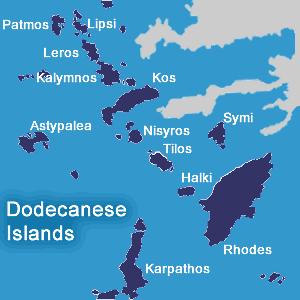
greek Kos sits bang in the middle of the Dodecanese chain of Greek islands that hug the Turkish coast. Kos island is about 45km long while its width varies from 2km to 11km. This is a hugely popular resort with the British and it is one of the Greek islands that has gone for mass-market tourism is a very big way.

greek A long, thin island Kos is also mostly flat and low-lying. In general the scenery is not outstanding by Greek standards. It is more mountainous in the south while the north has a flat, featureless and rather monotonous plain. The lack of hills however has helped to make cycling a uniquely popular holiday activity on Kos.

greek The coast of Kos is swept by magnificent sandy beaches and the island has some of the most interesting archaeological sites in the whole Mediterranean. But avoiding the tat can be demanding. It's large part ruin and a large part ruination, thanks to the growth of cheap package tourism, most notably on the east coast.

greek But the island still has much to offer the more discerning visitor, particularly away from the east and north coasts. Excursions to neighbouring islands such as Pserimos are popular and plentiful and there are any number of daily sea crossings to nearby Turkey.

greek Kos been one of the most popular package holiday destinations for many years. The combination of sand and sightseeing give Kos a uniquely broad appeal and for an all-in beach holiday Kos must be considered one of the best of the Greek islands. Those looking for more peaceful resorts should head to the west coast.

Kos map

Xscape With Us are hotel reservation specialists with more than 40 holiday properties on offer all over the island of Kos.
Xscape With Us

Kos east coast resorts

The east coast of Kos is package tour heaven. To see just how packaged it can get you have only to follow the road that runs from Lambi in the north to Agios Fokas in the south. Back-to-back hotels are strung along the entire coast, hemmed in by a service road and cycle track. Sandy beaches are common too - if you can find an unoccupied spot. What picturesque possibilities there once were have long gone, stamped out by the luridly multiplying hotel chains and the sun beds packed like cereal packets on supermarket shelves. But, if it's an all-inclusive hotel deal you want with sun, sand and a swimming pool then east coast Kos is hard to beat.

VISITORS RECOMMEND
Best eating:
Antoni, Anatolia Hammam, Ellinikhon, Hellas, Kouras, Miramares
Best drinking:
Blues Brothers, Camel, Fifth Avenue

kos bus The main bus station is in Kleopatras St. There are 10 buses daily to Tingaki, six to Kefalos, five to Mastichari, five to Pili and three to Zia.
Other buses serve Asklepion, Lampi and Agios Fokas.
kos train There's a mini train to Asklepion seven times daily but you only get an hour there before the return trip
kos car There are a great many taxis in the town of Kos. The taxi rank numbers: 22420, 23333, 23344, 22777. Bikes are widely available for hire.
kos boat Excursion boats leave the harbour daily with trips to Pserimos and Nisyros very popular. Visit Bodrum, Turkey, on a hydrofoil (20mins) or ferry (50mins) - you may have to pay a €10 port tax.
kos cash There were five ATMS in the town at the last count.
kos festival Festivals: March 7- 17 Winter Festival - theatre, dancing, exhibitions
July - Aug is the festival of Hippocrateia with many cultural events, mostly in the castle, the Orpheus Theatre or the Primary School

Blue Flag beaches icon

Kos satellite Satellite map Kos Town

Kos castle
Knight's Castle

Hippocrates tree
Hippocrates' tree

Kos Agora
Agora

Kos marina
Marina

Kos beach
Kos Town beach

Kos Town

KOS TOWN is a lunatic mix of beach resort, open air nightclub and ancient ruins that spreads in all directions inland from the enclosed port. Greek and Roman remains, including elegant columns and beautiful street mosaics, are incongruously pitted against music-thumping street bars that are a nightmare of neon at night.
It was an earthquake in 1933 that unearthed most of the ancient ruins which were subsequently excavated and restored by the Italians. It was the Italians too that laid out the town's 'garden suburb' grid of streets that are liberally punctuated with splendid Ottoman and Italianate buildings. But it was the concrete mixer that poured out the town's predominant architectural style of army pillbox bunker.
The winner in the battle between ancient and modern has never been in doubt. Recent efforts have been made to right the biggest wrongs — a one- way traffic system, a sewage treatment plant, protection for more notable monuments, a traffic-free main square and a smart new marina.
But the town is at core vulgar fleshpot bedlam with a noisy, Neanderthal nightclub scene that attracts thousands of young drunks from all over Europe. The Eksaria area in particular is stuffed with bars and packed with several thousand revellers nightly.
If you do need to escape the crowds (and most here prefer to do the opposite) you must rise early and explore while the clubbers sleep. It is worth the effort. This is still a picturesque town, despite the drab functionality of most of the modern buildings. Neatly arrayed streets, wide and tree-lined, converge on small squares, profuse with flowers, vines and palm trees.
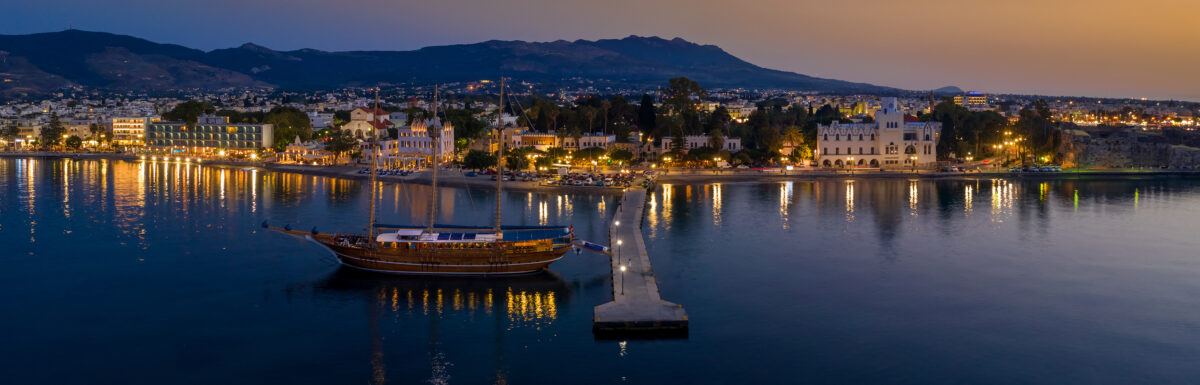
The newly built marina is worth a stroll and there is a wide and inviting promenade behind the beach, though you may have to dodge a silly green tourist train. The town's main Eleftherias Square, now mercifully traffic free, has the neatly restored Defterdar Mosque and some imposing, if pompous, Italianate buildings one of which houses the Archaeological Museum with its small but excellent collection of 3rd century Roman sculptures and mosaics. The square has a less than excellent collection of market stalls that peddle little other than tacky souvenirs.
Nearby is the less interesting of Kos' two main archaeological sites- the Agora. A sunken bowl filled with a confusing jumble of ruins of what used to be the town market. Just across a square is what purports to be the oldest tree in Europe. More than 50ft in diameter, it is said that Hippocrates himself was taught in its shade - a somewhat shady claim that would date the tree at 2,500 years. It was once supported by elegant marble pillars but nowadays must make do with ugly modern scaffolding.
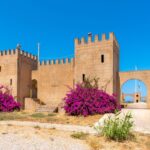
Behind the tree is the Venetian Castle of the Knights, built in the 14th century. The castle is approached over a bridge that spans a splendid avenue of palm trees marching along what used to be the moat. Through an impressive 16th century gateway is an inner set of walls and a large compound liberally littered with crumbled statues and pillars. The castle walls are a patchwork quilt of stone, much of it plundered from the Agora and while, not particularly high, they are worth a walk to take in the views across the town and harbour.
The other excavated archaeological area is to the south, though it is called the Western excavation. It is by far the most interesting. Ruins include a Roman nymphaeum, with mosaic floors, and the remains of some fine houses. The best of these is the House of Europa where a floor mosaic depicts a well endowed Europa being carried off by a bull. There are a couple of paved marble streets and restored colonnades. A low and ugly block of buildings turns out to be the Casa Romana - a 3rd century Roman villa completely rebuilt and restored. It has three courtyards, some swimming pools, and even more mosaics. Nearby too is the Roman Odeon, a splendid theatre now beautifully restored.
Kos town beach marks the start of a long trail of sand leading all the way south to the cape at Agios Fokas. Nearer town the beach is narrow and noisy with edge-to-edge sun beds as far as the eye can see.

Kos review Kos Town visitor reviews
VISITORS RECOMMEND
Best eating:
Syntrivani

Platani

Inland from Kos town is the village of PLATANI, the last refuge for the island's dwindling Turkish community. In the 1960s there were around 3,000 Turks here but as the enmity between the two countries has grown so the population has declined to a few hundreds. This is still the place for a Turkish night out at one of the many restaurants, all of which are superior to any in Kos town. Nearby is a Jewish cemetery surrounded by pines. Dates on the headstones end abruptly in the 1940s when the occupying Germans shipped out all the Jews to die in concentration camps in 1944.

VISITORS RECOMMEND
Best eating:
Zia: Alvi, Oromedon

Asfendiou
Asfendou

Zia taverna
Zia taverna

Asfendiou

West beyond Asklepion is a group of hamlets clustered on the green slopes of Mount Dikeos, or Dikaion, known collectively as the ASFENDIOU district. Lost in the greenery of the island's thickest forests this, sadly, is just about the only part of Kos that can genuinely be called traditional Greek nowadays. Here you can get a brief glimpse of what life must have been like before the package tour firms moved in - but not for much longer. The more accessible are beginning to succumb to the cash-rich tourists - and who can blame them?
At PILAIOPILI there is an amazing ruined castle perched proudly on a pinnacle of rock and giving wonderful views over hills and sea. ASOMATI has the most picturesque whitewashed houses on the island while EVANGELISTRA has some of the best tavernas.
At west facing ZIA the rot is already setting in as tour buses unload scores of visitors every evening to enjoy dramatic sunsets. That said, many enjoy the visit in an area known for the friendly locals who never seem to tire of the hordes. Tavernas are noted for good food and the village boasts the oldest windmill on the island. Many shops sell locally made thyme honey and olive oil.

asklepion trainA mini train runs daily from Kos Town to the Asklepion except Monday when the ruins are closed. It runs 15mins past each hour from 8.15 to 14.15 and the journey takes around 15 mins. You get an hour at the ruins before the return journey. Return tickets are €3.50 and €1.80 for children.

Asklepion

Asklepion

Asklepion

Asklepion

Beyond Platani and 4km to the southeast of Kos Town stands the island's most famous and interesting ancient site, the ASKLEPION or AESKULAPIUM. Kos' native son Hippocrates is rightly remembered with street names, statues, a medical centre and even a tree but he is most completely celebrated at this ancient sanatorium, founded in 444BC not long after his death and now a major tourist attraction.
It was both a temple to the Asklepios, the god of healing, and a renowned Hellenic medical centre that functioned for about 1,000 years before falling into disrepair. The setting is magnificent, elevated on hillside terraces that are connected by a monumental marble staircase.
It sits above the village of ANATOLIA on four terraces linked by a marble staircase, with views across the sea to Turkey. Little of the original centre remains, thanks in a large part to repeated earthquakes and to the use of the site as a quarry by the Crusaders. It was extensively excavated by Germans in 1902 and the Italians re-erected some Corinthian columns dating from the 2nd century. A Doric temple, built some 400 years earlier sits on the highest terrace.
Local guides love to elaborate on the Hippocratic connection but the famous healer's life story is elusive and his links to Kos are very tenuous. He was certainly born here in 460 BC and he also died here in 357 BC. But he spent most of his life away from Kos, traveling throughout the Aegean and advocating his 'scientific' approach to medicine, gaining fame by halting plagues through the then novel practice of boiling drinking water and isolating the sick.

Kos satellite Satellite map Psaldi

Psalidi
Psaldi icon

Psaldi

Around 3km to the south of Kos town - and really just an extension of it - is the tourist resort of PSALIDI. This is very much a holiday beach resort and doesn't consist of much other than a sprinkling of tavernas, a couple of supermarkets and lots and lots of large hotels.
Psaldi beach is not the best, consisting of scruffy pebbles and harsh shingle with a little sand here and there. Access is mainly down some very steep pathways. Beach facilities are what you would expect from hotel resorts - plenty of sunbeds and brollies, showers and toilets, beach bars and watersports.
The best area is known as Blue Beach, where there is a pleasant grassy area on which to sunbathe. What recommends Psaldi to holidaymakers is the proximity to Kos Town and its nightlife, along with all the trimmings that come with the luxury holiday hotel lifestyle. For those looking for beach holidays with plenty of nightlife in neaby Kos Town it's an attractive option. Buses to Kos town are frequent and cheap and there is a good cycle lane. You can also walk, though you take your chances with the mopeds and quad bikes that career along the road, day and night, in both directions.

Psaldi review Psaldi visitor reviews

embros bus Buses run every 15 mins from Kos Town to Agios Fokas No 1) with the hourly bus (No 5) going on to Thermi. Services run from 6.45 to 14.30 with the first Thermi bus at 9.15.

Embros Thermi satellite Satellite map Embros Thermi

Thermi
Embros Thermi

Embros Thermi

It's popular with windsurfers but AGIOS FOKAS has little else to offer the visitor. The resort backs onto a scruffy beach of grey sand and grit and, to add to the delights, there's a thumping huge Club Med type complex to keep those noise levels high.
Beyond the headland on the southern coast are the hot thermal springs of EMBROS THERMI. The crowds thin out a little here and it is not too hard to appreciate why. Backed by brooding rocks, the black volcanic sands are unattractive and narrow.
The proximity of Kos town, a regular bus service, and the novelty of hot natural springs makes the place a popular target for day trippers, though many express disappointment at their visit. The hot springs flow straight into the sea over a gravel beach so it's ideal for swimming and snorkelling but its a long, hard trek back up the steep hill.

Kos north coast resorts

The north of the island is flat and featureless, making access to resorts easy but providing little in the way of scenic interest except out to sea where Pserimos, Kalymnos and Turkey are all visible. Waters in the north are warmer but there is almost always a breeze especially in August when the meltemi blows. Cycling and horse riding are popular there thanks to the flat landscape. Beaches tend to be quieter than in the east and south.

Lambi Kos map satellite Satellite map Lampi

Lambi beach
Lambi icon

Lampi

LAMPI or LAMBI beach lies across the headland to the west of Kos town within bus, cycling or even walking distance, though dodging the traffic - mostly bikes - can be a headache. The sands have become more and more popular as people try to escape the crowded beaches of the island capital and it can now be said to be almost a busy.
The beach is a fine, long, straight and sandy stretch of white sand that goes on for anout 1km. It's considered my many to be the best family beach on the island with sand that shelves gently into the sea, making it safe for children.
The beach tends to attract daily visits from those staying in Kos Town as it is on a regular and frequent bus route. The traffic is usually in the opposite direction after 8pm when visitors head to town for the nightlife.
Like all northern beaches it can get windy at times and the waves can come crashing in. There are plenty of sun beds and umbrellas as well as lots of of watersports, including parasailing.
The resort used to be occupied by the military but the Greek army has long lost the battle with the tour operators who are now packaging up the place with an almost military precision.

VISITORS RECOMMEND
Best eating:
Ampela, Esperos, Grand Salle, Fassils, Flash, Margarita, Mediterrane, Meni Beach, Nisiotiko, Oramas, Rodini, Sagitarius, Syrtaki, Tingaki Grill, Unique
Best drinking:
Cosy, Kivotos, Jungle, Mascot, Memories, Rendezvous, Seven Day

embros bus Daily buses to Kos Town : 9am - 11.30pm

Tingaki Kos satellite map Satellite map Tingaki

Tigaki beach
Tigaki

Tingaki

Further west along the coast and separated from nearby Marmari by a vast salt marsh is TINGAKI or TIGAKI, a busy and often crowded beach resort that has become increasingly popular with British and German tour companies. The resort is a one-street affair packed with the usual bars, cafes and tourist shops. The landscape is flat and featureless except for the many hotels and apartments that are scattered across the rather unappealing plain.
Facing north, the long, deep and sandy beach gets its fair share of windy weather, so windsurfing is popular. In the most popular part of the beach there are plenty of sun beds for visitors. The beach is narrow in places but made up of good white sand backed by low dunes and you can wade out a good way offshore, making it good for children and families. The beach is fringed with a few cafes and bars, with more to be found in the main street and there are the usual watersports.
The sand improves the further west you go until you reach the salt pans where there are flat sands and shallow seas. There is a nude beach here, if you wade past the outfall from the salt lake.
Further west, the land turns to a marsh that can stay wet well into June, making this an ideal stopping off point for migratory birds, tame terrapins and zillions of mosquitoes. Beware pitching too near the shore - passing cruise liners can send waves crashing in and only those lying near the dunes will survive the wash.

Tingaki review Tingaki visitor reviews

embros bus Daily buses to Kos Town : 9am - 11.30pm

Marmaris Kos satellite map Satellite map Marmari

 Marmari
Mamari

Kos holidays in MAMARI
holiday YouTravel

Mamari

A few miles along the coast east of the salt pans is the beach resort of MARMARI or MARMARIS where the sands broaden and bank up into low-lying dunes. Slightly more sheltered from strong winds, Mamari enjoys quieter seas than Tingaki with the sand sloping more gently into the sea, though it can still get pretty rough in windy weather.
There is a local horse riding centre that takes full advantage of the flat sands but some local dispute over the legality of riding along the shoreline. The main resort is very popular with Germans while the UK hotels stand rather isolated along the shoreline.

embros bus Daily buses to Kos Town : 7am - 5.30pm

Pili
Pyli

Pyli

The inland road south from Mamari bring you to PILI, or PYLI, the joint name for three neighbouring hamlets of ARMANIOU, AGIOS GEORGIO and AGIOS NIKALO. The hamlets are set within verdant countryside and villagers here are mostly cattle farmers. The villages themselves are nothing special, but there is not much else to choose from in this neck of the woods if you want to take a break from beach resorts. You can visit the tomb of Harmylos, an ancient Kos hero.
From Pili the road leads to PALIO PILI where there is the well preserved remains of a Byzantine fortress that shelters a church dedicated to the Virgin Mary within its walls.

VISITORS RECOMMEND
Best eating:
Borsalino, Tasty Palace

embros bus Daily buses to Kos Town : 9am - 9pm
mastichari boat Ferries leave daily for the island of Kalymnos (see island report) and the nearby islet of Pserimos - only one beach but one to die for.

Kos satellite Satellite view: Mastichari

Mastichari
Mastichari

Mastichari

Mastichari

The fast developing beach resort of MASTICHARI or MASTIHARI has an attractive beach of flat white sand and has attracted package tour companies in some numbers. A forest of sun beds now adorns the shore, itself backed by a line of tavernas. Behind the tavernas lies a small warren of purpose-built shopping streets, neatly laid out and lined with tourist shops, cafes and small bars.
The beach itself is sharpish white sand - seen right devoid of the sun beds, a rare sight these days. At the western end of the beach is the remains of a 5th century basilica. Those seeking more privacy can take one of the many tracks that appear beyond the power station and tumble down to several sandy coves, backed by low cliffs. Underwater rocks can make the sea less than inviting for swimmers.
The resort has plenty of seashore restaurants and bars, half a dozen mini markets and a handful of gift shops selling the usual tourist trinkets. It is a quiet, relaxed and low key resort and this area of Kos is a big favourite with German tourists. The long harbour wall stretches out to sea for 200m or so if you want to catch one of the frequent ferries that leave for the nearby islands of Pserimos and Kalymnos.

Mastihari review Mastichari visitor reviews

embros bus Daily buses to Kos Town : 9am - 9pm

Andimakia
Andimakia

Andimakia

Around 5km inland from Mastichari is one of the most photographed windmills on the islands at ANDIMAKIA or ANDAHAHIA. Pretty impressive it is too standing on the main street with sails unfurled and preserved as a working museum. This is a popular picnic spot for coach tours.
Just to the east along a well signposted road is a crusader castle overlooking the straits. It has an imposing gateway and you can walk along the west parapet for great views. There are a couple of interesting chapels nearby well worth a visit. Andimakia itself is a picturesque hamlet of whitewashed houses and flowers Nearby the large Venetian fortress dominates the central plain.

Kos south coast resorts

The south coast is more popular than the north or east, with endless stretches of sandy beach. The seas in the south are usually much calmer than the north but much colder too. Mountains provide more scenic interest than can be found in the flat north and in the far west the landscape can get very wild indeed.

VISITORS RECOMMEND
Best eating:
Theologos

embros bus Daily buses to Kos Town : 9am - 11pm
kefalos festival Festivals: March 21 - Presentation of the Virgin
Sep 27 - International day of Tourism with music.

Kefalos Kos satellite map Satellite map Kefalos

Kefalos
Kefalos

Kefalos

Kefalos

The island narrows to about 2km before expanding into the rugged volcanic area of KEFALOS. The village sits high on a headland with views along the whole south coast with the old town above and the sprawling bay and long beach resort of KAMARI below. The old town is an attractive mix of whitewashed houses with colourful doors and windows.
Views from the hill fort are impressive but the going is steep on foot. Even higher, and forming an impressive backdrop are the twin peaks of Mt Zini and Mt Latia, both spoiled by radio masts and Zini by extensive quarrying. This is is also the end of the line for island buses and an outpost for more adventurous hikes into the western wilderness that ends on the rugged peninsula at CAPE KIKELLO. Regular tours are offered to a nearby Byzantine church, to the ruins of the ancient Astypalia amphitheatre (once thought to be island capital) and to a cave at ASPI PETRA said to be inhabited in Neolithic times.
There are series of tiny beaches and coves on the west coast. Though the area is wild there is a cantina on top of the cliffs behind the main beach which is known as either WAVE BEACH or SUNSET BEACH. It can be reached by taking the west road out of Kefalos past the cemetery.
North of Kefalos is LIMNIONAS which has twin beaches each side of the peninsula and a small fishing harbour.

Kefalos review Kefalos visitor reviews
VISITORS RECOMMEND
Best eating:
Annabels, Argo, Captain Johns, Faro, Four Seasons, Gallini, Golden Fleece, Hippocrates, Hub, Kastri, Kampos, Maria, Politis, Rainbow, Santa Barbara, Scorpios, Sebastian, Stamatia, Stop In, Syrtaki, Waves
Best drinking:
Acropol, B52, Bravo, Flamingo, Grand Cafe, Marias, Melody, Memory, Mundial

kamari cashOnly 2 ATMS and they can run out of cash

Kamari Kos satellite map Satellite map Kamari

Kamari
Kamari

Kastri

Kamari

The KAMARI bay area is the resort area of Kefalos with a 5km stretch of shingle and sand (mostly shingle) stretching almost to AGIOS STEFANOS. The beach is packed with restaurants and bars squarely aimed at the British tourist and it's chips with everything, large TV screens and expensive drinks.
It's hard to see how they all make a living as the resort is relatively quiet even in high summer and the cash spending youngsters are all living it up in Kardamena. This is very much a sedate resort for the middle-aged, and nothing wrong with that if you like a quiet holiday.
The shingle shoreline turns to large stones under the sea and dips sharply so the beach is not much good for children. The best sand is found near the Club Med complex and there is good swimming and snorkeling to be had.
The offshore islet of KASTRI is said to be within wading distance but swimmers take their lives in their hands given the volume of passing ski boats, surfboards and other water traffic. The water is crystal clear but known to be the coldest on Kos. Many visitors prefer to be based here at night and spend the days on Bubble Beach across the bay.

Agios Stefanos

The beach from Kamari stretches to AGIOS STEPHANOS, a once pretty village now overtaken, overshadowed and spoiled by a huge Club Med complex which has enveloped all the best sand. At this point the island is only 1km or so wide and even south facing beaches like this one have little protection from the howling meltemi winds. On the nearby headland are the remains of a couple of well preserved triple-aisled 6th century basilicas. There are some excellent bird mosaics here but they are usually covered in gravel and dust.

Kos beaches satellite map Satellite map beaches

Camel beach
Camel beach

Bubble beach
Paradise (Bubble) beach

Sunny beach
Sunny beach

Magic beach
Magic beach

Paradise (Bubble), Camel, Banana, Sunny, Magic

Along a major stretch of the southern coast are a succession of sandy beaches, once scenic and secluded but now packed with holidaymakers. In reality a single stretch of sand for several kilometres sheltered by a cliff backdrop they have inherited rather silly Anglicised names. There is no resort here as such and holidaymakers flock in for the day from other island resorts, especially Kefalos and Kamari.

CAMEL beach is in a small pretty bay and has fine golden sand and some interesting and dramatic wind sculpted cliffs behind. There are also rock formations in the clear water to add interest but a less interesting, if not downright ugly, cement block behind that houses the beach cantina. It is less popular than some others, probably because the access from the large car park behind is very steep. It is also a favourite with nudists, mostly Swedish and Dutch.

PARADISE beach is also known as BUBBLE beach on account of underwater volcanic vents which warm the water a degree or two. It is immensely popular, gets very crowded despite its considerable length and is fully commercialised. Sheltering cliffs, good clean sand and shallow water make it ideal for families with children, provided the youngsters don't get lost among the hundreds of sun beds. There are several cantinas to feed the hungry crowds and this is a popular day out for those staying in Kefalos and Kamari across the bay. To see the bubbles you need to snorkel out to sea a bit; you won't see anything along the shoreline.

BANANA beach is probably the cleanest beach of the lot and the most picturesque, with junipers straddling the low sand dunes behind. But it is rahter small and less popular than its neighbour Paradise beach. This beach is also called LAGANDA.

More than 2km of sand is found at the much wilder SUNNY beach. The beach is long and narrow and backed by low scrub carpeted rocks. There are sun beds and cantinas but far fewer hotels around so it is tends to be much less crowded than the others.

At 3 km MAGIC, also called POLENI, is the longest, broadest and least tamed of them all. It is also the least populated, though there is still no shortage of sun beds and there are a few beach cantinas to provide the basics.

The far western end of this strip is the beach called either XEROKAMBOS beach or EXOTIC beach depending on whether you can pronounce Greek or not and is backed by an army tank and artillery range, so keep your head well down.

VISITORS RECOMMEND
Best eating:
Ariadni
Best clubbing:
Buddies, Crackers, Crossroads, Downtown, Metro, Starlight, Status

embros bus Daily buses to Kos Town : 9am - 9pm
kardamena festival Festivals: Aug 7 - Birth of Virgin Mary

Kos satellite Satellite view: Kardamena

Kardamena
Kardamena

Kardamena

Kardamena

A generation ago, KARDAMENA was everything a picturesque Greek fishing village should be. Charming, friendly and famous for its particularly fine ceramics. It is now a monumental mess, a heaving tourist resort of down market discos and ugly burger bars that wouldn't look out of place on the Costa Brava. Menus of moussaka and red wine have been replaced by mountains of chips, baked beans and lager, predictably as low in quality as it is high in price.
Arm in arm with the transformation has come grim-faced exploitation at every corner. Sunburned visitors are here to be flayed by the sun and puddled with alcohol. Bars must turn off the ear howling music at midnight but clubs stay open to 3.30am in the week and 6am at the weekend. Names like Slammers, Bonkers and Crackers give a good idea of the standard. Street touts pester you to join foam parties and karaoke nights. Youngsters will love it to bits and, if you are in the market for a bout of singalong holiday fun this could be just the place.
A uniform grid of concrete closely follows the coastline and rows of bars and cafes open out onto wide sandy beaches that sweep out for around 5km either side of the resort. The usual beach entertainment and water sports abound.
You can catch a boat from here to the volcanic islet of Nisyros. At the end of the beach to the east is the self contained package resort of TOLARI, basically a 1,000-bed hotel complex where a village used to stand.

Kardamena review Kardamena visitor reviews

Kos highlights

Pserimos satellite map Satellite map Pserimos

Pserimos
Pserimos

Pserimos

PSERIMOS is a small island about half way between Kos and Kalymnos. It would be an idyllic place but for the day trippers that descend in droves throughout the season. A few lucky visitors can find rooms to stay but not many as there are a mere 30 or so houses.
The main beach on the island is at Avlakia, a lovely stretch of golden sand, quickly covered in sunbedded bodies. Day trippers arrive like locusts and snap up all available sun beds, pack the tavernas and generally make a noisy addition to what would otherwise be a peaceful islet. Even the ferries have been known to queue to tie up to the small quay. Those boats that can't find a berth head off to neighbouring PLATYS which has a similar, but smaller, sandy beach and far fewer trippers.
There are a couple of other beaches, not as attractive but much quieter. One is at Vathy in the north, reached with a 30min walk along a well marked path to a cove of sand and pebbles. Another is at Marathounda to the west, a 45min walk to a pebble cove. The island is so smal that nowhere is more than an hour's walk in any direction
Day trippers make up almost all the visitors as there is so little accomodation on the islet. There are rooms to be had above the tavernas and one small store which gets stocked up by the daily boat that leaves Pothia on Kalymnos around 9am each day. Nearly all the other boats that pull in are on daily cruises between Kos and Kalymnos with a stop here and at Platys.

Photos Pserimos photo gallery by DABS BANNER

Nisysros satellite map Satellite map Nisyros

Nisyros
Nisyros

Nisyros

A boat trip to the island of NISYROS, NISSYROS or NISSIROS is very enjoyable. It has active volcanic fumeroles, steam vents, boiling mud and sulphur. The island also has a very pretty village with very narrow streets, bougainvillea and many other beautiful flowers.
Local travel agents charge much less than the big tour operators for trips to the island and smaller boats and tour parties can make for a more enjoyable trip. The walk up the crater is a bit scary with very steep and unfenced drops and don't go in plastic flip-flops - they could melt off your feet.

Photos Nisyros photo gallery by CHRIS OAKLEY

Kos lowlights

Kos airport

Dominating the plain is Kos airport which has as much architectural interest as my rabbit hutch. More than 1.5m passengers pass through it each season and it seems like they all leave at the same time. The staff must run competitions on who can get the longest queue waiting for the longest possible time. The new departure terminal helps in that you no longer have to queue in the blazing sun but queues are virtually guaranteed and passengers regularly report of three-hour waits on the hot tarmac. On leaving Kos you are advised to check in your baggage then retire to the bar across the road. It can be a one hour wait or more for your suitcases to turn up on one of only two carousels when you arrive. Saturday is the day to avoid when arriving or leaving.

Kos map

Kos map

Kos is the third largest island in the Dodecanese after Rhodes and Karpathos. It is 64km long and 2km at it narrowest point. It is mostly a low-lying island, with two low mountains, Dikaio and Simpatro, that run along its southern coast.
A regular, if crowded, bus runs along the spine of the island from Kos town to Kefalos. Other buses serve the east coast resorts. Cycling is very popular on the flat plains of the north and east.

Kos weather
Kos weather
Five day forecast

Kos weather

JAN FEB MAR APR MAY JUN JUL AUG SEP OCT NOV DEC  
52 53 55 61 67 74 79 79 74 68 60 54 Avg °F
0 0 0 8 24 30 31 31 30 23 4 0 70°+ days
5.9 4.1 3.4 1.3 0.6 0.1 0 0 0.9 1.1 4.4 6.4 Avg rain (cm)
30 26 21 13 9 3 0 0 4 16 27 29 Rainy days

Northern beaches can be windy and southern resorts very hot from June to September.

Kos facts

Greek jetty

Situated just off the Turkish coast, the island of Kos is one of the best Greek Islands for a typical beach holiday. However, while the island may have adopted the package holiday in all it's glory, Kos still offers the more discerning tourist some of the best archaeological sites in the entire Mediterranean Sea. For many though, it is the long sandy beaches that stretch around the island that make a HOLIDAY TO KOS seem so appealing. If it is beach and book that you are after for a couple of weeks, give Kos a try!

Kos flights

Kos island airport is in the centre of the island just south of Mastichari and 26km west of Kos Town. It is known as Hippocrates Airport or Kos Ippokratis. Olympic Airways operate the only scheduled flights out of Kos, these to Athens (three daily flights) and Rhodes (about three a week). International charters push up passenger numbers to more than 2m annually and the airport open 24 hours a day over the summer months to cope with the traffic. The 12 check-in desks and three baggage belts aren't enough prevent queues at peak times. Despite the high traffic the airport is not particularly well equipped. There is a restaurant, a health centre, some shops and a cafe/bar but not much else. There is no public transport direct from the airport and most passengers take package tour shuttle buses, hotel minibuses or taxis. Public transport is available on the large roundabout outside the airport gates with a KTEL service to Kos Town and services to the ferry port at Mastichari. There is parking for about 200 cars.

Kos ferries

Kos lies on main ferry routes both from mainland Greece and the north Aegean so there are many connections both through Kos Town or the northern port resort at Mastichari. There are daily ferries to Piraeus (5-6hrs) that usually leave in the afternoon. The main Aegean route runs from Rhodes - Kos - Kalymnos - Leros - Lipsi - Patmos with several ferries each day. There are also less frequent boats to Syros, Samos, Thessaloniki, Ikaria, Fourni, Amorgos, Kastellorizo, Astypalea, Nisyros, Telos, Leros, Mykonos, Paros, Agathonisi and Symi throughout the summer.
The harbour area at Kos Town is packed with ferry agents and travel offices with offers of scheduled services, boat trips and excursions. There are daily boats to Bodrum (45mins) in Turkey leaving around 0830 and returning 1600. Check the offers in the local port. Excursion boats go to many island beaches as well as outlying islets such as Pserimos, Plati, Nisyros and Giali.

Kos roads

Roads are reasonably good between the resorts with the main road from Kos Town to the airport and Kefalos being the only one you could reasonably call busy. Taxis are plentiful and found mostly around the harbour area beneath the minaret or across from the castle. All Kos drivers are expected to speak English but some don't. Taxis fares are fixed (see Greek info pages) but is often a good idea to negotiate a price before getting in.
There are a couple of tourist trains operated by KTEL. A green one does a round trip of Kos Town and the blue one ferries people to the Asklepieion. They are pricey and slow but it is the only public transport to the Asklepieion from Kos Town.
The Kos Town buses (DEAS) run routes around the town while KTEL buses take you everywhere else. Buses are frequent to the main resorts. Most DEAS town buses operate from the bus stop on the south side of the harbour. The main bus station is in Kos Town, on Kleopatras Street. Tickets are bought on the bus but you get up to 30% off at the bus station. There are 10 buses daily to Tigaki, six to Kefalos via Paradise beaches, five to Mastichari and Pyli, three daily to Zia. Buses go from Kos Town every 30mins to Psaldi and Agios Fokas, Mesaria and Platani. Latest schedules are posted at Kos Town harbour and the bus station. Timetables are available free of charge, both in Greek and in English. Kos island buses get very overcrowded at peak times.

Kos cycling and walking

Kos is mostly flat and ideal for cycles. It is also one of the few, if not the only island to have dedicated cycle lanes over much of the island. The only road that is busy is the one from Kos Town to Kefalos, all the others have little traffic and are safe for cycling. Don't try to heave your bike onto a bus, they won't let you. There are about 4,000 cycles for hire on Kos and bike hire is available in many places, with prices from €4 to €12 a day, cheaper if you hire for several days. Cycles come with locks so you needn't worry about security but beware — they all look the same. It's a good idea to tie a coloured ribbon on it so you can spot which one is yours.

walking guide Marengo Books has several excellent walking guides and walking maps of Kos and other islands

Kos photo galleries

Photos Nisyros photo gallery by CHRIS OAKLEY
Photos Pserimos photo gallery by DABS BANNER

If you would like your photo gallery here then email details. It takes 10 photos to make a gallery and they can be of the whole island or of a particular resort.

Kos websites

A personal pick of websites on Kos

Kos Hotel Reviews : Select resorts in Kos to see a list of hotels and apartments with reviews and reports.
Golden Star Kos Hotel Apartments : Accommodation in Tigaki on Kos island.
Inside Kardamena : Complete and comprehensive guide to one of Kos' favourite resorts.
Tony Ainsworth's Kos : Tony has jotted down his favourite things about Kos.
Sunny Day's Hotel Apatments : Accommodation in Tigaki on Kos island.
Gaia Hotels : Your home in Kos and Crete island.
Kos Apartments : Katras Apartments in Tigaki, Kos Island Greece.

If you want your site considered please email me

Home | Reviews | Contact
© Copyright 2001 - 2008 Greek Island Postcards  Greek island  www.greekisland.co.uk - All rights reserved.

Tourist holiday travel guide to the Greek island of Kos

greek island greek island