
Wasp-waisted SKYROS island is the odd one out in the Sporades islands off the east coast of Greece. One of the largest of the Sporades it is also the most remote and the least visited of this island group.
Skyros' isolation has helped preserve its distinctive character and customs - foreigners, for example, are banned from owning houses here. Tourist beds number only around 1,000 and the resolutely traditional Skyros islanders seem intent on having no more, although visitors who do make the effort are warmly welcomed.
Skyros stands well apart from the rest of the tourist-hungry Sporades group. The landscape is half green and densely wooded, half dry, rocky and barren. The island has long been noted for its arts and crafts, beautiful pottery and hand-carved furniture.
A tomb in the southern half of Skyros island is renowned as that 'corner of a foreign field that is forever England'. It is where the verse's author, the poet Rupert Brooke, was buried in 1915.
The heavily indented coastline of Skyros is peppered with sand and pebble beaches, remote secluded coves, rocky inlets and even sea caves. Most summer visitors are found in the main beach resorts that line the shore below Chora. The 800m stretch of sandy that links the twin resorts of Magazia and Molos, are a favourite with holidaymaking families and watersports enthusiasts. Those looking to escape the crowds have a number of splendid coves to choose from but access can be difficult along rough tracks and several can be reached only on foot or by boat, especially in the south.


Prepare to be disappointed at your first sight of the island capital CHORA. It lies on the east side of the narrow waist of Skyros that divides the island north and south.
Sometimes touted as one of the prettiest places in the Aegean, the bus from Linaria will drive through a rash of charmless mini-markets and other utilitarian buildings built to be as ugly as only the Greeks know how.
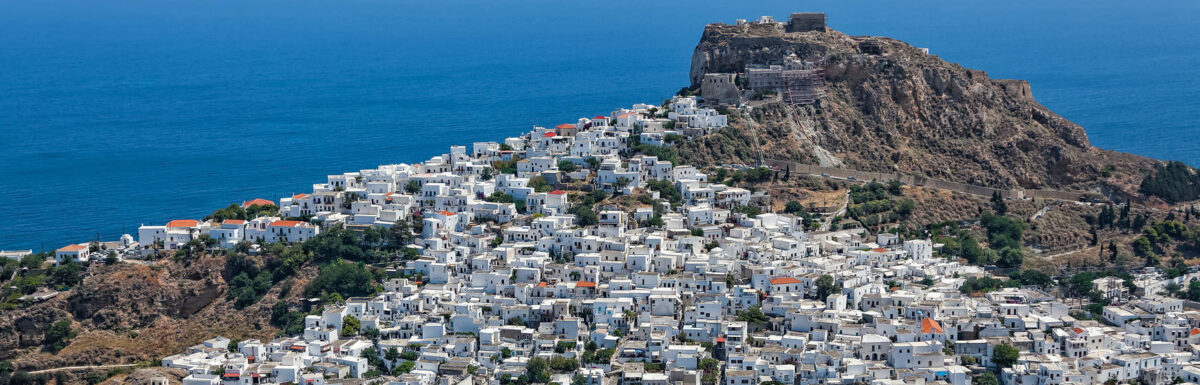
In the centre of Chora though, things change for the better, with white Cycladic-style cube houses stacked on top of each other to the summit of the hill. The subsequent fiendish maze of steep and narrow streets are ideal for walking.
The town is crowned by the Kastro‚ a mostly a Byzantine fortress with some Venetian trimmings built over an ancient acropolis. On the way up to it is the church of Agia Triada with some fine frescoes and the white monastery of Agios Giorgios founded in 962 which has a painting of St George slaying a dragon.
The main street of Chora is also narrow and little more than a strip of tourist shops, travel agents, cafes and overpriced tavernas that eventually lead to an open square overlooking MOLOS beach and the sea.
Here, perched on a terrace, is the banal bronze 'Statue of Immortal Poetry' erected in 1931 to commemorate the English poet Rupert Brooke, who is buried on the island.
Paid for by a rich Belgian businessman, it was actually intended as an allegorical figure rather than Brooke himself - the original model s thought to have been a male prostitute.
Under Brooke square and along some steps is the small archaeological museum which has exhibits of local copper artefacts‚ and a striking ceramic ring decorated with ducks and snakes from around 900 BC. Even more interesting is the private Faltaits Museum with a terrific collection of domestic items, clothes, embroidery and pottery.

The sprawling tourist development below Chora and behind Magazia beach now blends into neighbouring MOLOS village, about 4km north from the capital.
Typically squat and ugly Greek hotels and apartments now lie behind what is an attractive, long and sandy beach that snakes out to what was once a remote headland.
An old mill, now turned into a taverna, is a reminder of what a beautiful spot Molos must once have been. At least the taverna food is less mediocre here and less pricey than in the town. Lobster is the local specialty of Molos tavernas and worth a try.
There are a good many fish tavernas here as well as bars and cafes, a bakery and a mini-market. Molos is basically the northern end of the more popular Magazia beach.

A ten-minute walk down the hill from Skyros town, and a long stairway, brings you out past the island's official campsite and onto the fine dark sands of MAGAZIA just to the south of Molos.
Magazia is a long, sweeping beach that serves the main town of Chora and is named after the gunpowder magazines that were once stored here in Venetian times.
The Magazia area is fast being developed, but it is still reasonably quiet and relaxed despite the growing number of tourist trappings such as watersports. As Magazia is the main beach of the main town on the island, apart from Linaria, Magazia can get rather crowded in the high summer season.
Magazia beach is long and sandy, if rather narrow, curving out to the headland at Molos to the north. There are sunbeds on the most popular stretches and the water is quite shallow. At the southern end of Magazia a broken concrete breakwater lies offshore.
At the northern end of Magazia the rock has been carved and quarried into bizarre shapes, with a church and cave-like houses hewn from the stone.
The road past Molos bring you to the excellent PAPA TA CHOMATA or PAPATAHOUMA beach. The name translates roughly into 'land of the priest' but you are more likely to find less of the cloth and rather more of the flesh here as this is the island's unofficial nudist beach.
The sands at Papa Ta Chomata are fine and the water is clean, although it can be a difficult descent down a narrow cliff path to the beach. Beaches further south of here are disappointingly drab until you get to ASPOUSS which is a pleasant spot with a couple of nice beach tavernas.
Nearby BASALES offers an even less developed alternative to Papa Ta Chomata but visitors must beware the sewage that can float in on the tide when wind is in the wrong direction (north or north-east). This is not the cleanest beach on the island as sewers from the main town end up near here.
Further south still is the beach at ORMOS ACHILLIS. Set in a deep bay this once boasted one of the best beaches on Skyros and was earmarked by developers for a yacht marina.
The marina project was part of a government drive to attract yachting tourism away from Turkey but, apart from a half-dozen fishing boats, a few anglers and an abandoned tugboat, the place is deserted.
South of the bay at Ormos Achillis the coast becomes very rocky and virtually inaccessible except for the tiny resort of SARAKINIKO which has a cave and sits on almost the most southern point of the island.
This a popular area for boat trips, not only to see the grave of the English poet Rupert Brooke at nearby Tris Boukes, but to explore the spectacular caves and inlets on the southeast coast.

The functional fishing village of LINARIA is also the main port of Skyros and lies on the west coast at the island's narrow waist, tucked into a small bay about 10km from the capital Chora
The only other major settlement on Skyros apart from Chora, Linaria is little more than a cluster of modern concrete buildings packed around a tiny, though picturesque, harbour that brings in most of the tourist traffic by ferry.
Linaria boasts some excellent tavernas and many make the most of the good sunsets to be seen on this side of the island. There is a small beach within walking distance to the north at AHERONNAS.
It's worth a trek to the church of Agios Nikolaos, on a hill above Linaria port where you can enjoy some spectacular views.
Mainly though, Linaria is just a jumping off point for boat trips around the island. A great favourite is the islet of Skyros Goula which has a couple of small beaches and some rather dramatic caves. There are also jaunts to the islet of Saka Grino which has a small beach at Glyfada Bay.

KALAMITSA, just south over the headland from Linaria, is one of the best beaches in the south-west - which is not saying much as it is just about the only one.
Kalamitsa is not much more than a long swathe of shingle, although the sand does peep through the stones at the northern end of a beach which is fronted by tavernas, a few villas and a windsurfing club.
Nearby is a well-preserved stone sarcophagus and an upright Doric column. At the southern end Kalamitsa blends into the long, white, crescent shingle beach of KOLIMBADES which has some good swimming.
There are coves with stone and shingle beaches further south along the coast, though none have any facilities and most can only be reached by boat.

The road north out of Linaria heads up into the hills, barren landscape of low scrub and herds of goats. The road forks right to Chora and left around the bay to AHERNOAS, also called ACHERONAS or ACHEROUNES.
Aheronas has a pleasant long, sandy beach, well protected at the end of a small bay with good shallow water making it a favourite with families.
Two tavernas offer the basics and a café serves ice cream and drinks. As Aheronas beach is only a 10 minute walk from Linaria it is popular with those staying in this part of the island, although the prettier beach of Agios Pefkos is only just over the headland.

This is the beach most visitors head for on the west coast of Skyros. AGIOS PEFKOS lies over the headland from Aheronas at the head of a deep bay.
Once the site of a marble quarry, Agios Pefkos is where Syrian marble was shipped out. Pine trees tumble down to the shoreline at the attractive bay which can reached by car down a dirt track from the main Linaria to Chora road.
Agios Pefkos has a beach of sand and shingle, with rocky outcrops at either end and a small quay. A couple of basic tavernas open in the high summer.

A little further north from Agios Pefkos and down a steep bank is the even more attractive bay at AGIOS FOKAS. Despite being even prettier than its neighbour fewer make it here as it cannot be reached by car. The road deteriorates into a very rough track as you approach Agios Fokas so it can be dangerous except on foot.
Visitors to Agios Fokas must make a long trek along a track up and over the headland and through pine-scented woods and fields to reach it. The rewards for going the extra few miles are well worth it, with a trio of idyllic white pebble beaches.
Agios Fokas has a basic, but excellent, taverna that opens in the high summer. Both Agios Fokas and neighbouring Agios Pefkos have recently been discovered by villa companies and it looks like their days as peaceful havens may well be numbered.
The far north of Skyros has the best of the secluded beaches, although they are not always easy to find and few of them have any facilities.
This coast also takes the brunt of ferocious winds and heavy seas that batter the cliffs over the winter as well as the northern 'meltemi' that blows through July and August

Set in a peaceful wooded bay ATSITSA, on the north-west coast, doesn't have much of a beach. Atsitsa is mostly rocks and stones with a couple of ramshackle wooden quays where boats can tie up.
Atsitsa is home to a British-run holistic health centre which offers meditation, bungalows and PRIVATE KEEP OUT signs in case any non-paying passers-by might stray inside the 'exclusive' complex. The karma here is uncompromisingly up-market'
There are offshore islets, densely wooded coves and some iron mine installations dating from the 19th century. Pine trees plunge down to a shoreline that is rocky enough to make swimming difficult but there is a good fish taverna here.

Just north of Atsitsa are a couple of small and rather nondescript beaches of sharp sand and shingle at KALOGRIAS and at KYRA PANAGIA, the latter of which has a tiny chapel and a summer taverna.
The best of the beaches in this area is AGIOS PETROS, a pale sand beach with a few pebbles and backed by magnificent dunes. Access to Agios Petros is down a track through pine woods that starts near the air base.
Like the others beaches in the area there are few facilities at Agios Petros. A beach cantina sometimes opens in the summer when the beach can get quite busy.

There are several sand and pebble beaches along the stretch of coastline that makes up the northern tip of Skyros. None well known and all are sparsely populated.
Two that are most worth a visit are MARKESI and THEOTOKOS, though you may have to contend with the drone of jet aircraft taking off from the nearby military air base.
Though neither has any facilities both have shallow waters, a little sand and shingle with rocky outcrops on either side.
There are some ancient engraved tombs near Markesi for those interested in archaeology.

PALAMARI is most noted for the rather neglected site of a Bronze Age settlement which still shows the layout and pattern of the original streets and houses.
It was first built around 3,000 BC and flourished for a millennium. The total area covers about five acres, though the eastern part is now under the sea.
The main reason for the ancient city's growth was the metals that were once mined in the Palamari area. Below Palamari is a very pleasant sand beach but care must be taken not to wander too near the military base which is a restricted area.
Skyros is the southernmost island of the Sporades archipelago in the Aegean Sea, off the east coast of mainland Greece. Other islands in the Sporades are Skiathos, Skopelos and Alonissos
At 209 sq km Skyros is the largest island in the Sporades group and has a population of about 3,000, most concentrated in the island's capital town of Chora. There are very few settlements in the south of the island.
The north area of Skyros is lush and covered in forest and it has the island's highest point at Mt Olympus (792m). The roads are relatively poor, especially in the south which is mostly dirt track.
The southern area of Skyros is barren and rocky, very dry in the centre although there are a number of freshwater springs along the coast. In the east the rocks rise sheer from the sea and there are many sea caves, the most noted at Diatrypti, Pentekali, Yerania and Spilia.


Many visitors to Skyros like to make the pilgrimage to Brooke's tomb, set is a small olive grove in an otherwise desolate location near TRES BOUKES bay in the south-west of the island.
The tomb itself, restored by the Royal Navy in 1961, is not the site of the original grave. When Brooke died of blood poisoning on a French hospital ship anchored in the bay, the midnight burial party had no time for an elaborate funeral - they left for Gallipoli the next morning.
The original grave was just a pile of stones with a wooden cross and Brooke's mother commissioned the present white marble monument at Tres Boukes at the end of the First World War. Inscribed on the grave is Brooke's most famous poem, The Soldier.
The easiest way to reach the grave is to take an organised boat to Tres Boukes Bay, and then follow the track up the valley. There are plenty of trips that take in the nearby caves as well. The drawback is to view the site to a backdrop of camera clicking tourists.
There are taxis from Chora to Tres Boukes but they are not cheap. It is not an easy car journey either. South of Kalamitsa village the island is almost entirely uninhabited and the unsignposted road deteriorates as it rises through the mountains.
As you descend towards Tres Boukes you will see the grave tucked away on the left among an orchard of olive trees.

Skyros is renowned for its traditional street festivals and none more so than the slightly scary Apokries or 'Goat Dance' carnival leading up to Easter
Three weird characters dance through the streets in Chora with dozens of other masked revellers. Many of the participants dress in goatskins and masks with large sheep bells hanging from the waist.
The masks are mostly fashioned out of kid skin and the waist bells can weigh up to 50kg. They also wear heavy wooden clogs that make a huge racket. The noisy procession makes its way up to the top of the Chora and back down again.
As they prance through the streets they adopt a swaying lope so that the bells make a heavy clonking sound. Other figures include a humpback dressed in rags and a 'foreigner' or 'Frank' dressed in motley clothes and long trousers and blowing a conch shell.
The carnival procession is believed to be a relic of goat and cattle cults that once held sway on the island and is one of its annual highlights.

Skyros Town has many traditional houses whose interiors are considered living museums as they are adorned with hand beaten copper pots, carved wooden furniture and elaborately decorated ceramic and embroideries. Skyros islanders take much pride in their homes and furnishings and visitors are often invited in to admire them.
The unique style of home decoration originates in the days when islanders traded prized items from marauding pirates in exchange for food. Locals started making copies of ceramics, carvings and fabrics brought to Skyros from across the Mediterranean and the tradition has been handed down over generations.
Skyros has many shops selling pottery, carved furniture and other items made locally by highly skilled craftsworkers.

The south of the island is also home to the wild and tiny Skyrian ponies. They are said to be related to the Shetland pony, though how is not particularly clear. The ponies are tiny, with a shoulder height of only about 1m they are possibly the smallest breed in the world.
They are rare sight these days and you are unlikely to spot a wild one in the barren plains of the south, though there are now belated moves to protect them so hopefully numbers will increase.
You can sometimes find the odd domesticated pony tethered in Skyros town and children have pony races on Magazia beach during the island's the August 15th festival.
Syrian ponies are thought to be the same breed as those sculpted in marble on the famous Parthenon frieze. in Athens
Fly from all major European airports.
Details in most European languages and currencies.
There is an airport on Skyros that is mostly used by the military but it does take charter flights, mostly from Scandinavia and the Netherlands, as well as regular domestic flights from Athens. The airport is about 4km north of Chora.
In summer Olympic Airways has scheduled flights from Athens every Tuesday, Thursday and Saturday with a flight time of about 35 minutes.
You can call the Olympic office in Athens (210966 6666) for reservations or check with Skyros Travel which has details of how to get to Skyros in its 'About Transfers. section.
There are also flights from Thessaloniki on Wednesday, Saturday and Sunday. A bus meets most flights and goes to Chora, Magazia, and sometimes Molos. There are also taxis at the airport.
Many visitors fly to Athens then drive down to Kymi on the east coast of Evia to catch a ferry. There is no point flying to nearby Skiathos as there are no ferry services from other Sporades islands.
• The Liligo search engine finds hundreds of cheap flights to Greece and the Greek islands
• Flightline has been providing cheap flights to Greece, holidays and accommodation for over 20 years
The Skyros Shipping Company runs the only ferry service to Skyros. The company's stockholders are all islanders. In summer, the ferry runs twice daily from Kymi on the east coast of Evia to Linaria on Skyros, and twice daily back again.
The sailing takes just over two hours. In winter there is one daily ferry each way, leaving Skyros early morning and Kymi late afternoon. Details of sailings are on the website at www.sne.gr or from company offices at Kymi (22220 22020) or Skyros (22220 91790).
The company also sells connecting bus tickets to Athens, a three hour journey. In Athens, Alkyon Travel (210383 2545) can arrange bus transport to Kymi and ferry tickets to the Sporades.
Those trying to include Skyros in a tour of the Sporades will find it difficult. Ferries and hydrofoils from the other Sporades islands to Kymi rarely synchronise with the Skyros ferry and usually you have to contend with an overnight stop in Kymi.
On Skyros, ferries dock at Linaria, on the opposite side of the island from Chora. The island bus usually meets the boat. If you ask the driver will drop you off at Magazia beach.
Those travelling overland to Skyros can catch the bus to Kymi and Agios Konstandinos from Terminal B (260 Lission bus station) six times a day. If you leave later than 1pm you are unlikely to catch the ferry connection.
The trip takes 3-4 hours and from Kymi you catch a local bus to the harbour at Paralia Kymi. Ask the bus driver if you're not sure about making the ferry in time. It will save you a wasted journey
The only scheduled service on Skyros is the Chora-Linaria shuttle bus that runs four to five times daily, usually to arrive in Linaria the same time as the ferry.
Skyros Travel also has twice-daily beach excursion bus in high season and a day-long island tour with an English-speaking guide - not a bad way to get an overview of Skyros.
Cars and mopeds can be rented in Chora. The island has a relatively well-developed network of roads with the best roads in the north, where the main road roughly follows the coast and dirt tracks lead off to the various beaches.
Signposting is not a strong point though and you are well advised to take a local map. Taxis can be hired in Chora and Linaria and rates are standard, but agree the price before setting out.
Skyros is also a good island for walking. An island map is available from Skyros Travel and Tourism, in the main square of Chora, with several good walking routes. The most popular walking trails are in the northwest of the island which is covered in dense pine forest. If you are into hiking the south of Skyros take good precautions. It is very desolate in the south and very few people live in the area.
Skyros has a fair selection of hotels, apartments and self-catering studios but many visitors prefer to stay in traditional houses in Skyros Town. Many locals open their doors to visitors and some of the typical homes on Skyros are a joy to enter and full of handmade copper pots, exquisite embroidery and hand-carved furniture.
Room owners usually greet arrivals off the bus from Linaria and often include elderly women dressed in the traditional local costume of embroidered skirt and yellow headscarf. The main travel agent is Skyros Travel on Agoras and they have lists of accommodation.
The main beach between Magazia and Molos is lined with hotels and apartments and there are usually room available although these can get block booked in the high summer so its is best to make arrangements before you arrive.
Winter rains from November to February and a profusion of underground springs help keep most of Skyros abundant with water during the summer months. Winter storms can be ferocious but generally die out in April and by the end of May the days are hot and settled though August usually has a summer storm. Exposed beaches in the north and west can suffer from the northerly meltemi winds in high summer.
| JAN | FEB | MAR | APR | MAY | JUN | JUL | AUG | SEP | OCT | NOV | DEC | Averages |
| 10 | 10 | 13 | 18 | 20 | 25 | 26 | 27 | 23 | 18 | 14 | 11 | Temp °C |
| 4 | 5 | 6 | 8 | 10 | 12 | 13 | 12 | 10 | 7 | 5 | 4 | Sun (hrs) |
| 12 | 12 | 15 | 18 | 23 | 28 | 31 | 31 | 28 | 22 | 17 | 14 | Max °C |
| 78 | 63 | 51 | 22 | 18 | 5 | 6 | 10 | 18 | 39 | 54 | 78 | Rain (mm) |
| 9 | 7 | 6 | 4 | 2 | 1 | 1 | 1 | 2 | 4 | 5 | 9 | Rainy days |
‡ Skyros is known for its lobster and unique dishes include 'astakomakaronada' - lobster spaghetti.
‡ Music bars often stay open late even out of season because of the military base on Skyros
‡ Guided walking tours of Skyros are offered at the Argo shop near Plateia Rupert Brooke.
‡ In late July and August the Faltaits Museum in Skyros Town hosts a festival of theatre and dance.