The small island of ITHACA is part of the Ionian group and lies off Kefalonia's east coast. Overshadowed by its more popular neighbour it has escaped the more damaging attentions of the package tourist industry.
Ithaca is a sleepy, rocky, some say dull little island - Homer called it 'good for goats' - where time, when not standing still, tends to wander about rather aimlessly. Apart from the small annual influx of tourists and occasional invasion by day trippers there is little to disturb the soporific atmosphere.
Ithaca is almost split in two by the bay at Aetos, with large peninsulas north and south. The north has the best resorts and the more interesting walks. The south has the capital at Vathi and the more important links to Homer. The west side coastline is rough and ragged with only a couple of decent beaches while the east is typified by rolling hills and lush farmland.
Ithaca is an island for those looking for somewhere to unwind and where the most exciting event of the day is catching a waiter's eye.
If you are in the market for a sleepy island then give Ithaca a close look. Apart from tenuous links with Homer and beautiful scenery there is not much more on offer.
Island visitors are mainly sailing types, enjoying upmarket flotilla holidays in the north, or the daily round of Homeric sightseers on one-day boat and coach trips from nearby Kefalonia.
Byron thought Ithaka so beautiful he wanted to buy it but Homer thought it 'overrun with barren rocks and cliffs . . . good for goats'.
Beaches are stone and couched in deeply carved bays. The countryside is truly heartbreakingly beautiful. If you are looking for tranquillity, look no further.

Vathy

Vathi harbour

Vathi cafes
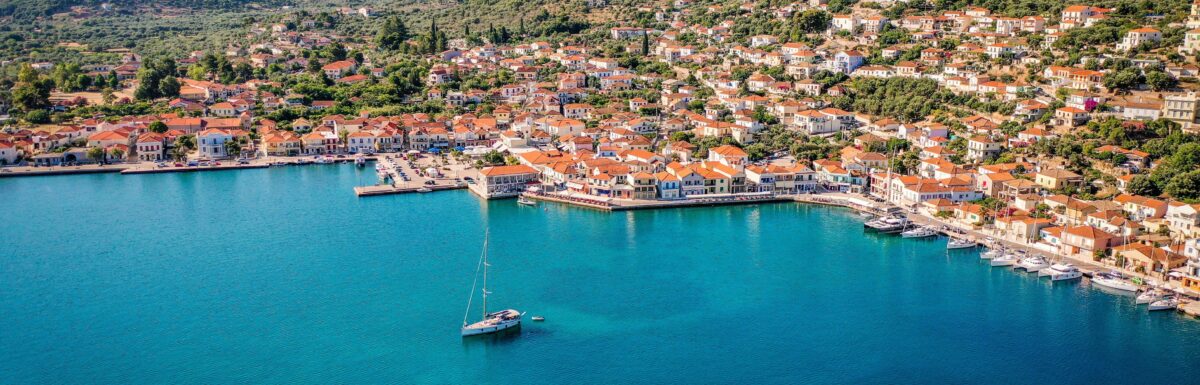
The south of the island is empty but for a few Homeric sites and the main port of VATHY or VATHI. The port has one of the most idyllic seafront settings in Greece, nestled at the end of a long, deep bay and embraced by mountains.
The wooded islet of Lazaretto sits in the bay where a quarantine station was built in 1668. It was converted to a prison in 1864 and demolished by the earthquake in 1953. All that remains are trees and a picturesque, whitewashed church.
Unfortunately the idyll ends as you step ashore onto an unprepossessing quayside lined with functionally bland buildings that owe something to pre-quake architecture, but not much.
A preservation order in 1978 prevented unsightly building and protected the town from naked commercial development but the results are nothing to send postcards home about.
The utilitarian view is not enhanced by a large car park and some seedy looking tavernas on the quayside.
There is also a small and dull archaeological museum that appears to survive only on daily diet of whistle-stop tour visitors. The best of the island treasures were carted off to Athens or looted by European archaeologists long ago.
The Folklore and Cultural Museum of Ithaca is behind the Agricultural Bank and has exhibits of island life as well as photographs of the devastating earthquake of 1953.
The poor state of island roads makes Vathi the best base for exploring by boat although there are several out-of-town walks to sites that claim a mention in the Odyssey.
Vathy is where most island amenities are found - post office, bank, cash machine, bakery, mini markets, travel agents and shops. Ferries leave here for mainland Greece, Kefalonia, Corfu and Italy and boats offer many trips around the island and to neighbouring Kefalonia.
Apart from the capital port at Vathi the southern half of the island has few settlements and few beaches. It is mostly barren rock and scrub,particularly in the west which is virtually inaccessible to al but he hardy trekker. What beaches there are can be found north of Vathy. The south is reputedly identified with sites mentioned in Homer's classic Odyssey, a claim that is much disputed by scholars. Most notable is the Cave of Nymphs where Odysseus is supposed to have hidden his treasure on his return from Troy and the 8th century citadel above Aetos thought to have once been Odysseus' castle.

Aetos beach
Directly west of Vathy the huge bay at AETOS almost cuts Ithaca in two. Its dramatic setting, with the steep ridge above and towering cliffs behind, is somewhat offset by the scruffy, unkempt stretch of rock, stone and shingle that is the beach.
Despite being near Vathy and backed by a road providing easy access it is often strewn with rubbish and detritus washed up on the waves or flung from the windows of passing cars.
The road runs behind the beach for around 1km and, being above the beach atop a high cement wall, the traffic can be enough to destroy the peace. There is the occasional tamarisk to provide shade but it is generally very exposed.
A forest fire has scarred much of the hillside but is now slowly reverting back to its natural state.

Piso Aetos
The narrow mountain ridge at Aetos separates the north and south and is a favourite place for walkers who can overlook bays on either side and interrupt their ramblings to visit the ruins of a citadel built in the 8th century and abandoned in Roman times.
Some say this was the castle of Odysseus but frankly, the evidence is pretty thin. There is a waymarked path from at Aetos behind the chapel
On the opposite site of the ridge from Aetos and facing west with, views across the strait to Kefalonia, is the small port of PISO AETOS.
More of a ferry port than a beach resort, the tiny harbour has been enlarged to take bigger ferries which can thus avoid the long sail around to the other side of the island to reach Vathy.
There is a thin and narrow beach of rough pebbles here but few use it for bathing as it is barren and very exposed. A small cantina opens near the harbour in the summer months but there are no shops, toilets or other facilities.

Dexa beach
The road north out of Vathy follows the bay to a narrow beach of coarse sand, pebbles and stone at DEXA.
This is supposed to be the beach upon which Odysseus landed on his return home. It is about 2km from Vathy and a fair number of apartments have been built here, so the beach tends to get commandeered early in the day.
It was once a very pretty beach but is now, though not unattractive, less than it was. There are rubbish bins along the shore though they don't stop flotsam floating in on the tide.
It's not much use setting out to sunbathe in the afternoon either as the beach is in full shadow from the hills opposite by 2pm. And a desalination plant has also been built nearby so, if the wind is right, you get an irritating hum.
Parking is also a problem on the narrow road. A small cantina opens in the summer.
Nearby at LOUTSA are the ruins of a French fort built in 1805 overlooking the bay and where narrow tracks lead to even quieter coves.

Skinos beach
On the headland east of Dexa is the long and narrow beach of SKINOS, set in very attractive countryside that is dotted with some very exclusive villa properties.
The beach is approached down a dirt track and is all pebbles and stone, some of it none too clean as, like Dexa, it seems to attract tidal rubbish. Being more isolated than Dexa it doesn't get cleaned as often.
That said, there is decent snorkeling to be had along the rocky shore. This is a pleasant place to hide away from the crowds with plenty of shade from tall cypress trees along the shoreline.
Again, like Dexa, it suffers from a late afternoon in shadow and there are no facilities here.

Filiatro beach
No problem with shade on the east facing bay of FILIATRO where there is an extremely pretty beach of pebble and stone serviced by a summer cantina.
The water is shallow in the enclosed bay, making for an nice warm dip if you fancy it though footwear is recommended as there is no sand underfoot.
Car access has no problems - just follow the road east out of Vathy for about 20min until you reach the bay. Olive trees and tamarisk provide shade and the back of the beach where there is also some camping.
When I was last there in high summer there were pedaloes for hire but no sun beds. Despite the lack of the latter the beach was still very busy.

Sarakiniko beach
The SARAKINIKO bay gives it name to a couple of shingle beaches that are separated by a rock outcrop into the sea.
One of the beaches is dominated by an ugly cement villa that reminds us of the Greek love affair with the concrete mixer. This beach is also used to launch boats from a slipway and serious bits of boat rubbish is strewn around.
Sarakiniko is a quite attractive beach in a sheltered bay, though most visitors are merely passing by on their way to the better beach at Filiatro.
There is plenty of shade from olives and cypress but there are no facilities here. If you get fed up of sunbathing on the pebbles there are sandstone slabs nearby.
There was once a German 'commune' here than numbered about 200 people but only a handful live there now.

Perachori
The rather scruffy mountain village of PERACHORI or PERAHORI sits above Vathy and is where most of the island's wine is produced.
Small tavernas open in summer although this is very much a working, not a tourist, village. A wander round will reveal the ruins of fortified houses that were once used by islanders to escape the eye of passing pirates.
Villagers have recently taken a lead in growing organic produce. Visitors get unobstructed views over the whole south of the island. Nearby is the Monastery of Taxiarchis built in 1645 near the top of the mountain.
The northern peninsula has the better resorts, the biggest villages and the more interesting walks. The west side coastline is rough and ragged with only a couple of decent beaches while the eastern side is typified by rolling hills and lush farmland.

Agios Ioannis beach
The resort of AGIOS IOANNIS looks spectacular from the cliffs above, with nearby Nikolaos completing the scene with an old windmill for romantic effect.
Getting down to the beach is a problem, particularly if you make the mistake of trying to make the descent before reaching the village of Lefki. There is dirt track before then but it is a precipitous drop and you will never get back up in a car.
Even the road from Lefki is difficult with hairpin turns on a steep track that ends about 100m from the beach. A steeper path then leads down past the windmill.
The beach is a long narrow strip of pebble and stone with fine views across the straits but there is no shade and no facilities.

Polis harbour and beach
POLIS is the only west coast resort on Ithaca that could reasonably be called popular with tourists.
A medium sized bay of white limestone and shingle has a small harbour at one end with a taverna nestling beneath the eucalyptus trees.
It sits below the main northern town of Stavros and, with parking on the beach, sun beds, umbrellas and the taverna it can be a popular, crowded place in the summer.
Land behind the beach itself is flat scrubland so there is little in the way of shade unless you retire to the taverna or sit on the harbour wall, although there are a few tamarisks along the back of the beach.
There is a small harbour at the southern end and boat trips also leave here for Fiskardo on Kefalonia and around Ithaca itself. It was a port for ferries until the expansion at Piso Aetos, just down the coast.
At the north end of the bay was once the Lozios Cave where important religious artefacts were unearthed but earthquakes have reclaimed it and the cave has collapsed.

Stavros
Inland from Polis and overlooking the bay is STAVROS, the capital village north Ithaca at the foot of Mt Neritos.
Stavros, which means crossroads, also envelops the hamlets of Pilicata and Kalyvia. It acted as a chora in the 16th to avoid pirate attacks.
Worth seeing are the fine churches of Sotiris, Agia Varvara and Zoodochos Pigi. A stern and imposing bust of Odysseus stands in the central platia and there a few traditional houses that survived the 1953 earthquake.
There are several tavernas, cafes and a mini-market. Excavations from the Loizos cave used as a temple are displayed in the tiny archaeological museum. The museum contains various finds from Ithaca, from the Early Helladic periods to the Roman.

Exoghi
EXOGHI is found north of Stavros is one of the oldest villages on Ithaca and it is picture postcard stuff for the visiting tourists.
It's a picturesque village in a picturesque spot with wonderful views down to Aphales Bay and over the sea. The main church of Agia Marina is well worth a visit and there is a small cafe here and some rooms for rent.
The village is also noted for its three small pyramids built in 1933. The eccentric builder and his mother are buried under two of them.
You must travel to one of the northern tips of the island to find another beach, though you are unlikely to visit.
Dramatic white cliffs enclose the deep inlet at ASFALES which sits a few hundred feet below the village of Exoghi. Remote and relatively inaccessible it is rarely visited in the high season.
Those that go are rewarded with astonishing views on the descent. Arrival is less than stunning though as the north facing beach of stone and pebble tends to collect its fair share of litter and is shrouded by the surrounding cliffs and woods.
There are no facilities here.
The stone beach at MARMAKES is around 4km over the headland from Asfales and can be reached by a dirt track but it is a brave driver that tries it.
Sheer drops to the sea along narrow unfenced and crumbling dirt tracks are for the suicidal only. You really need a boat or strong legs for the goat track from Frikes, two good reasons why it is usually deserted.
That said there are moves afoot to improve the road which may open it up to more visitors. The stone beach is very attractive with an offshore islet sporting a tiny chapel to add to the romantic setting.
Trees line the shore and there are walks through the groves of olive and fruit behind. There are no facilities here.

Frikes

Kourvoulia beach
FRIKES is one of the major resorts in the north (if anything can be called such a thing on Ithaca), along with its neighbour Kioni just around the headland.
Though tarted up for tourists in recent years it manages to retain some Greek charm. Cafes and tavernas are strung around the dainty harbour with the sleepy village behind luxuriantly planted with bougainvillea and jasmine.
Feuding between local families adds a certain edge to village life where local festivals have been known to end in drink fuelled village punch-ups.
Ferries from Lefkas arrive in the morning and the village is briefly busy with the new arrivals before settling back to sleep. A one-way system prevents what little village traffic there is grinding to a halt.
This is a good base to explore the island with splendid walks through delightful countryside and various recently cleared trails along the coastline. Since a new jetty was built in 2000 it has grown in popularity.
The bay to the south offers a string of small coves and beaches, most of them easily accessible from the coast road though it can be a scramble to get to a couple of them. All are much the same - small pebble and stone coves with no facilities.
One of the best, and nearest to Frikes, is KOURVOULIA, a narrow scoop of shingle by the roadside.

Kioni

Kioni beach
KIONI is the premier resort on Ithaka and it shows. Its a picture postcard idea of a Greek island resort with smart houses and apartments climbing the hills around a secluded horseshoe bay.
Well-heeled holidaymakers parade around the harbour before setting into one of the waterside bars and tavernas. Cars are banned from the village over the summer.
It is so cute it could be cheesy but has somehow managed to marry authentic Greek charm to the demands of tourism. This comes at a price though and this is reflected in the costs of staying here and the big expensive yachts in the harbour trying to outdo each other in vulgarity.
For those that tire of sitting in the tavernas there are tiny coves at the mouth of the bay, windmills on the headland and old donkey trails to explore.
The town beach sits below the windmills, a steep, short and narrow bank of pebble and shingle with overhanging trees for shade at one end.
There is a cantina in high summer and takes 20 mins to walk (the narrow road is closed to traffic except out of season). Sun beds hadn't made an appearance when I was last there but it can't be too long
Above the beach at Dexa is the CAVE OF NYMPHS also known as MARMAROSPILIA. This is the cave where Odysseus is supposed to have hidden his treasure on his return from Troy. What treasures have been found are more of an archaeological nature and can be found in the museum in Vathy.
The cave is, well it's a cave, and has a hole in the roof and a clump of cypress at the entrance. What atmosphere it may have had has been lost in a blaze of tacky coloured lights. Some say this is not even the original cave anyway, the real one being inadvertently demolished in a nearby quarry some years ago. The route to the cave is well signposted from the road.
Around 10 km south of Vathi is the ARETHOUSA SPRING, where the swineherd Eumaes supposedly brought his pigs to drink as told in The Odyssey. The landscape and sea views are breathtaking but the route is precipitous and you are not advised to walk alone. To get there follow the asphalt road out of Vathy that is signposted to the Marathis Plateau. At the village of Anemothouri, on the right, there is a large blue and white sign pointing to the Arethousa Fountain track. Follow the red waymarkers.
The scenery at the fountain is pretty impressive and a difficult rock-strewn descent down a ravine brings you to an unnamed beach opposite the islet of PERAPIGADIA. The spring itself is little more than a dribble and many may wonder at the effort taken to get there
The smallest of the Ionian island's, after Paxos, it is just 96 sq. km with a population not much above 2,000. The population declined steeply after World War II and again after the 1953 earthquake. The steep and straight 16 km long western coast is just over 1 km from Kefalonia at its narrowest point and contrasts sharply with the jigsaw inlets of the east. In fact, it is almost two islands in one, joined by a high ridge that is only 600 m wide.
| JAN | FEB | MAR | APR | MAY | JUN | JUL | AUG | SEP | OCT | NOV | DEC | |
| 12 | 13 | 15 | 18 | 23 | 27 | 30 | 30 | 27 | 22 | 17 | 14 | Avg day °C |
| 5 | 5 | 7 | 9 | 12 | 16 | 18 | 18 | 16 | 13 | 9 | 7 | Avg night °C |
| 5 | 5 | 6 | 7 | 9 | 11 | 13 | 12 | 9 | 7 | 5 | 4 | Sun (hrs) |
| 2 | 3 | 5 | 6 | 8 | 9 | 10 | 9 | 7 | 4 | 3 | 2 | UV Index |
| 145 | 122 | 91 | 62 | 37 | 16 | 11 | 15 | 47 | 131 | 167 | 186 | Avg rain (mm) |
| 12 | 11 | 10 | 9 | 7 | 4 | 2 | 3 | 5 | 8 | 10 | 12 | Rainy days |
UV: >3 Low; 3-5 Moderate; 5-8 High; <8 Very high | Rainy days 1mm+ | 1 inch=25.4 mm
Cyclonic depressions provide the Ionian islands with mild, wet winters and little frost. Beginning in late autumn and continuing through the winter, the Ionians and the western mountains of the mainland receive abundant rain, with occasional snow at the higher levels. The average annual rainfall off the west coast is three times that in the eastern islands. Wet winters account for the island's verdant forests and lush, fertile plains. In April and May temperatures rise steadily with sharp showers slowly dying out. By June rainfall drops dramatically and temperatures soar. By September rain is much more likely while temperatures remain high compared to other Greek islands. But October brings heavy rain once or twice a week that can continue throughout the winter months.
The beautiful Greek Islands are renowned for their spectacular scenery, magnificent mountainous backdrops, stunning sandy beaches and crystal clear waters. Holidays to the Greek Islands are often most cherished for this combination of sunshine, warm waters and beaches set against truly wonderful scenery. Whether it is a traditional beach holiday you would like or something with a little more history, you'll find that a break away to the Greek Islands is just the answer!
Cheap flights from all major European airports
Details in most European languages and currencies
There is no airport on Ithaca. The nearest airport is Kefalonia which has daily domestic flights from Athens with Olympic Airways and Aegean Airlines. You will need to cross Kefalonia to Sami on the west coast to catch one of two ferries that call in around 3pm. Unfortunately plane and ferry times rarely match so an overnight stay may be needed.
There are also flights to Preveza or Araxos on the mainland with ferry connections or AirSeaLines have seaplane flights from Corfu on Monday and Tuesday.
Kefalonia International Airport (EFL) is 9km south of the island capital at Argostoli. International charters take passenger number to upwards of 400,000 annually. The airport has only one terminal for incoming and outgoing flights and passenger services are limited given the annual throughput. Expect long delays at the three meagre check-in desks and the two baggage belts.
There is no left luggage facility and no bank. There's a post office and first aid centre, some shopping, a gift shop, cafe and bar.
There is no public transport from the airport and a taxi is not cheap. Some hotels offer private minibus transfers. There are only 110 parking spaces so it can get crowded at busy times.
Olympic Airways has a daily flight to Athens all year round and this runs to several flights a day during high summer.
There are several daily ferries services that call in at Ithaca:
From Athens: At Patras, Blue Star ferries leave twice daily for Ithaca calling at Sami on Kefalonia on the way, usually at 12.30pm and 8.30pm but check first. From Athens KTEL buses leave hourly for Patras from Kifissou bus station. The ferry takes 3hrs 20min. The earlier ferry docks at Piso Aetos and takes 3hrs 20mins, the later one docks at Vathy and takes about an hour more. From Athens you can also take a bus to Xanthoula for a ferry that takes about 2hrs 20mins to Ithaca, but the bus ride is around 6hrs.
From Kefalonia: As well as the daily ferries from Sami outlined above there is also a water taxi service from Aghia Efimia operated by Yellow Boats.
From Lefkas: There are daily ferries from Nidri in Lefkada calling at Fiskardo on Kefalonia and docking in Friskes, Ithaca. The journey time is about 2hrs. There is also a 2hour journey from Vasiliki, Lefkada to Piso Aetos on Ithaca. Taxis wait for the ferry.
From Corfu: Flying Dolphins sail from Corfu to Ithaca on Wednesday, Thursday and Saturday at 9.15am and take around 3hrs. The return sailing leaves Vathy at 2pm. There are also dolphins from Sami to Corfu on Wednesday and Saturday at 4pm.
Driving on Ithaca is car hire or taxi. Many hire cars in Kefalonia and bring them over on the ferry. Taxis are about but not plentiful, although there are always some on hand to meet ferry arrivals. If you hire a car or bike take note that police have been active the past few summers handing out hefty spot fines for not wearing seatbelt in cars or crash helmets on bikes. They don't wear them themselves but there you go.
There is a twice daily bus from Vathy to Stavros, Frikes and Kioni that leaves Vathi at 6.15am and 11am and leaves Kioni at 7.15am and 2.30pm. There is no bus service on Sunday or Bank Holidays. Many find it a hair-raising ride through the mountains.
Although small Ithaca is a mountainous and wild island. Many old mountain tracks fell into disuse over the years but have been cleared by the island council and volunteers. There are maps of local walking trails in many island souvenir shops. The main routes are waymarked and many of the paths have been cleared by islander Denis Sikiotis. Online walks can be found here
Ester van Zuylen has guided walks on the island. See her website here.
KIONI ITHACA photo gallery by LYNNE ADAMS
Going to Ithaca Greece this year? If you would like your photo gallery here then email details. It takes 10 photos to make a gallery.