
KALYMNOS is one of the northern islands in the Dodecanese group, about100km north-west of Rhodes. It lies near the Turkish coast, with Leros to the north and Kos to the south. Around 17,000 live there, most in the busy capital of Pothia.
Tourism hasn't taken off in a big way in Kalymnos. This is mainly because Kalymnos has no airport, the beaches are mostly indifferent and the landscape is, in large part, barren limestone, although the valleys are as lush as you will find anywhere in the Greek islands.
What Kalymnos lacks most is charm. That said, visitors who take to the island are fiercely positive about its attractions. The main Kalymnos tourist strip is at Massouri on the west coast, opposite the island of Telendos.
There is a splendid beach at Emborio, a charming resort at Vathi and the added interest of the islet of Telendos but, other than that, Kalymnos consists of barren, grey rock that is more a magnet for climbers than for holidaymakers.
Though not a particularly small island, much of Kalymnos is barren and inhospitable mountain. The scarred cliffs make it very popular with mountaineers who arrive in droves each year.
Despite its size there are a limited number of Kalymnos resorts for the summer visitor to enjoy with the east coast virtually uninhabited and the main tourist strip in the west very busy.
Kalymnos beaches are not the most attractive and the best, virtually all down the west coast, have been monopolised by hotel companies - so crush any hopes of a charming Greek getaway.
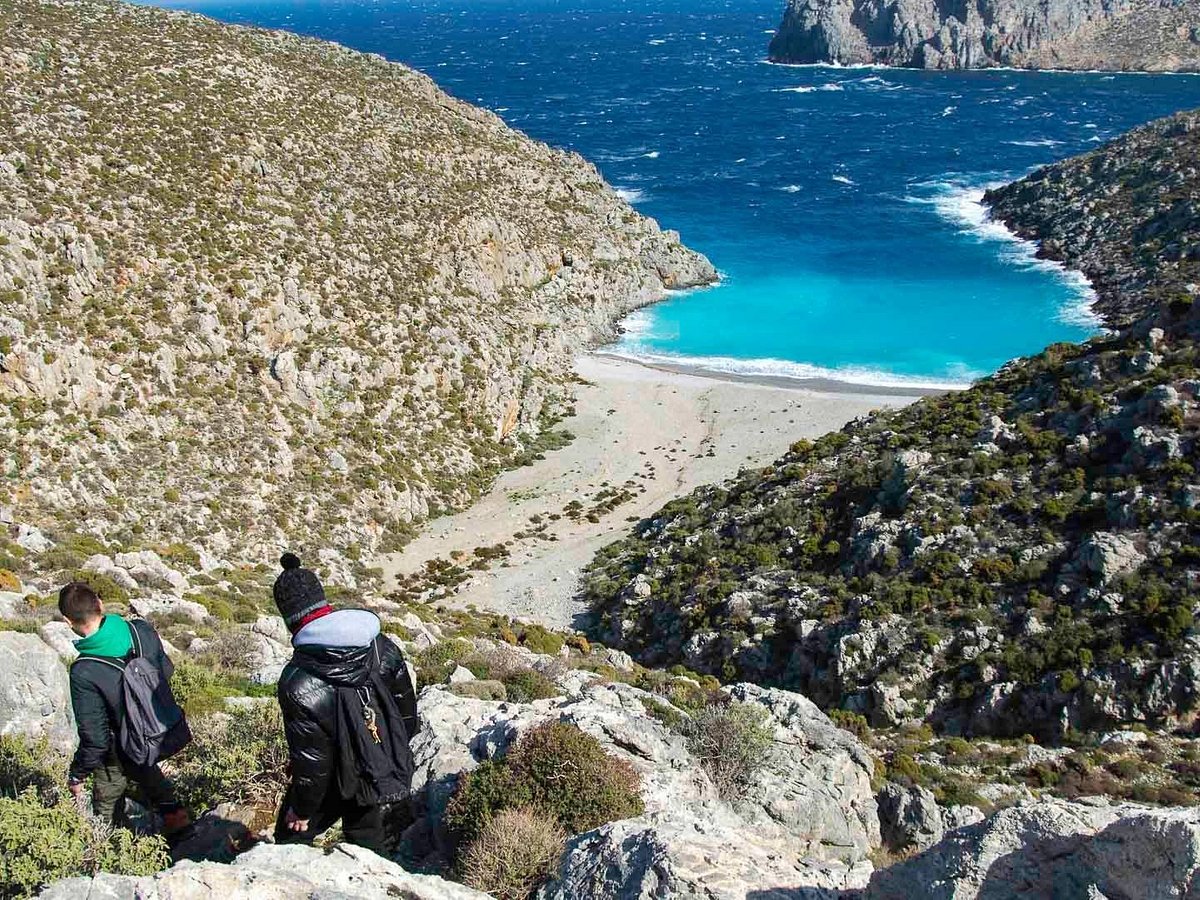
The rocky interior, a favourite with climbers, is criss-crossed by deep, attractive green valleys lined with mule trails that walkers will find very enjoyable.

Pothia waterfront

Pothia harbour

Car wrecks at Pothia beach
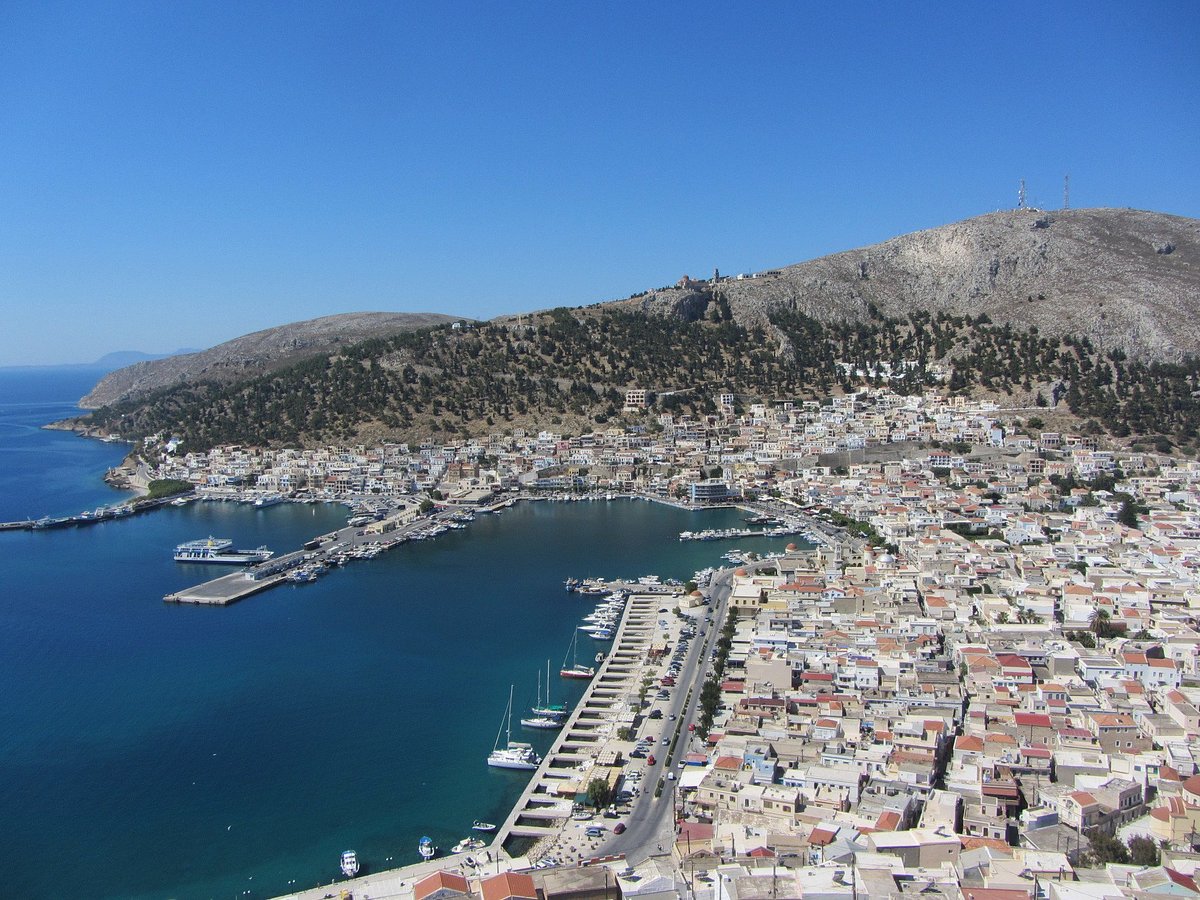
The island capital of POTHIA is squeezed between steep grey mountain slopes in the south-east of the island. The approach by ferry sails past drab cement works, gas towers and other industrial eyesores.
But Pothia town itself is a colourful and lively, if noisy, place built in an amphitheatre around the port. At the centre is a complex of public buildings - cross between fortress and palace - with town hall, police, customs and various official departments.
This complex splits the Pothia in two with the posher end to the south - full of tourist shops, bars, hotels and yacht moorings - while to the north is the rather more interesting market, fish restaurants and booze retailers.
But wherever you are in Pothia expect lots of noise. This is a busy place, with a reputed 6,000 motorbikes for sale or rent most of them seem to be whizzing back and forth along the sea front or down side streets.
Apart from a dual carriageway that follows the shoreline the Pothia streets are very narrow and a maze of bars, cafes, pool halls and bike shops - worth a stroll if you don't mind dodging the traffic. The roads in Pothia have been relaid recently after years of neglect so cars and bikes now tear along at suicidal speed.
Pothia town is huge, so its easy to get lost, but in the back streets there are some fine examples of neoclassical houses with extraordinary wrought iron balconies.
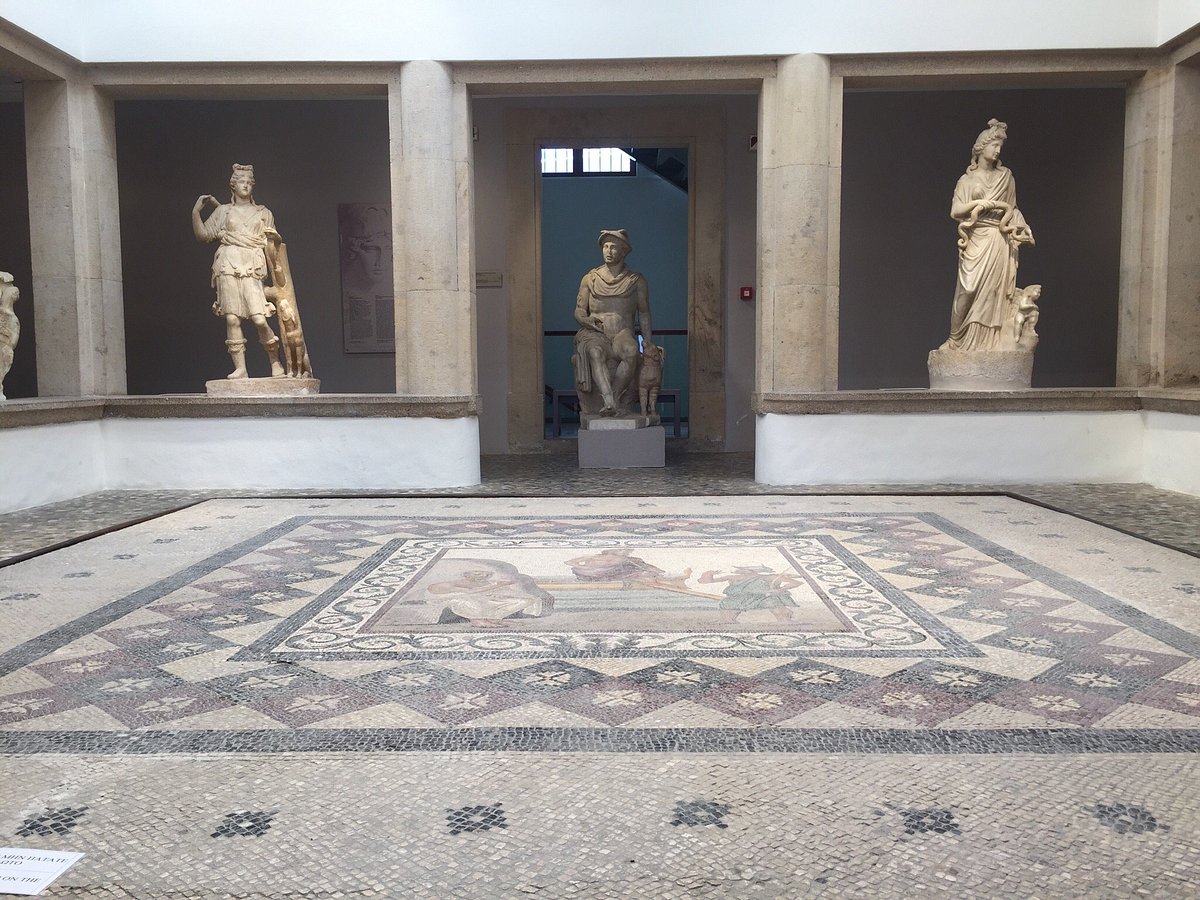
There is an Archaeological and Folk Museum on the northern hillside and the Nautical Museum at the western end of the port with details of the lives of Pothia sponge divers - if you can find it open.
There's also a horrible beach just beyond the museum which is little more than builders' rubble dotted with a few tamarisk trees. It has an unpleasant concrete harbour wall on one side and an even more unpleasant car wrecking yard on the other.

Vlychadia beach
The road west out of Pothia leads to the village of VOTHINI then down to the inlet at VLYCHADIA where there are two pleasant bays each side of the small harbour, one a gentle curve of shaded sand the other a small strip of clean pebbles.
Good tavernas back both beaches and regular excursion leave Vlychadia for the cave at KEFALA just along the coast south-west of Vylchada.
It's a 30 minute walk off the boat but you are rewarded with vividly colourful rock formations and a particularly imposing stalagmite in the largest of the six chambers.
Vlychadia beach is a pleasant crescent of coarse sand and shingle with a line of tamarisk trees behind to provide good shade. The water is shallow, though a little stony underfoot.
Clearly marked behind Vlychadia beach is the extraordinary Museum of Submarine Finds, open most days. Former diver Stavros Valsimades has collected an impressive array of underwater ephemera including sponges, amphorae, salvage from sunken ships as well as stuffed marine animals. (See Highlights)

Akti beach

Rina

Rina Harbour
The coast road heading east out of Pothia winds along the coast past ugly cement factories, oil terminals and gasworks before heading up into the hills. The coastal views are magnificent and the road, often lined with bougainvillea, is very good.
After 4km or so a steep concrete track plunges down the hillside to the small bay at AKTI where there is a delightful stretch of shingle beach with a couple of large tamarisk trees for shade.
It's backed by a single taverna serving basic food and an ideal peaceful spot after the turmoil of Pothia, though boat trippers can fill the place up during the high season.
Around 10km out of Pothia is the short, fertile valley of VATHI, covered in groves of olive, tangerine and lemon.
A right turn takes you to the quiet port of RINA where a clutch of big tavernas take care of visiting tourists and boats line the long narrow gorge.
Boat excursions start from here to visit the stalagmite DHASKILIO cave set in the cliff along the gorge and there are tiny beaches at ALYMYRES and DHRASONDA accessible only by boat.
The valley behind, though beautiful from a distance, is a moribund, flyblown place close up. Signposted villages are little more than clusters of houses set behind high walls.
The north-east coast of Kalymnos is uninhabited and mostly inaccessible to all but hardened walkers and climbers. Almost all tourist development is on the west coast and of that most is concentrated opposite the islet of Telendos. Two roads run parallel to each other heading north-west along the valley out of Pothia and to the coast, joining at Chora and a single road then running along the western coastline.
Vlychadia is pretty well the only beach to be found west of Porthia while to the east is Akti and the port of Rina. For the main island beach strip you must head north-west along the valley towards the islet of Telendos.
The area north of Pothis is mostly suburban sprawl as you head out, punctuated by the village of PANORMOS at a main crossroads.
Panormos was once a drab and unattractive spot, but it has undergone a recent facelift. There are several cafes and tavernas plus a minimarket and kiosk wrapped around a busy traffic island.
Several of the tavernas at Panormos have had major revamps and are now popular places with both visitors and locals. Meals are cheaper here than at many beach resorts provided you don't mind the busy main roads that converge on the spot. Highly recommended are Marinos for its Greek food and Artisano for pizzas.
The village of Panormos is also the main jumping off point for a trio of nearby beaches at Platys Gialos, Linaria and Kantouni.

Linaria with Kantouni beyond
Signs from Panormos point to the beaches of Platys Gialos, Kantouni and Linaria. KANTOUNI is a disappointing thin stretch of coarse grey sand that shelves steeply into the sea.
There are stones underfoot out to sea at Kantouni. A couple of bars line the back of the beach, one pumping out loud pop music all day, even when empty.
There is a small cave at the northern end of the beach that offers marginal interest as well as a steep concrete path that leads to the slightly better beach at Linaria.
And LINARIA is only slightly better, as the sand is coarse grey gravel and grit that tends to collect rubbish. It is thin and narrow with a few overhanging trees to provide a little shade in the mornings.
There are a couple of cafes on the headland and two good tavernas on the road above Linaria with fine views over the bay- the best being the unnamed taverna set in the cliff midway along the beach which serves excellent food grilled on an open charcoal fire.

Platis Gialos
The road sign to PLATIS GIALOS or PLATYS YIALOS is the most prominent in Panormos and it points to one of the best of the beaches in this area.
Access to Platis Gialos is down a steep road or you can take the steps leading down from a taverna whose owner is not only exceptionally friendly but serves excellent food too.
Platis Gialos beach is a long swathe of shingle, clean for once, with explorable rocky coves at each end and it gets progressively sandier to the north, though these are only occasional patches between the shingle.
There are a few sunbeds outside the basic, but excellent, taverna that has been built into the cliff at the back of Platis Gialos beach providing food, drink and toilets.

Myrties
North of Panormos lies Kalymnos island's main tourist strip which begins at MYRTIES though it is still very much low key. The road snakes down the steep hillside to reveal views of the impressive island of Telendos opposite.
The main street of Myrties contains a few tourist shops, a mini market and a couple of bars near the taxi rank. Being at the southern tip of the main tourist trip it can be pretty busy here with bikes roaring by every few seconds.
Small side streets lead down to the Myrties ferry jetty which is flanked by tavernas, and narrow stone and shingle beaches. It's pleasant enough but hardly the stuff of tourist dreams.
Myrties beaches are stone and shingle and the stones continue under the sea so you will need footwear. There are tamarisks for shade and sunbeds come out during the high season.
Apart from being a seaside resort Myrties is the main jumping off point for visitors to Telendos with caiques leaving every hour, so there is plenty of through traffic.
There is also an early afternoon ferry to Xerokambos, on Leros, that departs from Myrties.

Massouri

Melitcahas
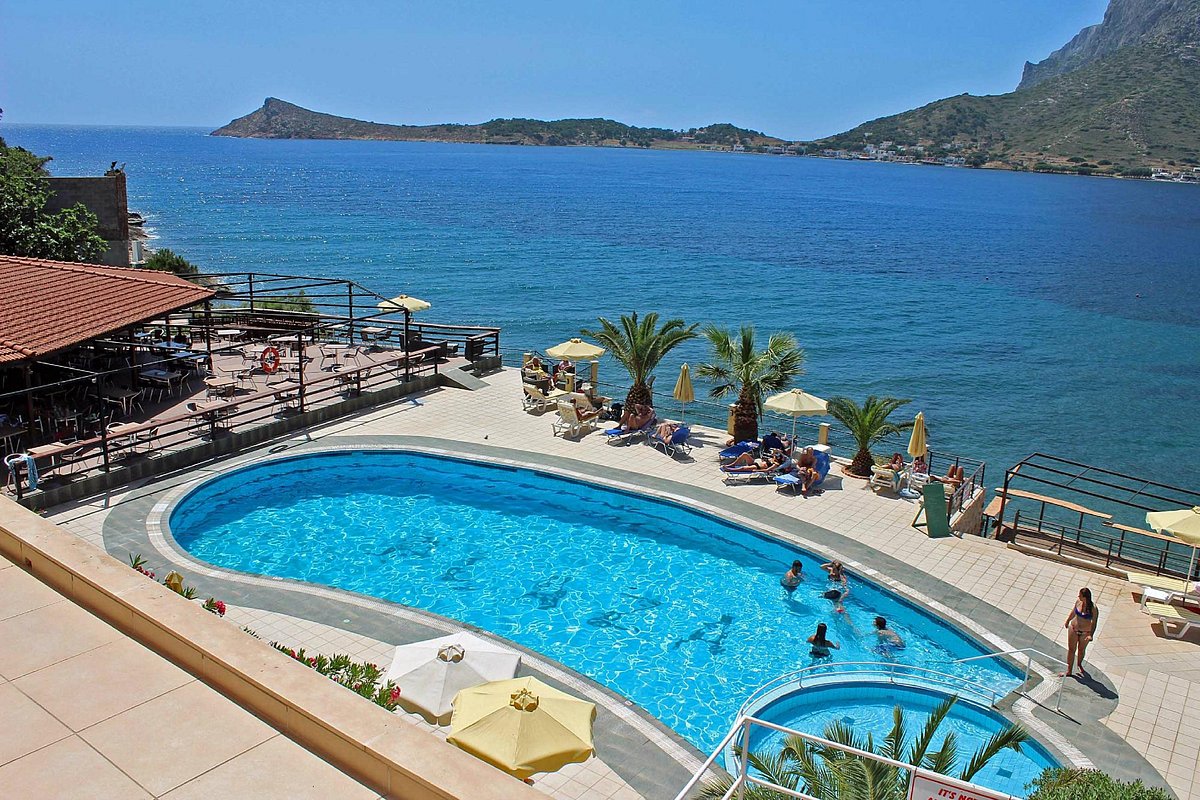
MASSOURI is the main tourist strip on the Kalymnos. There are plenty of hotels, souvenir shops, English breakfast bars and general neon tat - but it is all on a relatively small scale.
The Massouri main street runs straight through the resort following the coastline. A clutch of hotels and apartments hug the slope between the main road and the shore.
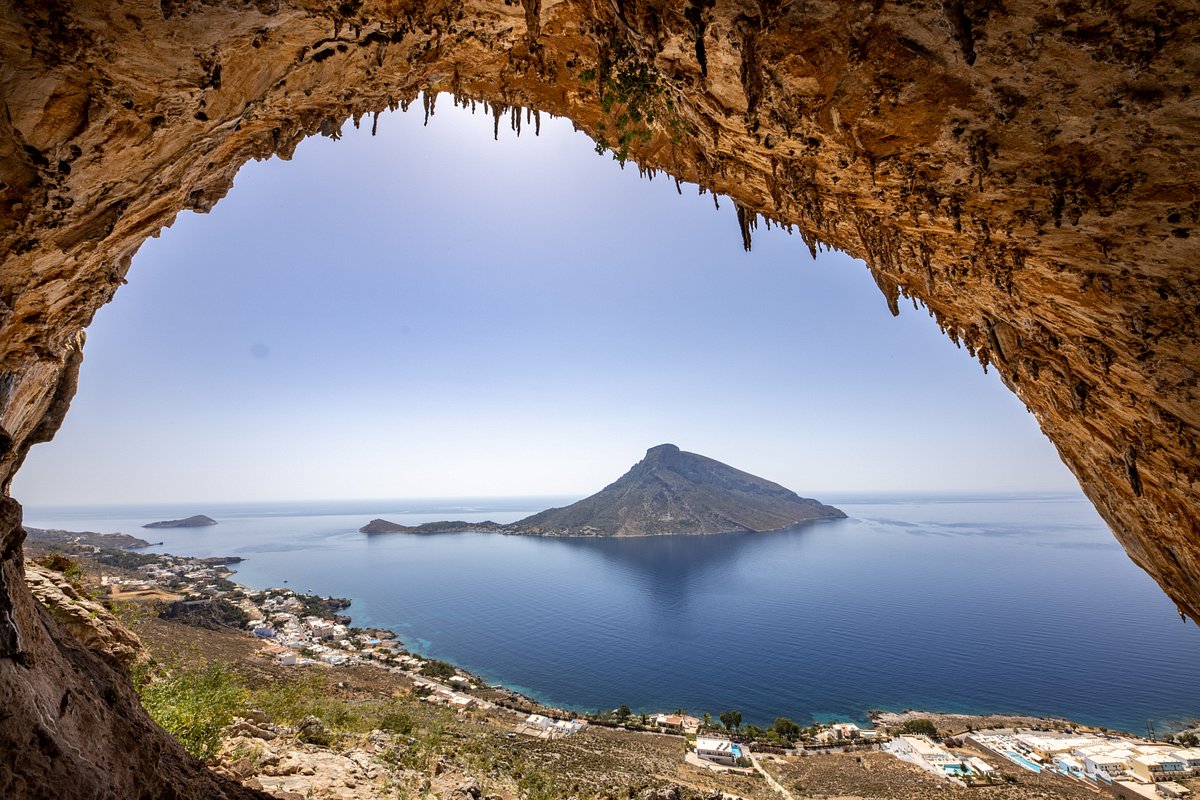
Massouri is a very impressive stretch of coast with steep majestic hills behind, lush vegetation along the coastal strip, and the spectacular island of Telendos rising dramatically out of the sea across the bay opposite.
Massouri beaches here aren't terribly impressive though. They are mostly narrow and composed of grubby grey sand, stones and shingle that dips quite sharply into the sea with stone and sand underfoot.
The best of the Massouri beaches are found at the southern end, notably at MELITCAHAS, well signposted off the main road. There is room for a couple of lines of sunbeds and there are tourist facilities, tavernas, shops etc, in the village that sits overlooking the beach.
Sand and shingle predominate on the main Massouri beach which is backed by hotels and sprinkled with sunbeds. Shade is provided by a line of tamarisk trees and there are the sort of facilities you would expect in the island's most popular resort, as well as regular ferries across to Telendos.

Kastelli
The road north our of Massouri snakes around the heavily indented coastline, offering staggering views out over the sea and inland to the stark rock hillside.
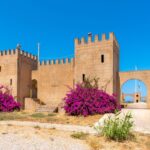
The Kastelli area of Kalymnos is a huge draw for climbers eager to tackle the limestone cliff faces. On a small promontory just north of Massouri and facing the islet of Telendos is the impressive ruined fortress of KASTELLI.
It overlooks the sea in one of the wildest parts of the island where the coast is full of rocky coves. There is parking on the bend and it is a 30min walk from Massouri.
Several steep crags make Kastelli a very popular climbing spot. Below below the fortress ruins is a picturesque white chapel and, although there are step down the cliff, it is difficult to reach and should only be attempted if you are fit.

Agonindas
The coast road north from Massouri turns east around the headland and past the coastal hamlet of KARAVOSTAVI where there are spectacular views over the sea, now dotted with several fish farms.
The sheltered inlet of ARGINONDAS has a small pebble beach backed by olives, pines and a couple of tavernas. Arginondas is also the start of an inland walk over gentle hills to Vathi on the other side of the island.
Arginondas is also another jumping off point for many climbers tackling the many cliffs and rock faces that run along this part of the coast.
A little further north is the village of SKALIA where there is a large cave, but it is not open to the public.

Emborios

Harry's Garden
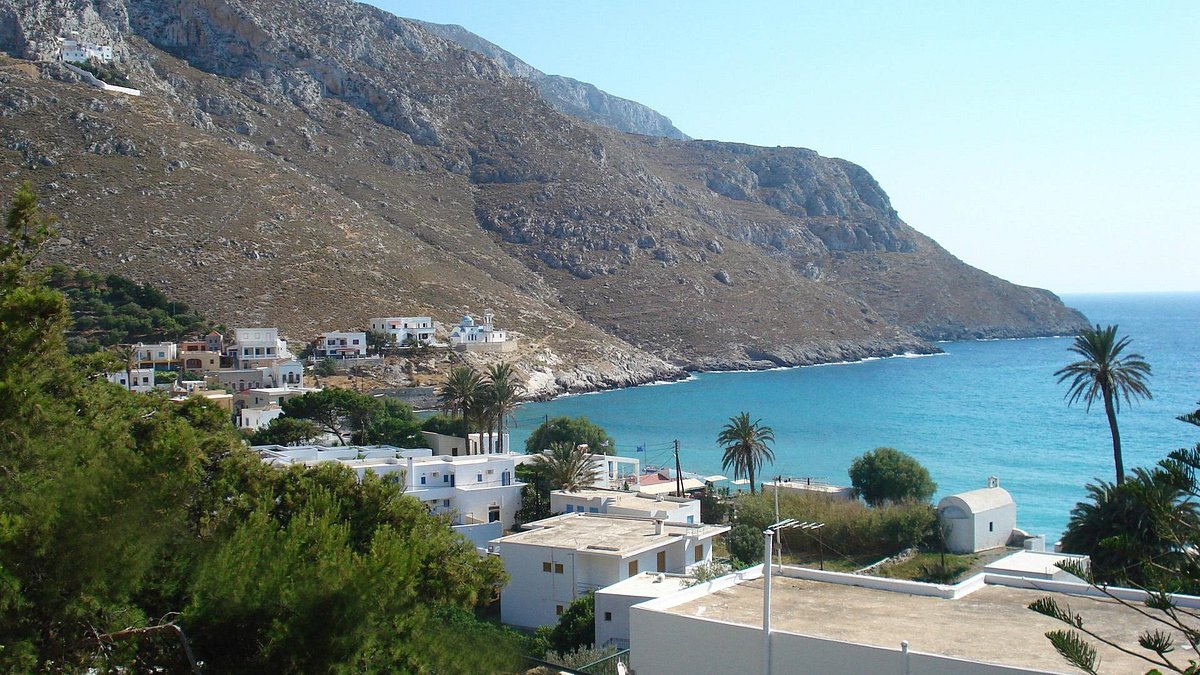
The road north ends at the sheltered, peaceful and south facing the beach of EMBORIOS, otherwise called EBORIO or EMPORIO, and this beach is one of the best on the island.
The sand at Emborios is gritty but fine and backed by tamarisk trees and a string of tavernas. The beach shelves steeply into the a sea of large stones and banks of seaweed so it's not particularly good for children.
There are a few sunbeds on Emborios beach and a couple of good tavernas along the shore. Views of the offshore islets are delightful and there is a caique back from Emborios to Massouri that leaves at 4pm if you don't fancy the bus.
A steep climb at the far end of Emborios beach takes you over the hill to another beach at RACHI much more secluded, with trees for shade and a small beach cantina.
Best of the tavernas in Emborios is Harry's, set back up the hill with a beautiful flower garden to sit in, although you sometimes have to wait an age to be served but there you are, this is Greece and there is no more pleasant a place to wait.
Emborio is the end of the road for the daily bus and only hardy hikers will venture into the hills from here.

Telendos
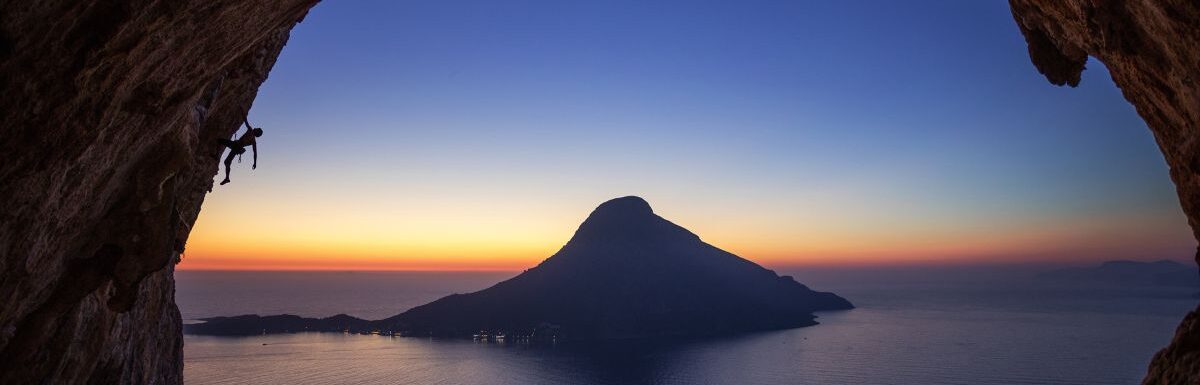
The islet of TELENDOS soars majestically from the sea opposite Myrties like a giant volcanic plug. It was actually formed by a massive earthquake in 500AD that split it off from the mainland, destroying the ancient capital of the island as it did so.
Today Telendos is one of the best reasons for visiting Kalymnos, with a smart new quayside packed with good tavernas and delightful tiny beaches dotted about in the islet's many coves. Every hour during the day small caiques takes a dozen or so passengers to and fro on the 10 minute journey to Telendos from Myrties jetty.
There are no roads on Telendos so no traffic. The wide Telendos quayside has been recently paved and any number of tavernas have placed their tables along it. Its a romantic setting and a favourite with couples enjoying the views across to the twinkling lights of Myrties and Massouri
It has to be said they look far more appealing at night than they do in the daytime. The last ferry leaves around 10.30pm though some run later in the high season if the Telendos tavernas look full. There are a few rooms to be had on Telendos in season.

Telendos quayside

Telendos beach

Paradise beach

Hoklakas beach

Early Christian buildings
Beaches on Telendos are small and accessible only along rough tracks. The nearest is at the northern end of the harbour but it's a rather dull, flat stretch of dark, gritty sand backed by a row of tamarisk trees.
There are fine views across the Telendos straits to the main island and the impressive remains of an early Christian basilica being excavated behind the beach that's worth a look. The small path that runs behind the beach leads to better coves beyond
The path along the Telendos coast here peter out after a while into what is little more than a goat track. A further scramble along a rough and rocky track reveals a couple of small coves dotted with sunbeds.
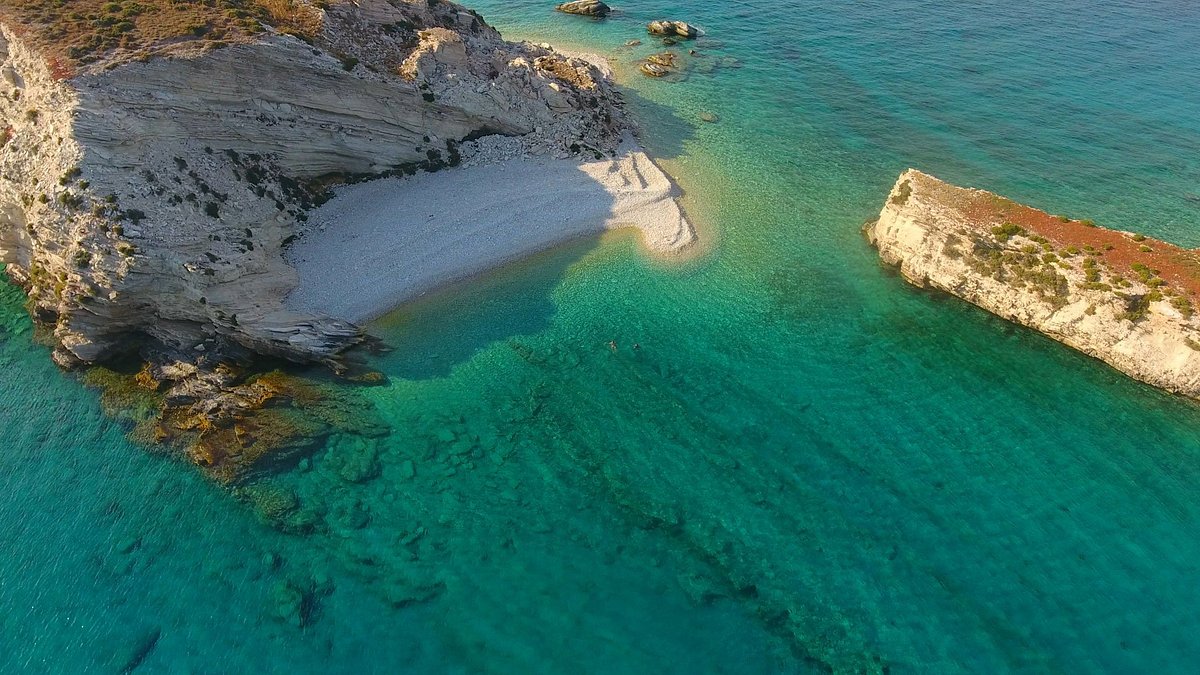
The furthest cove, known as PARADISE BEACH, is the best with a bank of shingle dipping into shallow seas beneath a large rock outcrop that provides shelter.
This is also a naturist beach and helps to keep it quietly exclusive as, no matter where you sit, you are likely to be thigh to thigh as it were with a naturist.
Other beaches can be found on the western coast of Telendos by following the alley off the main harbour past the Barba Stathis taverna and up a paved and tiled track which peters out at the top of the hill.
To the right down a precipitous cliff path is the small cove of HOKLAKAS with a few sunbeds set on shingle beneath the sheer cliffs. This is a great place for snorkeling and enjoying the sunset to the west.
The rough hilltop track leads to a fork where the right hand track takes you to similar cliffside beach at TRIVALIA.
The left hand track wends its way through a large pine wood to open scrubland where a couple of early Christian ruins are set among some scrub and trees.
The track continues right to the end of Telendos island but there is little here of note other than scrub and good views across to the main island.
A track opposite leads to a small featureless bay of coarse sand. Its a peaceful spot but has no facilities and no shade and tends to gather some rubbish.
Talking of rubbish, don't bother following the wide track that winds around the headland it only leads to the island rubbish dump - a pile of old burning blue plastic bags belching out fumes when I visited.

Museum of Maritime Findings
This free museum is in the coastal resort of VLYCHADIA west of Pothia and one of the richest private collections in the whole of Greece.
There are showcases packed with sponges, shells and corals. You can also see the wreck of an ancient ship, amphorae, stuffed fish and various of finds from the sea bottom
Virtually all the exhibits were collected by former sponge diver Kostas Valsimades who is often on hand to show visitors around the museum.

Rock climbing
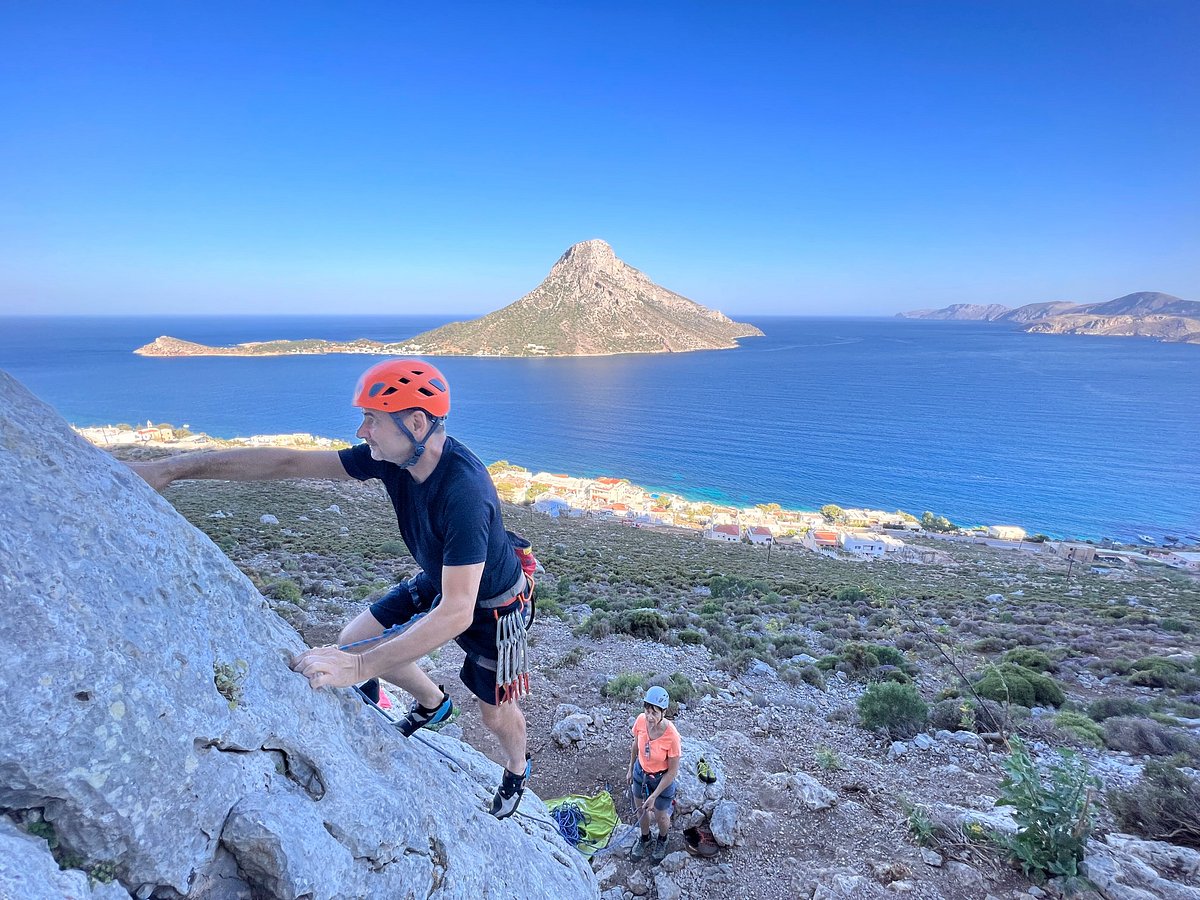
Kalymnos is a favourite with climbers thanks to challenging climbs in the most picturesque locations. Rock formations are excellent quality.
Climbing took off on Kalymnos in 1997 and new crags and routes are being tested every year. The best of the climbing is concentrated around Massouri with some high quality routes with some spectacular climbs.
As well as around 200 single-pitch routes (5/2000), there are many cliffs of 10 to 200 metres offering new routes. The climbing is always varied with overhangs and roofs with holes and demanding stalagmites.
You can generally climb on Kalymnos all year round and you get pleasant sea breezes to keep cool in summer. Most pitches are west or southwest and get morning shade.
All tourist facilities - hotels, restaurants - are open until mid-October. Approaches to the various sectors climbs average 20 to 30 minutes. For more details on rock climbing on Kalymnos see www.rockfax.com/

Pserimos
PSERIMOS is a small island about half way between Kos and Kalymnos. It would be an idyllic place but for the day trippers that descend in droves throughout the season. A few lucky visitors can find rooms to stay but not many as there are a mere 30 or so houses.
The main beach on the island is at Avlakia, a lovely stretch of golden sand, quickly covered in sunbedded bodies. Day trippers arrive like locusts and snap up all available sunbeds.
They also pack the tavernas and generally make a noisy addition to what would otherwise be a peaceful islet. Even the ferries have been known to queue to tie up to the small quay.
Those boats that can't find a berth head off to neighbouring PLATYS which has a similar, but smaller, sandy beach and far fewer trippers.
There are a couple of other beaches, not as attractive but much quieter. One is at Vathy in the north, reached with a 30min walk along a well marked path to a cove of sand and pebbles. Another is at Marathounda to the west, a 45min walk to a pebble cove. The island is so small that nowhere is more than an hour's walk in any direction.
Day trippers make up almost all the visitors as there is so little accommodation on the islet. There are rooms to be had above the tavernas and one small store which gets stocked up by the daily boat that leaves Pothia on Kalymnos around 9am each day.
Nearly all the other boats that pull in are on daily cruises between Kos and Kalymnos with a stop here and at Platys.
Kalymnos belongs to the Dodecanese chain and is located off the Turkish coast near Bodrum, between Kos, about 12 km south and Leros only 2 km north. It has population of about 16,500, making it the third most populated island of the Dodecanese after Kos and Rhodes. Including several uninhabited islets it has a total land area of 134.544 sq km.
The island is roughly rectangular in shape, with a length of 21 km and a width of 13 km, and covers an area of 109 kmē. Kalymnos is mainly mountainous with three main chains running northwest to southeast. The coastline is irregular, with many sheltered coves. The soil is mostly barren limestone with two fertile valleys at Vathi and Pothia, where olives, oranges and vines grow.
Kalymnos was once the capital of the Greek sponge fishing industry, its diver noted for their skill in diving to great depths. But a mystery disease wiped out most of the sponge beds in 1986. Warehouses still process sponges but almost all are now imported though Kalymnos is experimenting with establishing new sponge beds around the coast. There's still a small fleet which sets out at Easter for remaining beds around Cyprus and Italy, returning in the summer with the catch.
Cheap flights to Kos from European airports
Details in most European languages and currencies
The nearest international airport for Kalymnos is on Kos, which has a regular scheduled service by Olympic Airlines and is also served by summer charters and some low-cost airlines during the summer months.
Kos International Airport (KGS) is 26km west of Kos Town. It is also known as Hippocrates Airport or Kos Ippokratis and has the usual facilities including aircon.
International charters push up passenger numbers to more than 2m annually and the airport open 24 hours a day over the summer months to cope with the traffic.
There is no public transport direct from the airport and most passengers take package tour shuttle buses, hotel minibuses or taxis. Public transport is available on the large roundabout outside the airport gates with a KTEL service to Kos Town and services to the ferry port at Mastichari. There is parking for about 200 cars.
Kalymnos has its own new airport for domestic flights since 2006. The airport is located at Argos a few kilometres from Pothia. Olympic Airlines has scheduled service daily from Athens International airport. Airsea Lines also flies a schedule seaplane service from Lavrio Port, a few kilometres west of Athens, to Kalymnos.
Olympic Airways operate the only scheduled flights out of Kos, these to Athens (three daily flights) and Rhodes (about three a week).
Kalymnos is on the main Dodecanese ferry route for long and middle-distance traffic so trips to nearby islands like Kos, Leros, Patmos and Samos are not a problem. Get tickets from travel agencies lining the port or the cafe on the main harbour jetty itself. There's a regular daily ferry to Pserimos leaving at 9.30am and returning at 4pm at the eastern end of the harbour and cruise caiques offer various days out - check the travel agencies.
Two ferry firms operate a joint service from Piraeus, near Athens. GA Ferries has sailings on Monday, Wednesday and Friday while Blue Star operates Tuesday, Thursday and Saturday. These ferries usually leave 5-6pm and arrive at 8am the following day. They both operate a Sunday service, one at 8am and another sailing at 3pm.
There are regular sailings to Chalki, Chios, Kos, Leros, Lesvos, Lipsi, Naxos, Paros, Patmos, Samos, Rhodes and Tinos as well as some of the smaller islands.
The two main roads on Kalymnos run along the south coast through Pothia and northwest from Pothia to the west coast resorts. There is another road that runs northwest up the valley from Vathi to the village of Stimenia. Steep bends, unfenced cliffs, potholes and loose gravel make driving difficult. Roads can narrow suddenly and hidden hazards unsigned. The streets of Pothia were resurfaced in 2005 after years of neglect but expect Greek drivers to ignore one-way signs and mopeds to fly just about anywhere. Taxis cruise the main route from Pothia to Massouri and can be flagged down easily though they can suddenly disappear around 11pm when the last ferries have pulled in from Telendos. Buses are cheap and punctual, though not very frequent, and you must get a ticket before you board from the local supermarket or kiosk.
The rugged limestone landscape makes Kalymnos ideal for walkers and rock climbers. Local buses will get you to most resorts for walks. In spring the mountainsides are swathed in thyme and oregano, not only making for pleasant aromatic walks but providing food for the island's bees and flavour for the delicious honey. There is a paved donkey track that leads from Pothia to Vathi that is considered one of the best walks in Greece.
Marengo Books have several excellent walking guides and walking maps of Kalymnos and other islands.
| JAN | FEB | MAR | APR | MAY | JUN | JUL | AUG | SEP | OCT | NOV | DEC | |
| 14 | 14 | 16 | 20 | 24 | 29 | 32 | 31 | 28 | 24 | 19 | 16 | Day avg °C |
| 8 | 8 | 9 | 12 | 15 | 19 | 22 | 22 | 19 | 16 | 12 | 10 | Night avg °C |
| 5 | 6 | 7 | 9 | 11 | 13 | 14 | 13 | 11 | 8 | 6 | 5 | Sun (hrs) |
| 2 | 3 | 5 | 6 | 8 | 10 | 10 | 9 | 7 | 5 | 3 | 2 | UV Index |
| 166 | 111 | 74 | 34 | 19 | 6 | 1 | 3 | 16 | 59 | 89 | 159 | Rain (mm) |
| 12 | 10 | 9 | 7 | 5 | 3 | 0 | 1 | 3 | 6 | 8 | 13 | Rainy days |
Kalymnos has a pleasant Mediterranean climate with dry summers with high temperatures. At the height of the summer season temperatures can soar upwards of 30°C, with average highs peaking at 32°C. Prevailing northerly winds start in June and strengthen until September helping to keep it feeling cooler. Gusty winds also help keep humidity down with fresh beach breezes. Spring and autumn sees mild days with 7-8 hours of sunshine, with showers quite common during April and May. Heavy rains can be expected in winter months.
The beautiful Greek Islands are renowned for their spectacular scenery, magnificent mountainous backdrops, stunning sandy beaches and crystal clear waters. Holidays to the Greek Islands are often most cherished for this combination of sunshine, warm waters and beaches set against truly wonderful scenery. Whether it is a traditional beach holiday you would like or something with a little more history, you'll find that a break away to the Greek Islands is just the answer!
Airport Parking
Savings of up to 60% on gate prices at most top airports. Book online with Airparks for airport parking and airport hotel deals
Car Rentals
A leader in car rental services for more than 50 years Auto Europe has over 7,000 locations worldwide and a low price guarantee
Travel Insurance
Buy online at Endsleigh and save 10% on the standard travel insurance rate. Single and multi-trip, backpacker, gap year and more
Travel Gear
Extensive range of luggage, bags, accessories, holdalls, travel gadgets and more. Tasteful travel gear direct from stock
Holiday Taxis
Arrange any type of airport transfer for any party size with Holiday Taxis. Private taxis, minibus and low cost shuttle transfers