Leros Greece | holiday travel guides to the Greek islands

Print Leros
You are here: Home » Leros
Leros island GreeceLeros holidays GreeceLeros Greece

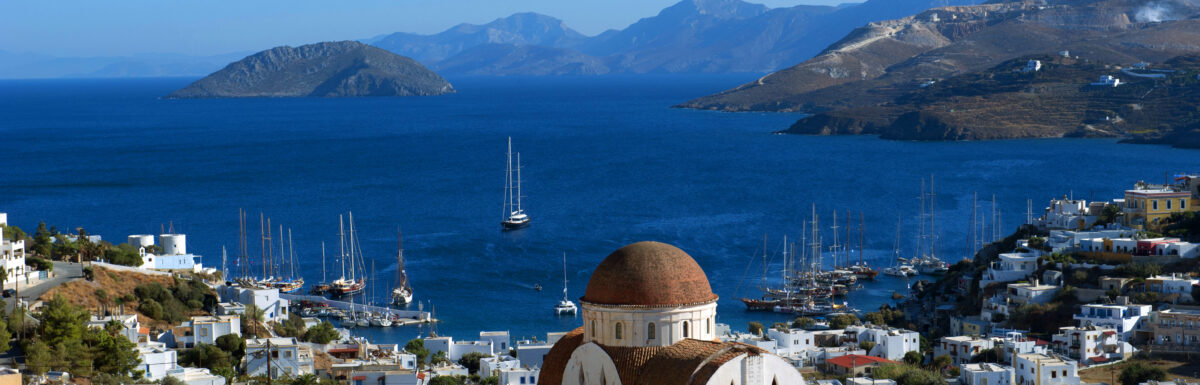
An Italian naval base for 30 years and once home to a notorious mental asylum, later a penal colony, the island of LEROS Greece has been a late emerger on the Greek island holiday scene.
But Leros has been making up for lost ground and is now one of the more sought out upmarket destinations among the Greek islands, and growing in popularity each year.
Leros is located among the north Dodecanese group, just off the Turkish coast between Kos in the south and Samos in the north. Both these bigger and more popular neighbours provide airports where tourists can fly in to pick up the daily ferries.
Leros has a long coastline with deeply indented bays. None contain any beaches of note but what sands there are do have that tranquil, picturesque charm that has vanished from many Greek island resorts over the years.

Leros island holiday What Leros lacks in sandy beaches it more than makes up for in charm. Cappuccino may have replaced Greek coffee in the pavement cafes but craft shops and bakeries still prevail over trinket stalls and fast food takeaways in the narrow streets.

Leros holidays The picturesque port of Agia Marina and the beach strip of Alinda to the north are the main tourist haunts, but there is still much to discover on this small and attractive island.

Leros holiday beaches Leros is a popular stopping off point for island hoppers as it is on the main ferry route between Rhodes and the Greek mainland, with the islands of Kalymnos, Patmos and Lipsi nearby.

Leros holiday A strategically important island in World War II, Leros suffered heavy bombing by both British and Germans and many relics of the wartime years can be found dotted about the island.

Leros map Greece 
Thomson Greek holidays
   
Cyprus  holidays

Leros overview

Leros has been slow in cashing in on the tourist market. Its occupation by the Italians, the heavy bombing in the last war and a scandal over an island mental asylum haven't helped. A general lack of good beaches and stiff competition from its better known neighbours has kept it off the tourist trail for some time. It is now emerging though as one of the more 'traditional' Greek islands as more discerning travellers have sought it out.

Its position on the main Dodecanese ferry route make it relatively easy to reach and the proximity of other islands make it an ideal island hopping destination too. Good beaches can be found, the landscape is as delightful as any Greek island and the people as friendly. Cafes have mushroomed and new apartments built as more have discovered its delight. But the growth is low key, as Leros begins to make its mark.

 
Leros bus Buses
Leros boats Boat hire
Leros car hire Car and bike hire
Leros ATM cash Cash point
Leros ferries Ferry port
Greek holidays
 

Agia Marina Leros
Agia Marina windmill

Agia Marina Leros
Agia Marina quayside

Agia Marina Leros

The port of AGIA MARINA is one of two large harbours on Leros (the other is at Lakki) and the main tourist centre on the island and the port of call for most ferries, catamarans and excursion boats.

Cafes line the quayside which eventually leads to a narrow shingle beach. The beach is a miserable, scruffy affair, no more than a thin line of sharp sand littered with debris and backed by a dull line of plain houses and bare concrete wall.

By way of compensation there are sweeping views across the bay and, at the northern end, squats an attractive and much photographed windmill that sits at the end of a small causeway.

A warren of whitewashed back streets, though pleasant to look at, is marred by the seemingly endless stream of traffic that squeezes through alleys and makes crossing roads a head spinning pain and driving through them a major test of nerve.

Cafes have turned upmarket in recent years, with hard cane chairs abandoned for soft cushioned settees and internet access a much touted addition to the menus.

Cappuccinos and iced tea are not particularly Greek but the atmosphere is, and the charm of colourful boats bobbing in the harbour a few feet away and fishing nets sprawled across the quay is hard to beat.

The whitewashed homes of Agia Marina sprawl up the hillside to merge with Platanos behind, while the impressive Byzantine castle stand aloof on the barren skyline of Apityki, visible from virtually everywhere on Leros.


Leros south

Leros is a jigsaw shape of an island that divides rather neatly into north and south at the islands capital port of Agia Marina/Platanos. There is not much to choose between them though the south is slightly more mountainous with a large bay gouged out at Lakki. Both parts of the island are thinly populated with only one or two villages and in the southern half of the island both east and west coastlines are barren cliffs and rock with little or no road access. Large quarry works on the eastern hillside at Vathia Lagadia are plainly visible.

 
Leros bus Buses
Leros car hire Car and bike hire
Leros cash Cash point
Leros laundry Laundry

Leros Platanos
Fort above Platanos

Platanos church
Platanos church

Platanos Leros

Spreading south from Agia Marina, and now virtually indistinguishable from it, is the island's commercial capital of PLATANOS.

A chaotic spread of whitewashed houses stagger up the hillside between two barren mountains, flanking a narrow, busy main road that seems designed more for donkeys than the cars, lorries and bikes that seem to stream endlessly along it.

It's a steep, exhausting and dangerous walk up the hill with no paths in places - you are better off in a taxi. Attractive houses line the main road and the even narrower alleys that branch off left and right.

Platanos houses the island council and library and there are plenty of shops, cafes and supermarkets. The area was extensively bombed by the British in World War Two but much has survived or been restored. At the top of the hill is the main square which holds one of the biggest markets on Leros.

The Venetian castle dominates, and you can drive up to it or walk, though the climb involves trudging up about 300 steps. There are tremendous views of the whole island and the beautiful 10th century Church of Our Lady stands inside the castle and has a small religious museum.

There is also an Archeological Museum on the main road to Agia Marina, housed in the renovated building of the old Astiki Sholi built in 1882.


Pandelli Leros
Pandeli beach

Panteli Leros
Pandeli windmills

Panteli Leros

Below Platanos - and as much a part of it as Agia Maria is on the other side of the hill - sits the small seaside resort of PANTELI or PANDELI. The road drops steeply down to the beach where there is limited parking.

Cafes and tavernas embrace a small but attractive strip of sand and shingle at the end of a deep bay. The best of the sand is in the middle of the beach where a couple of tavernas encroach onto the shore.

There are tamarisk trees behind for natural shade and a small harbour at one end is usually packed with fishing boats and yachts.

There are no sunbeds or umbrellas on the beach so you are stuck for shade if all the best spots are taken. The sea is shallow with a few stones that give way to sand further out.

A pleasant cafe lines the southern headland and a newly paved walk beyond it leads to views over the nearby long beach at Vromolithos, though getting down to it can be tricky from here as the path runs out on the edge of a steep cliff.

Back in Panteli houses climb the hill behind and both the castle and a line of six ancient windmills sit on the skyline. There are some clubs and a disco for those who enjoy nightlife, though nothing too wild or noisy. On the way into the village a sign points to the winding road to the castle.

Panteli is a pleasant, mild seaside resort and makes for a good base Leros, with plenty of places to eat and easy access to Platanos and Agia Marina.


Leros Bromolithos
Vromolithos

Vromolithos Leros

Vromolithos Leros

Around the headland from Panteli and down a hill off the Platanos road is a long beach at VROMOLITHOS or BROMOLITHOS.

Often touted as one of the best beaches on the island it turns out to be only the biggest. There is shingle and coarse sand and a couple of tavernas - the one at the northern end providing a few sunbeds.

Coarse sand at each end of the beach turns to shingle and stone in the middle and it's a pleasant enough spot with dense vegetation all around and trees on the beach to provide shade. The straight beach runs the length of a large open bay.

The biggest problem is the large slabs of rock that lie just under the surface of the sea along the whole length of the beach. The slabs are large, flat and extend well offshore, many of them with deep crevices between them and a slippery seaweed coating on top.

The slabs are extensive enough to make swimming a problem unless you are prepared to venture some way offshore.

Apartments dot the low hill behind and there are shops, minimarkets and cafes within easy walking distance. There is plenty of good parking near the Taverna Paradisos.

The resort is also close to both Platanos and Panteli so there is plenty of variety for those basing a holiday here.

   
Leros bus Buses
Leros car hire Car and bike hire
Leros boat hire Boat hire
Leros ATM cash Cash point

Lakki Leros
Lakki promenade

Lakki Leros
Lakki marina

Lakki Leros

The large bay at LAKKI is one of the biggest and deepest natural harbour in the Mediterranean and one of the dullest too.

Occupied by the Italians for 30 years before the end of the last world war, Mussolini had the loopy idea of turning it into an Italian flagship city for his Greek island empire.

They created the grandiose town of Portolago, now called Lakki, and erected wide, boulevard streets, impressive parks and bombastic buildings in a strange blend of Art Deco and Bauhaus dubbed 'Rationalism' by the showy Fascist regime.

Though individual buildings are of some architectural interest, the overall impression is of an empty car park with as much character as a garage forecourt.

Nowhere is the bizarre grandeur more monumentally in evidence than at the old cinema, currently being with EU grants after being heavily bombed in Word War Two.

A long promenade, wide enough and long enough to host a military parade, runs the length of the shore and sports eucalyptus trees and ornate lampposts, ending in a large yacht marina to the west.

In 2005, the Leros War Museum was opened in Merkia, near Lakki inside an old tunnel created by the Italians in World War Two. There are several items from the battle of Leros including guns, helmets, bombs, uniforms and photos.

There are a couple of small beaches around the bay at KOULOUKI and MERIKIES but they are rather stony and have no facilities, thought they are popular with locals and easily reached from Lakki. A couple of tavernas provide the basics.

Also near Lakki is the temple of Agios Iiannis Theologos, which dates from 1000 and is one of the island's more noteworthy churches with some astonishingly good 11th century mosaics.

 
Leros bus Buses
Leros camping Camping
Leros diving Diving

Xhirokambos Leros
Xirokambos beach

Leros Xirokambos

Xirokampos Leros

Located in the extreme south of the island XIROKAMPOS or XIROKAMBOS or KSIROKAMPOS is an old seaside village located in a small inlet.

It's only about 4km from Lakki and well signposted but the beach road is not easy to spot and if you miss the turning you head up into the hills to a huge quarry where you will be sharing the narrow and unfenced road with giant lorries.

The village, though tiny, has a large and incongruous football stadium. It sits in a valley of olive groves, with almond and cypress trees spread along the valley in good numbers. There are plenty of rooms to rent in the area and there is a campsite based here.

Above the village is an ancient castle, Paliokastro, which was built on the site of an even older Acropolis, itself thought to date from around 2,500BC.

The beach is coarse sand with a few trees and bisected by a small jetty from which local schoolchildren like to dive. For the more adventurous there is also a diving school based here.

There are shady tavernas behind the beach and out to sea the tiny Glironisa islands out to sea and beyond them, only about 2km away at the nearest point, the northern tip of Kalymnos.


Leros north

North of the capital port at Agia Marina is the main tourist strip of Alinda with a single road leading north to the island's small airstrip and Partheni, a military training ground to the west and mountains to the east.


Leros bus Buses
Leros car hire Car and bike hire
Leros boat hire Boat hire

Leros Alinta
Alinda beach

Leros Alinda

Alinda Leros

The main beach strip of Leros, if you can call it that, lies just north around the bay from Agia Marina at ALINTA or ALINDA.

The beach is not particularly impressive, just a long string of shingle and sand that peters out into a rocky area where improvised wooden jetties stick out from the shore like fingers to provide anchorage for small boats.

But tavernas and apartments have sprung up along the road that runs along the back of the beach and chairs and tables are placed along the shore at intervals for those who enjoy a romantic meal with waves lapping at their feet.

Long lines of tamarisk give plenty of natural shade and taverna owners sometimes put out a few sunbeds where they can, but the beach is often so narrow there is barely room.

The main road at the back of the beach can hardly be said to be busy and cars park along most of its length. A small wall separates it from the sands. There are good views across the Agia Marina.

For those that like their sunbathing spots a little more isolated there is a small crescent beach of shingle and sand at a sharp bend in the road at KRITUONI to the south, with a small roadside cafe nearby, and there are more quite, sand and rock coves to the north within a short walking distance and before you reach Panagia, though they have no facilities and little shade.

Inland is the Mpeleni Tower, a renovated mansion house that houses the island Folklore and History Museum. In August its large courtyard hosts several cultural events.


Leros Panagia
Panagia beach

Leros Panagia

Panagia Leros

Two tavernas sit above the coarse sand beach at PANAGIA where the road around the bay from Alinda eventually runs out. This is a very pleasant spot with cliffs at one end, a swathe of fine sand and clear, shallow waters and an outcrop of rocks to add interest.

Taverna owners lay out sunbeds on the sand that are known locally as DIO LISKARIA and you can always climb the short steps to the tavernas themselves, that both overlook the beach, if you fancy a meal or refreshment. There is plenty of parking in a large concrete area, and the road to Panagia is good, with lighting at night.

Strange that this small and very attractive beach rarely gets a mention in the island brochures and guidebooks when the sands are one of the best on the island, it has all the tourist facilities you need and there are very fine views across the bay to Agia Marina, nestling between two mountains.

Locals however will point to the blue roof across the bay (one of the tavernas has roof tiles of pale blue) and suggest a visit. It is easily walkable at no more than 2km from Alinda.

Another small beach can be found at KRIFO of KRIFOS further around the headland and there is a rough track that gets you about half way before it dwindles to a footpath. There are no facilities


Leros Gourna
Gourna beach

Leros Agios Isodoros
Agios Isodoros

Gourna Leros

West of Alinda and set in a large bay on the west coast of Leros is the small resort of GOURNA. The wide bay is home to two beaches, at Gourna and a little way south at DRIMONAS, both disappointingly drab and uninspiring.

Gourna has a wide and long swathe of dirty coloured sand with a clutch of tamarisks at the far end of the beach. Banks of dry seaweed line the shore and rubbish litters the unkempt beach. The scene when I visited wasn't enhanced by a rusting upturned pick-up truck in the field behind and some abandoned sunbeds dumped in the trees.

The beach to the south at Drimonas is marred by great mounds of black seaweed that cover the narrow stretch sand to a depth of half a metre. Stunted tamarisks stand like broken teeth along the road that runs behind.

There are a few houses scattered on the relatively flat, open countryside behind and the odd taverna along the coast road, but not much else except groves of citrus and olive.

On the north side of the bay, and approached through the inland village of Kamara, is a tiny shingle beach at AGIOS ISODOROS with a beautiful white chapel spectacularly perched on an offshore rock and connected to the shore by a long stone causeway.

   
Leros bus Buses

Leros Partheni
Cove at Partheni

Partheni Leros
Plane takes off over Partheni Bay

Partheni Leros

The main road heads north is a straight line past the island airport and through a Greek military base to the north coast fishing port of PARTHENI, set at the end of a long, deep bay with the island of Archangelos at its mouth.

There are no beaches here as such, though small scraps of sand can be found in coves dotted along the shore west of the village. There is a large boat repairing company here and various semi-industrial sites, with the airport taking a up large chunk of land, as does the large Greek military base.

Tracks lead west into the hills and around the coast for those that enjoy hill walking in the mountains of Kasteli, Markelos and Tourloti, though the coastal path unfortunately leads to a military area and warning signs to keep out.

If you follow the tracks south you will find a small, stony beach at LIA. Nearby is the 10th century church of Agios Georgios built with stone from an ancient temple to Artemis.

The area around Partheni is notorious for the mental asylum once sited here and closed in 1999, where seriously ill patients were kept in shocking conditions.

To the north of the village is small inlet of Agios Kioura where the church has wall paintings by political prisoners held in the same asylum during the US-backed Junta's control of Greece from 1967 to 1974.


Leros Plefouti
Plefouti

Leros Plefouti

Plefouti Leros

A jewel in the crown of Leros beaches, PLEFOUTI or BLEFOUTI lies to the east of Partheni over the headland and down to a long and peaceful bay fringed with a beach of coarse sand.

At the western end, at the bottom of the hill, are several small jetties providing anchorage for fishing boats and yachts with a pleasant and shady taverna set back among the trees.

There are no sunbeds on the long and narrow beach, but tamarisks every few yards provide plenty of natural shade. The sea is stony underfoot for a few meters before giving way to sand. It is shallow and clear with views out to the uninhabited islets of Strogili and Tripyti offshore in the bay.

There are low hills behind the beach with fields of wheat, olive and citrus orchards, a small white chapel and the odd home here and there among the trees.

A long road runs down the back of the beach to the eastern end, where the shoreline slowly gives way to rocky coves and, in one of the coves a relic from the last war - a machine gun post with the gun holster still pointing out to sea.

The road eventually gives out and a rough track curves up to the headland and then follows the coast for several kilometres until it reaches a small stony cove at VAGIA, which would be a pleasant spot but for the rubbish that always seem to gather on remote northern beaches in Greece.


Leros island notes

Leros festivals

Leros is known for its many annual festivals and it is a joy for visitors to be on the island to see them. Dancing, eating and drinking are usually connected with some religious celebrations. The main festivals are:

ALONARI: This takes place at Gourna beach at the end of July. It's a harvest festival with dancing on a reconstructed threshing floor with a party afterwards that includes free wine for all.

VIRGIN MARY: This is held at the castle above Platanos on August 15. Many locals climb the steps to the castle to light candles. There is a funeral procession in the evening and celebrations afterwards.

TRATA: This is held at Panteli in early September to celebrate island fishing. Nets are hauled in from the beach in the evening and the catch grilled and, along with wine, handed out free to visitors to dancing and music.


Leros war cemetery
Leros war cemetery

Battle of Leros

Lakki's deep water port made Leros a strategic target in World War Two and the island suffered repeated bombing by both British and German forces in World War Two. Indeed it is thought that only Crete was hit by more bombing raids. Empty shells and other war ephemera can still be found on the island.

Leros had been under Italian occupation and turned into a heavily fortified military base. After the fall of Greece in April 1941 and the Allied loss of Crete in May, Greece and its islands were occupied by German and Italian forces.

With the surrender of Italy in September 1943, Leros was occupied by the British. The Battle of Leros began in October with German air attacks followed by troop landings in November and its capture four days later. It was considered by some to be the last great defeat of the British Army in World War Two and one of the last German victories.

Reminders of the war lie all over Leros, particularly in the hills between Platanos and Gourna. At Vigla is the former 306th battery, an impressive fortified position with entrance tunnels, and at Rahi the 211th battery is still visible.

At Marcello in the northwest, is the Farinata battery and a well preserved lookout post. At Partheni there are many buildings now occupied by the Greek army but at nearby Plefouti is the remains of 888th battery and opposite the islet of Strogili is a sunken German landing craft.

The British War Cemetery is near Agia Marina has 183 graves, though the identities of many were lost during the German occupation.


Leros asylum
These photographs were taken by
Nikos Panayotopoulos at the
Leros asylum in 1982

Leros asylum

Leros mental asylum

The so called "psychiatric hospital" of Leros was founded in 1959 to hold psychiatric patients from mental health institutions across Greece who were considered "untreatable". Leros was chosen because it had many empty buildings left over after the Italian occupation which had ended in the Second World War.

The asylum grew rapidly as "difficult" and problematic patients were shipped to Leros and by the 1980s as many as 4,000 patients were held there. But in September 1989 the Observer newspaper in Britain published details of horrific conditions at the Leros asylum, describing it a "concentration camp". A barrage of protest followed when the asylum was closed to press and independent organisations and stories circulated about conditions there.

In March 1990 the BBC secretly filmed inside the asylum and the documentary showed naked patients, barbed wire, and guards with sticks. Eyewitness reports later that year alleged two doctors for the 1,153 inmates and reported every wall stained with blood and excrement. Patients had few mattresses and no bed sheets. Reports claimed the most "difficult" patients were placed in a compound surrounded by a 2m high wall with no door into it. Food and water was dropped in from above.

In 1969, during rule by the Greek junta, political prisoners had also been incarcerated there, living in the same conditions. The asylum was closed in 1997 and patients were integrated back into their communities. The former asylum is now part of a Greek military camp.

There were many who described Leros as a "ghastly aberration" of Greek psychiatry and society by alarmists while others claimed it was, at the time, representative of Greece's inpatient care services for the mentally ill and a savage indictment of broader mental health care attitudes in Greek society.


Leros island map

Leros map

Leros is one of the Dodecanese islands located between Patmos and Kalymnos. Oblong in shape with many gulfs and coves it resembles an upside down letter 'f', and is surrounded many small and uninhabited islets. It has an area of around 53sq km, with a length of 15km and 1.5km at its narrowest point. The coastline is about 46km. Leros has a population of about 9,000, most of them living in the region between Agia Marina, Platanos and Lakki. The largest part of the island is relatively flat (Leros is Greek for 'smooth', with plains reaching down to the sea. The highest mountain is Kleidi above Alinda. Other mountains are Apitiki above Platanos, Tsigounas, Diapori and Skoumbarda in the south and Merovigli over Spilia. Leros also has many freshwater springs. Leros is noted for it many deep, protected harbours - notably Lakki to the southeast, one of the largest natural harbours in the Mediterranean, and Agia Marina to the northeast.


Leros island - getting there

Leros flights

Cheap flights to Samos from European airports.
Details in most European languages and currencies.

There are no charter flights to Leros and visitors usually fly to Athens, Samos or Kos and catch a ferry to Leros. There are flights to Partheni airport on Leros from Athens Airport with Olympic Airways. These are usually on Mondays, Thursdays and Saturdays. There are also flights to Rhodes, but it is best to check with the airport. It's worth noting that the runway at Panteli is very short and not for the faint-hearted.
Olympic Airlines and EasyJet offer scheduled services to Athens, useful for travelling out of season. There are charter flights from the UK to Kos with early morning departures, so you have the chance of a same day ferry connection to Leros.
Catamaran and hydrofoil services leave from Kos Town but there is also the possibility of a local ferry to Kalymnos from the port at Mastichari, which is close to Kos airport, and a fast ferry connection from there. If you cannot make a same day connection you will have no problem picking up an overnight room on Kos.

Leros ferries

Greek ferry tickets
Book tickets online

Leros has daily ferry connections from Piraeus (Athens).Ferry Boats usually leave Piraeus around 2pm. Leros is also on the main Dodecanese islands ferry route and there are connections daily from Rhodes, Kos, Kalymnos, Lipsi, Patmos, Nisyros and Symi. These include car ferries,hydrofoils and catamarans.
The catamarans Dodekanisos Express and Dodekanisos Pride run daily services through Leros to all the main Dodecanese islands.
Leros is near many small islands and islets in this part of the Dodecanese and in high summer there are daily excursions to islands such as Lipsi, Patmos, Marathi, Arki, Aspronisia and others. The Barabarossa offers daily excursions from Agia Marina at 11am and returning at 7pm.

Leros roads

Roads on Leros are generally good, though very narrow, even through the busier areas of Agia Marina and Platanos. The main bus station is in Platanos and serves Agia Marina, Krithoni, Alinta, Kamara, Partheni, Platanos, Lakki and Xirokampos. Taxis are found in al the main villages, notably around the ports when ferries are due. The main taxi station is in Platanos. You can also call for a taxi in Platanos area on 23070/24970 or the Lakki area on 22550


Leros island weather

JAN FEB MAR APR MAY JUN JUL AUG SEP OCT NOV DEC  
12 13 15 29 24 29 31 31 28 22 18 14 Avg day °C
5 6 7 10 13 17 20 20 17 13 10 17 Avg night °C
5 6 7 9 11 12 14 13 11 8 6 5 Sun (hrs)
2 3 5 6 8 9 10 9 7 5 3 2 UV Index
159 108 88 42 28 6 1 1 16 42 103 167 Av rain(mm)
12 10 9 7 5 3 1 1 3 6 8 13 Rainy days

UV: 3 Low; 3-5 Moderate; 5-8 High; 8 Very high | Rainy days=1mm+ | 1 inch=25.4mm

Average winter temperatures in Leros are comfortable at 14°C with plenty of rain, generally falling for 10-12 days of the month. In spring the temperatures rise significantly to 24°C by May with rainfall dropping back to five days in the months. June sees a steep rise in temperatures to an average 29°C and very little rain and the main summer season of clear days and hot sunshine until September. October and November days can still be warm and sunny with only six to eight days of rain in the month but December sees a big rise in heavy rainfall, though temperatures are not uncomfortable at 14°C.


Leros island facts

Greek island holidays

The beautiful Greek Islands are renowned for their spectacular scenery, magnificent mountainous backdrops, stunning sandy beaches and crystal clear waters. Holidays to the Greek Islands are often most cherished for this combination of sunshine, warm waters and beaches set against truly wonderful scenery. Whether it is a traditional beach holiday you would like or something with a little more history, you'll find that a break away to the Greek Islands is just the answer!


Camping at Xirokampos, Tel: 22470 23372

Useful travel links


Leros island websites

A personal pick of websites on Leros