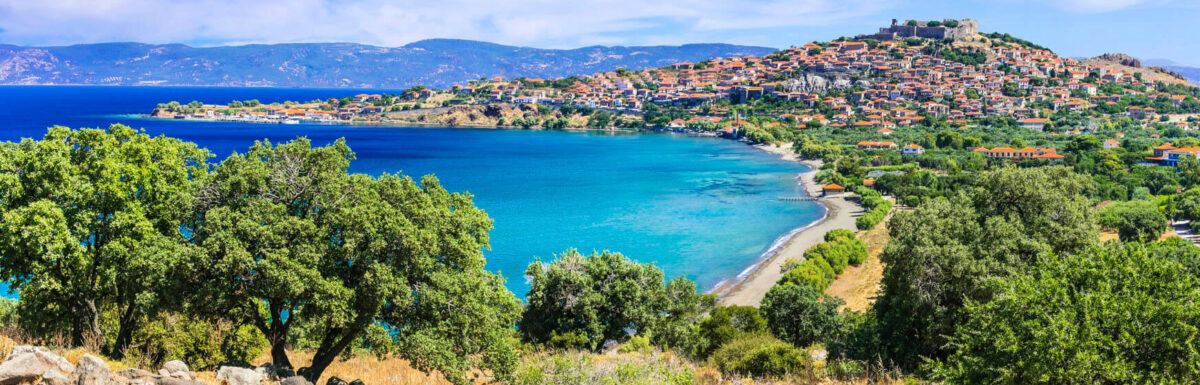

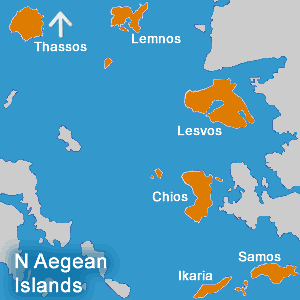
LESVOS or LESBOS lies among the north-eastern Aegean islands and close to the Turkish mainland. Lesvos is relatively isolated from other Greek islands with the nearest of any note, Chios to the south and Limnos to the north, both some distance away.
Big and beautiful, Lesvos is the third largest Greek island after Crete and Evia and has, in parts at least, had its arms stretched wide to embrace the package tourist market. It also has its own airport and regular charter flights, so doesn't have to rely on ferries to bring in the business.
Tourism is evident on Lesvos but does not dominate. As yet, olive oil and ouzo are still the most important commodities for the local economy. The islanders also have a strong and proud identity, marked by long cultural traditions.
For the visitor, the attractions of Lesvos may not be as many, nor the landscape as lovely, as some other Greek islands but Lesvos is quietly impressive, especially for those who like to experience the more provincial side of Greek life. The specific tourist attractions of Lesvos are its impressively varied landscape, the quaint hill villages and some splendid beaches.
It being such a large island, Lesvos demands both time and transport for a full appreciation. Resorts are scattered widely and some overland road links can be bad enough to trouble a car's suspension
While little on Lesvos stands out, this eclectic island has hidden treasures. There are wonderful beaches, fascinating villages and interesting towns, although it requires journeys past endless tracts of olive groves to savour some of them.
The huge variety of flora and fauna on Lesvos is a magnet for botanists and for bird watchers, especially in the spring and during migration seasons when many birds rest in the Lesvos wetlands.
Many visitors to Lesvos come for a dip in one of the many healing hot water springs that are found at several resorts across the island.

Mytilene waterfront

Mytilene statue
MYTILINI or Mytilene is the island capital and a big, messy and noisy port of some 30,000 people (a third of the island's total population).
Mytilini has its grim side, notably in the industrial area which is dominated by the tall, belching chimneys of the olive oil refineries. The waterfront, although noisy and crowded, is still very pleasant with a double harbour separated by a castle-topped headland.
The southern harbour of Mytilini takes the tourist ferry traffic while the northern shows signs of a clean-up after years of neglect. Mytilini's main attractions remain its castle and a wealth of good museums. The castle, founded in the 6th century and rebuilt by the Genoese in the late 14th, also has the remains of a Roman cistern and some Turkish prison cells.
Entrance charges are moderate for a glimpse of some fine Roman sculptures and mosaics plus a nice display of jewellery. Summer concerts are popular and picnic tables perch in the pines.
Museums in Mytilini are plentiful and impressive. On the waterfront, the old harbourmaster's house now hosts the Museum of Traditional Arts and Crafts with its Roman reliefs and Greek mosaics. The Theophilos Museum is as delightful as it is unexpected, stuffed with paintings by folk artist Theophilos Chatzimichael.
Around 4km south, through dreary Mytilini suburbs, are the Teriade Library and a Museum of Modern Art that boasts illustrations by better-known artists such as Picasso, Matisse, Chagal,and Miro.
There is also a very fine collection of icons in the Byzantine Museum beneath the impressive dome of Agios Therapon. And, as if that weren't enough, there is a mock-up of a 19th century Lesvos village house and a museum of costume and embroidery.
The Mytilini waterfront is where the tourists congregate and the main shopping street, just behind, has a hectic mix of shops and stalls. Full of surprises, the city even has its own 'Statue of Liberty' erected by one of the island's emigrating sons on his return.
Mytilini boasts plenty of tavernas, and are noted for fine dishes - especially sardines. There is a small, and mediocre, man-made beach at Tsamakia that you pay to enjoy. It has showers and a cantina but gets very crowded.
Fine Mytilini public gardens can be found near the beach. To the north-east is the Hellenistic Theatre, reputed to have held 10,000 people in its heyday, but now more of a home to scrub and weed. When the Roman emperor Pompeii visited he was so impressed he ordered a replica to be built in Rome.
The capital Mytilini is the only place of any size on Lesvos' long and rocky east coast. It sits in the south-east opposite the Gulf of Gera and though there is a decent road north and south it is a long haul to get anywhere. Despite the lack of resorts the countryside along this stretch of coast is some of the best on the island.

Agios Ermogenis
The coastline to the south of Mytilini passes through dreary suburbia to the airport and some uninspiring countryside beyond. The paved road ends at the village of KRATIGOS. There is a half decent beach and taverna some distance beyond at KHARAMIDA, but it is a long trek to get there.
However, 4km east on the mouth of the Gulf of Geras is the charming AGIOS ERMOGENIS with its idyllic double beaches slung either side of a chapel-topped rocky promontory and a wonderful taverna tucked into the pine clad hillside behind.
Don't expect solitude though, some days it appears as though the whole island has discovered Agios Ermogenis.
Many take the road through LOUTRA to get to Agios Ermogenis and some indulge in a thermal bath at nearby SKALA LOUTRA one of Lesvos's five thermal spas.
Others head here to catch a ferry across the GULF OF GERA to PERAMA. The gulf itself has a few tiny beaches, but nothing worth seeking out. Densely packed olive groves push right down to the seashore.

Moria viaduct Lesbos
North out of Mytilene the coast road branches inland to MORIA where there is a Roman viaduct surviving from the late 2nd century AD. It is well worth a visit, though surprisingly difficult to find.
A couple of well hidden signposts point west out of Moira village's one-way traffic system to olive groves where the viaduct can be found, remarkably intact given its great age.
The preserved section is around 170m long and includes seventeen arches that stand high above the trees. The walls were built in the "emplekton" system - two parallel rows of stone filled with rubble while the pillars are of local marble.
It once carried water from the many springs in the Agiassos region to the ancient port at Mytilini, a total distance of around 26km. The viaduct was shorn up in 1995 but apart from that has had little done to it and it remains an impressive sight.

Therma baths Lesbos
Further north are the iron-rich thermal springs of THERMA. The ancient public baths are now closed to the public but behind is a new Therma public bath house.
The Turkish tower standing next to Therma baths is impressive and there are restaurants and a small beach near the harbour. Also worth a visit is the nearby monastery of Agios Raphael.
There are sands near MISTEGNA and NEAS KIDONIOS but they are not particularly attractive. Mistegna village is a maze of alleyways and has some interesting ceramic shops.
The road runs along the coast for several kilometres north then turns inland at the resort of ASPROPOTAMOS where there is a long stony beach and not much else. It then branches to the inland village of MANTAMADOS, noted for its cheeses and fine pottery.
Aspropotamos is a large village of grey stone houses known for its 18th century pilgrimage church and the 'black icon' of the archangel Michael. The icon is reputed to have been made from blood of slaughtered monks.
On the third Sunday after Easter an ox is killed and hankies are dipped in its blood to draw crosses on the foreheads of the local children. Something for them to look forward to each Easter then.
At the nearby hamlet of KAPI is the start of a marked hiking trail that takes in some of the finest scenery on Lesvos.

Skala Sikaminias

Tsonia beach, Lesbos
The road heads north out of Madamados to the charming north coast village of SIKAMINIA with its attendant fishing hamlet of SKALA SIKAMINIAS, even more hopelessly charming.
The road runs down the steep hill to a picturesque harbour buried beneath huge plane trees and enclosed by a concrete jetty tipped by the tiny chapel of Panagia Gorgona (Mermaid Madonna) set into the rock.
The church is also known as Panagia Ton Psaradon (Madonna of the Fishermen) and has been an inspiration for writers and painters. Indeed, it takes its name from a wall painting by an anonymous folk painter which shows the Virgin with a mermaid's tail.
Taverna tables line Skala Sikaminias harbour in the shade of the trees. A more romantic setting would be pretty hard to find. Tourist boats arrive regularly from Molivos and many rent rooms in Skala Sikaminias for a two or three day stopover. The village's sunset views are renowned.
Beaches are in short supply around here, although there is a pebble strand at KAID. Further east down a 6km dirt track is a 600m swathe of pink volcanic stone at TSONIA and a summer taverna beneath the trees.
Tsonia is known locally as the 'hot beach' and boats often call in here after dropping tourists off at Skala Sikaminias. There is another even more remote beach on the southern side of the bay at LIMANI.
The huge Bay of Kalonis virtually splits the island in two and, once the east coast has been explored it leaves two large areas to the north and south. Apart from the plain of Kalonis itself, and the even bigger plain of Eressos to the west, the landscape is mostly wild and rugged mountain with few roads. An inland road follows the northern slopes of the mountain ranges overlooking a virtually uninhabited coastline. A coast road in the south turns inland before dropping down to the plain of Eressos

Molyvos castle

Molyvos street
MOLIVOS or MOLYVOS is the main holiday destination on the island of Lesvos and a spectacularly beautiful one. Solid grey stone houses are topped with red-tiled roofs and many old timbered buildings have been meticulously restored.
The market in the centre of Molyvos is shaded by lovely wisteria and full of tourist trinket shops. Steep, cobbled and traffic-free streets lead up to an imposing Genoese fortress that is romantically illuminated at night.
Below the Molyvos market is a narrow, cobbled main street, again overhung with vines and flowers and stuffed with craft shops, artists galleries and souvenir sellers. Tavernas along here have superb views over the sea so expect to pay more for a meal.
At the bottom is a very pretty Molyvos fishing harbour lined with tavernas (where you can find excellent fish dishes but again pay a premium) and a long, narrow, stony and rather mediocre beach.
The Molyvos town end of the beach is the best bit with sand underfoot in the shallows while the southern end, although less crowded, has large underwater boulders and a sea full of spiky urchins. Fortunately the mini resort that has sprung up behind the beach is much in keeping with the old Molyvos town itself.
Beautiful as it is Molyvos feels much like a tourist stage set and little in the way of authentic Greek life is to be seen. The whole place is just so tasteful it seems untrue.
The number of excursion boats and tour buses in Molyvos testifies to its attractions as a resort. Other attractions of interest include a small museum, open air cinema and a big festival of music and theatre in midsummer.

Eftalou beach, Lesbos
West of Sikaminias, along the coast road, is EFTALOU where there is a pebble and sand beach overlooked by several new hotels and served daily by buses from Molivos.
Eftalou beach is set below a cliff and fringed with trees. It is mostly round pebbles with a few sand patches here and there. There is an excellent taverna and bath house for those dipping in the nearby thermal springs.
At the newly renovated baths you can hire your own private tub or you can swim along the Eftalou shore where hot mineral water seeps through the rocks into the sea to create warm pools.
Less public parts of Eftalou beach are favoured by nudists and there are several small coves to be found by walking eastwards from Eftalou along the coast to towards Skala Sikaminias

Petra beach, Lesbos
The road heads south down the coast out of Molyvos to PETRA where there is a wide bay of fine, grey sand dominated by the prominent 18th century church of Panagia Glykofilousa which crowns a sheer rock outcrop.
Visit the church at Petra if you must but be prepared to negotiate around 120 steps to do it. At the foot of the Petra rock are a few lovely old houses set in narrow winding lanes, many with wooden balconies.
The church of Agios Nikolaos in Petra village centre is rather more interesting than the one on the rock, with some very fine 16th century frescoes.
Petra has more recently become a main target for package tour firms and this has thrown up an ugly sprawl of tourist development along the back of the long, wide beach with associated bars, discos and car rentals.
The lack of a decent sands at nearby Molivos also makes Petra the target of large numbers of day trippers. A women's co-operative runs its own taverna and offers visitors more unusual and local crafts.
Just off the road south out of Petra is the sprawling mountain village of STIPSI whose huge tavernas are the main candidates for bus loads of tourists out on 'Greek Nights'. This is also a noted hill walking and donkey trekking area, with sparkling views over the sea.

Anaxos beach, Lesbos
To the west of Petra lies the holiday resort of ANAXOS, once an empty 3km stretch of coarse sand and now a sprawling beach resort dubbed 'up and coming' in the brochures.
Despite interest from the cheaper end of the travel market, Anaxos is still a resort with character. Parasols and sunbeds clutter a smartly kept beach although the sand pitches steeply into the sea so families must keep a keen watch on young children.
Half of Anaxos beach is narrow, with just enough room for a couple of rows of sunbeds. There are snack bars nearby and a sprinkling of the usual package tourist paraphernalia such as pedaloes and watersports.
The west-facing Anaxos resort does offers some splendid sunsets over the three offshore islets and Anaxos visitors report above average food in the local tavernas.
A few kilometres further west of Anaxos is AVLAKI which has a tiny, sand beach with a couple of excellent tavernas. Other small coves can be found all along this stretch of coastline offering good opportunities to escape the crowds.

Skalochori village, Lesbos
From Anaxos the road turns inland and heads across the mountains to the west coast. High up the mountain is the village of SKALOCHORI.
Here you can take tracks down to ANCIENT ANTISSA where there are ruins of the ancient settlement, once an important outpost on Lesvos, on the promontory. Some high walls are still standing but most have been reduced to rubble, sprouting gorse and weed.
There is a secluded beach nearby and a pretty church above it and a nearby taverna. There are other small and beautiful but lonely beach coves all around the headland.
To the west is the long beach at Campo Antissa with a couple of tavernas and views right across to Turkey.

Antissa centre, Lesbos
On the hills just before you reach Antissa is the lush monastery of PERIVOLIS with a flower-filled courtyards and faded 16th century frescoes in the delightful church.
Just beyond is the mountain village of modern ANTISSA or ANDISSA where three enormous plane trees provide shade for the cafes and tavernas in the village square.
Antissa village is very quiet and many of the local houses are in need of repair. The main road bypasses the village but signs welcome visitors to Antissa village centre.
Apart from the shade and the tavernas there is not a lot to reward those that make the effort to visit Antissa, although there is the remarkable Digital Museum of Georgios Iakovidis at the nearby hill village of CHYDIRA (see Highlights). The museum pays homage to the notable Greek painter who was born in the tiny village but there are no actual paintings on show. Instead the museum is crammed with digital displays of his work.

Gavathas beach, Lesbos
There is a track north of Antissa, poorly signposted, that eventually leads to the remote and unremarkable fishing hamlet at GAVATHAS built on a peninsula.
Nearby is the long, narrow and sandy Gavathas beach with a couple of tavernas and a few small hotels. There is a small harbour at one end of the beach, backed by a few trees that offer natural shade.
The headland shelters the main Gavathas beach and there are several pebble and rock coves nearby. There is a taverna, a couple of cafes and a small chapel on the rocks above Gavathas village. Locals have made some effort to clear the weed which can be a nuisance along the shoreline.
Tracks lead west past wild beaches around the headland at KAMBOS. Lonely beaches can be found here although the going is rough, and so are the seas when the north wind gets up.

Sigri windmill, Lesbos

Faneromeni beach, Lesbos
Out of Antissa the road forks west and south. To the west is the remote seaside village of SIGRI approached down a long road over the broad coastal plain.
Sigri is a quiet fishing harbour with a fine but small Turkish fortress, built in 1757, and a narrow sheltered crescent of sand and pebble that shelves gently into the sea.
The island of NISSOPI provides shelter for the coast and anchorage for NATO warships which has resulted in restricted access to some parts of this coast.
Sigri village centre is modern and dull but the harbour area has a much more traditional feel, though some of it is obviously fake and tarted up to appeal to tourists - there is even a 'Cycladic' windmill.
But there are plenty of good tavernas in Sigri and its remoteness helps keep visitor numbers down. Sigri can be so quiet that some visitors have likened it to a ghost village and it does have that end-of-the-world feel, ideal though for those looking for a relaxed holiday.
The noted petrified forest is nearby and a new forest visitor centre has sprung up just outside Sigri village. Some of the best specimens of petrified tree trunk are to be found near here along a path to the south, well marked with yellow triangles.
Sigri village beach is good enough, though rather hemmed in by the road. The seas are shallow and a regular offshore breeze keeps sunbathers cool. It is remarkable that Sigri has not been overrun with windsurfers, as conditions in the wide bay are often ideal.
There are several isolated coves to be found north and south. FANEROMENI in the north is probably the best - a lovely arc of sand set at the mouth of a river, although the waters here are not shallow.
The best beach to the south of Sigri is at TSICHLIODA where tall grasses spring up at the end of a long valley - a haven for migrating birds.

Skala Eressos beach, Lesbos


Podaras beach, Lesbos
The main western resort on Lesvos is SKALA ERESSOS. The area has been a mecca for lesbians thanks to the ancient Greek lyric poet Sappho who penned the first verses on lesbian love in 580 BC and ran a school for girls here.
In the main, the Skala Eressos locals are relaxed about the connection though in September 2000 the Mayor of Eressos asked an island court to ban a group of British lesbians from holding a week-long party amid fears it could corrupt morals.
Nowadays Skala Eressos is even more popular with families and a firm favourite with heterosexual honeymooning couples. The reasons are pretty obvious.
Skala Eressos boasts the most beautiful and dramatic beach on the island with a vast and splendid swathe of good sand, though it shelves rather steeply into the sea.
Tamarisk shaded tavernas fringe Skala Eressos beach, many built on bamboo covered decks over the sands and specialising in remarkably inexpensive fish dishes - the gulf being famed throughout Greece for its sardines.
Despite being targeted by package tour firms Skala Eressos resort retains a cheerful charm with an attractive central square. Behind the beach, the village is modern but nicely laid out with car-free streets.
There a small and attractive harbour with its own sheltered beach and nearby, a spring-fed lake full of wildlife including storks and some very tame turtles that take food from your hand if you don't mind the occasional nip. The Skala Eressos area is a major centre for bird watching and the flat plains are ideal for biking or horse riding.
There are several beaches found to the east of Skala Eressos. CHROUSOS beach is a fine crescent of golden sand at the mouth of the Mallonta River. Further east is a pleasant sand and shingle beach at TAVARI, backed by shady tamarisk trees and with a small harbour and beachside tavernas. Tavari village has a couple of mini-markets.
A little further east is the quiet sand and shingle beach of PODARAS with a long swathe of deep sand backed by a fertile river valley with olive and citrus groves.
Inland from the resort, through lush and fertile farmland, is ERESSOS village which sits at the bottom of a wild and grand mountain gorge.
Unspoiled, with interesting old houses, tiny shops and really good tavernas some consider Eressos the best and most authentically old-Greek village on the whole island. There are ruins of a 5th century church next the archaeological museum.
A nice sandy beach with shallow waters can be found at TAVARI south of MESOTOPOS. There are a couple of cantinas and a small harbour.
When it comes down out of the hills the road mostly hugs the coastline around the western edge of Kallonis Bay but there is little of interest here apart from the wild countryside and fine views over the bay itself.
It eventually forks, with the north road leading to KALONI, KALLONI or KALONIS. Kaloni is an unremarkable, even dull, market village lying on flat farming country in more or less in the middle of the island and about 45km west of Mytilini.
Kaloni's not bad for a spot of shopping, especially for jewellery and crafts for which Kaloni is noted. Its position makes it a major intersection for buses and, if you are a touring the island, you can bank on passing through Kaloni at some time.

Skala Kallonis beach
To the south of Kalloni, about 3km, and on the edge of the Gulf of Kaloni is the beach resort of SKALA KALLONIS now a major package resort thanks to a long beach of coarse sand backed by tamarind trees.
There are plenty of tavernas, apartments and small hotels to cater for the tourists and Skala Kalloni can feel overcrowded and busy.
The sands are long and deep and the waters generally calm and shallow, making it an ideal place for children, although a prolonged stay in Skala Kalloni could prove rather dull if you yearn for more than sea, sand and a sun bed.
Sardines from the sheltered Gulf of Kaloni are prized throughout Greece and if you like them it is worth visiting Skala Kalloni tavernas near the harbour where the freshest catch of the day is served up.
In August they hold the Skala Kaloni Sardine Festival in the village square with free ouzo and sardines as well as music and dancing. There are plenty of tavernas, both in the harbour and along the beach, with some shops and a bakery in the village square.
Skala Kalloni resort's other attraction is birds. Thousands of birds descend on the river and the salt pans, rivers, reed beds and other wetland areas for the spring nesting season and even flamingos can be seen in the shallow waters edging the gulf.

Agia Paraskevi
To the north-east of Kaloni is the charming village of AGIA PARASKEVI, full of crumbling old mansions. It is know for its Bull Festival that has been celebrated for more than 200 years.
Near Agia Paraskevi village are the ruins of ancient temples dating from the 3rd century BC. There are also traces of a temple to Aphrodite at nearby MESSA. Just 11th century BC foundations and a few pillars are left, alongside the ruins of a 14th century basilica.
To the west of Kaloni is the vast monastery of IXONOS, an austere not to say grim complex founded in 1527. The church has an interesting carved wooden ceilings and archways but women are barred from it by ancient custom, not that they are missing much.
There is a small museum open to both sexes with a cornucopia of treasures from copper trays to stuffed birds.
Heading north-west takes you through the villages of FILIA and SKOUTARIS and back to the north coast.
The southern region of Lesvos is dominated by the mountain of Profitis Ilias and flanked east and west by the bays of Kallonis and Geras. Olive groves and pine forest dominate the landscape and this is one of the most beautiful parts of Lesvos, with pretty villages flung around the rolling hillsides.
Many of the decaying mansion houses found in the larger villages demonstrate how prosperous this part of Lesvos once was. The 10km long Bay of Yeras is almost an inland sea and some of the most important wetlands of Greece can be found there.

Polichnitos houses, Lesbos
The western shore of Kallonis Bay is weed infested and much of it inaccessible so there is little here to interest the visitor.
There is a small resort at SKALA POLICHNITOS, noted mainly for many tavernas its salt pans which hardly ever dry up even in high summer and attract as many birdwatchers as birds. There are a few seafood tavernas here and a small beach.
Further south inland among the pine forests is POLICHNITOS, a rather dreary village full of decaying mansion houses, though it does have a domed and recently restored thermal baths that boast the hottest waters in Europe (91°C).
There are three mineral springs in use near Polichnitos. The main bathhouse is close to the river bank above the seashore and has two pools (male and female).
There is another spa at nearby LISVORI where the water is heavily stained with iron. This is one of the lesser visited hot springs and all the better for it with no crowds, lovely countryside and a small, but excellent, taverna.

Vatera beach, Lesbos

Agios Fokas harbour, Lesbos
South of Polichnitos is VATERA which boasts the longest beach on the island, a huge and magnificent sand and shingle beach backed by wooded hills and about 50km from Mytilini.
The length of Vatera depends on which guide you read but it is anything from 6km to 20km. Sunbeds are free and the tourists in Vatera are mainly Greek.
But most of Vatera beach is untouched and ideal for any seeking solitude, although some find it to big and barren to be worth staying. There are good walks to be found to the east of Vatera on paths well-marked with yellow circles.
Vatera itself is nothing more than a beach resort and the nearest shops are 4km inland at the attractive village of VRISSA where only the walls remain of an ancient Trojan town destroyed in 1180 BC. There is a good Museum of Natural History here with fossils of a mastodon and various other treasures.
At the west end of Vatera beach is a clutch of package hotels and restaurants where tables line the shore. Here you can enjoy views to the cape at AGIOS FOKAS where there are the remains of a temple to Dionysos beneath the ruins of a Christian basilica.
The chapel of Agios Fokas marks the spot where the ancient port lay, where you can still see paved slabs under the water. Today, it is a small fishing port with kafenion and fresh fish tavernas.

Plomari harbour, Lesbos

Agios Isidoros beach, Lesbos
PLOMARI is the only settlement in the south of any size. A charming if slightly dilapidated town, it is the second largest on the island and home to around 10,000 inhabitants many of whom work in the many ouzo distilleries.
Despite the lack of beaches Plomari has no shortage of visitors in the summer to enjoy the luxuriant surroundings, the charm of a lively port and some of the best ouzo in Greece, including the excellent Barbayiannis label.
Many Plomari houses have timbered, overhanging galleries and there are several Turkish fountains and Ottoman-style architecture. There are a number of good tavernas around the palm fringed Plomari harbour and a small stony beach in the Amoudhelli suburbs to the west, although it is meagre and not particularly attractive.
A longer and better pebble beach can be found to the east where the road turns inland across a creek but there are even better beaches at MELINDA about 6km out of town where a pebble beach lies next to some remarkable rock formations.
The best beach is to the east, past a semi-industrial landscape of abandoned factories and tall chimneys, at AGIOS ISIDOROS which boasts a good long stretch of coarse sand.
Agios Isidoros beach shallows are ideal for snorkeling as the rock formations are full of sea-life, though the bays are not sheltered and the waters can get choppy. Several hotels have been built along this part of the shoreline.

Tarti beach, Lesbos
About 18km east of Plomari is the small sheltered bay at TARTI which is hardly touched by package tourism, though Tarti beach is a favourite of the locals.
Tarti is in a pretty bay with a beach of coarse sand and pebble with sunbeds and tavernas behind. Tarti is a popular spot for rough camping and boats pull in at the small quay.
There are some tavernas and a few rooms inland. Access to Tarti beach is along a rough track that leads down from the main road, helping to keep out all but the most adventurous.
The nearby underwater caves on the islet of FARA, close to Tarti, are a popular target for scuba divers.

Megalochori village, Lesbos
The coast road east out of Plomari turns inland through the extraordinarily pretty villages of SKOPELOS and PALAIOKIPOS. Take the north road directly out of Plomari to reach the most beautiful hill town on the whole island.
MEGALOCHORI shelters in a remote wooded valley beneath Mount Olympus about 10km north of Plomari.
The first sight to greet you in Megalochori is the ranks of parked cars at the foot of the village, but they give way to traditional houses lined along the narrow, cobbled streets, all now protected by building laws.
The central 12th century church in Megalochori, with its beautiful flower filled courtyard, is in the main square lined with kafenion, tavernas and yogurt shops.
On weekend afternoons music plays as Megalochori locals dance in the streets and August 15th celebrations are some of the liveliest (and most inebriate) in the whole of Greece.
Megalochori tavernas offer good food at cheaper prices than those often found at seaside resorts.

Agiassos street, Lesbos
North over the mountain from Plomari is the lovely village of AGIASSOS sitting high on the slopes of the pine covered hills and a favourite target for excursion tours.
Leafy tavernas and tourist shops line the cobbled Agiassos streets beneath the medieval castle. The village is also known for a two-week festival in August centred on the 19th century Panagia ti Vrefokratousa and a reputedly 'miracle' icon of the Virgin Mary.
Pilgrims flock regularly to Agiassos and many of the kitsch souvenirs on sale in the shops are aimed directly at the religious market. The present church was built in 1812 after fire destroyed the original 11th century building and it now has one of the finest interiors you will find.
Another Agiassos festival in mid-September celebrates a reputed remnant of the holy cross that is kept in the church.
Agiassos village is about 26km from Mytilini and a maze of narrow streets and pleasant houses. Many have upper floors with projecting wooden balconies often bedecked with flowers.
Agiassos village is also know for its crafts, with pottery and weaving sold everywhere.

Lesvos forest
The road north out of Eressos takes you past the island's much advertised PETRIFIED FOREST which was formed when the Mt. Ordymnos erupted and drowned the trees in ash, an estimated 20million years or so ago. Earth tremors helped submerge the forest further, eventually turning the trees to stone.
At 3km across it is bigger than the better-known petrified forest in Arizona. But generations of souvenir hunters have walked off from the Lesvos Petrified Forest with the best examples, and what few tree stumps remain can sadly disappoint those making the 2km walk from Sigri to see them.
Locals seem amazed that anyone would want to trek through barren countryside to look at such a meagre collection of dried up tree stumps and they may have a point.
Set high on a former volcano is the handsome IPSILOU monastery founded in the 9th century and rebuilt in the 12th. It well worth a visit just to enjoy the splendid courtyard, small museum of ecclesiastical oddments and inevitable bits of petrified wood. It once had some fine frescoes but these were touched-up in the early 1990s and no longer worth seeing. Visitors must also ignore the cluster military buildings that share the same site if they want to enjoy the heady views.

Geras

Therma

Eftalou

Hot springs
Once believed to be the spring of the goddess Artemis, Thermi has a modern double domed bath house built in front of the ancient ones which are now closed to the public. The springs are recommended for treatment of the usual problems of rheumatism, arthritis and sciatica but also claim to help with hypertension, gall bladder, liver and lymphatic problems. Inhaling the steam is also said to help with bronchial catarrh. The temperature is around 40°C.
The splendidly domed and recently restored thermal baths boast the hottest waters in Europe with temperatures from 70°C to more than 90°C. The springs have been used since ancient times. These are two mineral springs open to the public near the banks of the Almyropotamus River about 60m above the sea shore in a landscape that resembles another planet. There are five springs of which only three are used. The main bath house has separate pools for males and females and there are showers and changing rooms. The waters are said to aid sufferers of chronic rheumatism and arthritis as well as gynaecological problems. Gently steaming pools can be found over the whole area.
The waters here are iron stained and contain chlorine and natrium. They are hot - around 70°C and are said to help cure rheumatism, arthritis, gynaecological and dermatological infections. They are known locally as Agios Ioannis, with springs on both banks of the river and in exceptionally beautiful countryside about 3km from the village of Lisvouri. The springs are in two separate buildings, only one of which is open and there are nine rooms as well as a public domed semi-circular bathing pool.
Hot springs reach around 45°C and the waters are said to be high in sodium chloride (salt) and good for the treatment of rheumatism, arthritis, sciatica, neuralgia and gynaecological infections. The renovated main building houses modern baths next to the old domed bath house. The original bath house has great charm with an entrance through some gardens to an outer chamber, where you leave your clothes before stepping down into the bath itself. The new building has six private rooms and a public pool. The baths are located at the northwestern tip of Lesvos about 4km from Mytilini.
Geras or Yeras springs are found on the Gulf of Yeras and are sometimes call Therma Springs. These are the largest baths on Lesvos with separate pools for males and females. Recommended for rheumatism, arthritis and bronchitis the temperature is around 40°C. Alongside the main baths is a café overlooking the bay and there is fine swimming to be had in the shallow waters off the small beach.

Georgios Iakovides Museum

Landscape by Georgios Iakovides

Chydria map
In the remote and tiny hill village of Chydira, east of Antissa, is a remarkable museum dedicated to local artist Georgios Iakovides.
The museum is remarkable in that there are no actual paintings on show, but very fine digital displays of his lifetime's work. The museum uses state-of-the-art technology to display a detailed picture of the life and work of this acclaimed Greek painter.
The artist was born in 1853 in Chydira and studied painting in Athens and Munich, spending much of his early life in Germany. In 1900 he was appointed first director of the newly established Athens National Gallery and was Honorary Director of the Athens School of Fine Arts, dying in 1932.
The museum is set out on two floors like an ordinary gallery but digital technology is used to show the painter's work through flat TFT panels, cinema projections and holo screens.
The works cover all the artist's main output, including mythological subjects, scenes of childhood and family life, landscapes, portraits and still lives. There are also educational and interactive activities at the museum that will appeal to both children and grown-ups.
The hill village of Chydira is found in the mountainous northwest of the island and has about 450 inhabitants, traditionally occupied in cattle-breeding and farming. Tourist resorts of Antissa, Eressos and Sigri are nearby. The museum opens Tuesday to Sunday, 9am - 5pm.
For more details and a look at the work of Georgios Iakovides visit the museum website at jakobides-digital-museum or better still the museum itself.
Just off the Turkish coast, Lesvos is 70 km long by 45 km wide, with an area of 1630 sq. km. It has two large narrow necked bays at Kaloni and Geras. Abundant springs and tidal river mouths ensure some parts never dry out even in high summer and the two large salt pans at Kaloni and Polichnitos attract many birds.
Much of the coastal area is flat scrub with the main marshes and flatlands around Kaloni, in the south, and Sigri in the west. The hilliest areas are found in the north around Molivos and the east near Agiassos. The island uplands are cloaked in pines and oaks with olives groves below them. A great frost destroyed all the island's olive trees in 1850 but farmers planted frost resistant varieties and now Lesvos boasts some 12 million of them covering nearly a third of the island and producing 20,000 tons of oil each year.
| JAN | FEB | MAR | APR | MAY | JUN | JUL | AUG | SEP | OCT | NOV | DEC | |
| 11 | 11 | 15 | 18 | 22 | 24 | 30 | 30 | 25 | 21 | 16 | 12 | Avg day °C |
| 5 | 6 | 7 | 10 | 14 | 18 | 21 | 20 | 17 | 13 | 10 | 7 | Avg night °C |
| 5 | 5 | 7 | 8 | 10 | 13 | 14 | 13 | 11 | 8 | 5 | 4 | Sun (hrs) |
| 2 | 3 | 4 | 6 | 8 | 9 | 10 | 8 | 6 | 4 | 2 | 2 | UV Index |
| 124 | 96 | 75 | 47 | 25 | 9 | 3 | 3 | 11 | 37 | 94 | 142 | Av rain (mm) |
| 12 | 10 | 9 | 8 | 6 | 4 | 1 | 1 | 3 | 6 | 9 | 13 | Rainy days |
UV: 3 Low; 3-5 Moderate; 5-8 High; 8 Very high | Rainy days=1mm+ | 1 inch=25.4mm
The weather in Lesvos is typically Mediterranean with mild, wet winters and warm, dry summers and many days sunshine. The meltemi wind can be strong in high summer and dry and warm when it blows from the southwest. The mean annual temperature is 18°C and the mean annual rainfall is 750 mm. Its exceptional sunshine makes it one of the sunniest islands in the Aegean Sea. Snow and low temperatures are rare.
The beautiful Greek Islands are renowned for their spectacular scenery, magnificent mountainous backdrops, stunning sandy beaches and crystal clear waters. Holidays to the Greek Islands are often most cherished for this combination of sunshine, warm waters and beaches set against truly wonderful scenery. Whether it is a traditional beach holiday you would like or something with a little more history, you'll find that a break away to the Greek Islands is just the answer!
Cheap flights to Lesvos from European airports
Most European languages and currencies
Lesvos is easy to reach even in the winter. Flights land at Mytilini International Airport (MJT) also known as Odysseas Elytisis, about 6km south of the island's capital town.
By air there are the usual package charter flights from the UK, Germany, Sweden, Denmark, Belgium and Holland throughout the summer months. Alternatively you can fly to Athens using an airline such as Aegean Air or Easyjet and then take a local flight to Lesvos.
Domestic flights by Olympic Airways and Aegean Airline land from Athens up to seven times a day depending on the time of year, the journey time is about 50min. There are also flights from Salonika daily.
The airport has one small terminal that services both international and domestic flights. It has a small number of cafes and souvenir shops and, in the passenger only area, there is a small duty free and travel store.
Car hire companies operate out of Mytilini International and firms include Europcar, Hertz and Budget.
Using Greek Island Postcards you can now pre-book a taxi to meet you on your arrival on Lesvos. Drive straight to your hotel or apartment, no queues, no hassle. Get your holiday off to a quick start and make the most of every day. And book a taxi pick-up from your hotel when it's time to leave.
There are daily ferries to Mytilini from Piraeus (West Athens). The journey time is 12 hours and is usually overnight. The ship leaves Piraeus in the evening and arrives in Mytilini early.
In high summer there are a some "fast ferries" to Mytilini with a journey time of 6.5 to 8.5 hours. NEL Lines has two large modern ferries and a fast ferry in the summer. Hellenic operates a ferry service as does SAOS from Lavrio, near the new Athens International Airport to Sigri on the west coast of Lesvos where ferries also leave for Kos.
There are also ferry connections to Thessaloniki and Ayvalik (Turkey) as well as to other Greek islands such as Chios, Ikaria, Kalymnos, Kos, Limnos, Mykonos, Rhodes, Samos, and Syros.
TAXIS: There are plenty of taxis at the airport, at Mytilene town centre near the country bus station, and at the main resorts of Petra, Molivos and Kalloni. Most villages will have at least one local taxi driver to be found in the main square. Lesvos Taxi Service offers transport to all the main attractions on 0030 697 220 3663.
BUSES: There are two bus stations in Mytilini. The one in the municipal car park in the harbour is the town service and operates in the city suburbs and from the airport in the south to Thermi in the north. The other is the KTEL operated countryside services that run from KTEL Square. A timetable is usually posted in the window of the ticket office. Main services are to Petra and Molivos usually leaving at 1100 and 1315. The journey takes about two hours and fares are around €5. Always check before boarding the bus - it doesn't always go where it says it is going. Local service connect more remote villages with main routes but timetables can be unreliable.
There are regular buses linking Mytilene with Ipio, Sikounda, Agiassos, Vassilika, Lisvori, Polichnitos, Vrissa, Vatera, Kato Tritos, Paleokipos, Plakados, Papades, Skopelos, Trigonas, Plagia, Plomari, Kaloni, Filia, Skalohori, Vatoussa, Andissa, Eressos, Sigri, Petra, Mithymna, Agia Paraskevi, Parakila, Agra, Messotopos, Mistegna, Nees Kidonies, Mandamados and Klio
WALKING: There are many walks on the island, mainly old donkey routes. For details of walks around Molyvos and Petra check out Mike Maunder' s On Foot in North Lesvos published in 2003 and regularly updated on his website. Marengo Books have several excellent walking guides and walking maps of Lesvos and other islands.
Airport Parking
Savings of up to 60% on gate prices at most top airports. Book online with Airparks for airport parking and airport hotel deals
Car Rentals
A leader in car rental services for more than 50 years Auto Europe has over 7,000 locations worldwide and a low price guarantee
Travel Insurance
Buy online at Endsleigh and save 10% on the standard travel insurance rate. Single and multi-trip, backpacker, gap year and more
Travel Gear
Extensive range of luggage, bags, accessories, holdalls, travel gadgets and more. Tasteful travel gear direct from stock
Holiday Taxis
Arrange any type of airport transfer for any party size with Holiday Taxis. Private taxis, minibus and low cost shuttle transfers