
NAXOS sits at the heart of the central Cyclades group of Greek islands. Naxos is a big island, but most tourist accommodation is confined to the south-west coast.
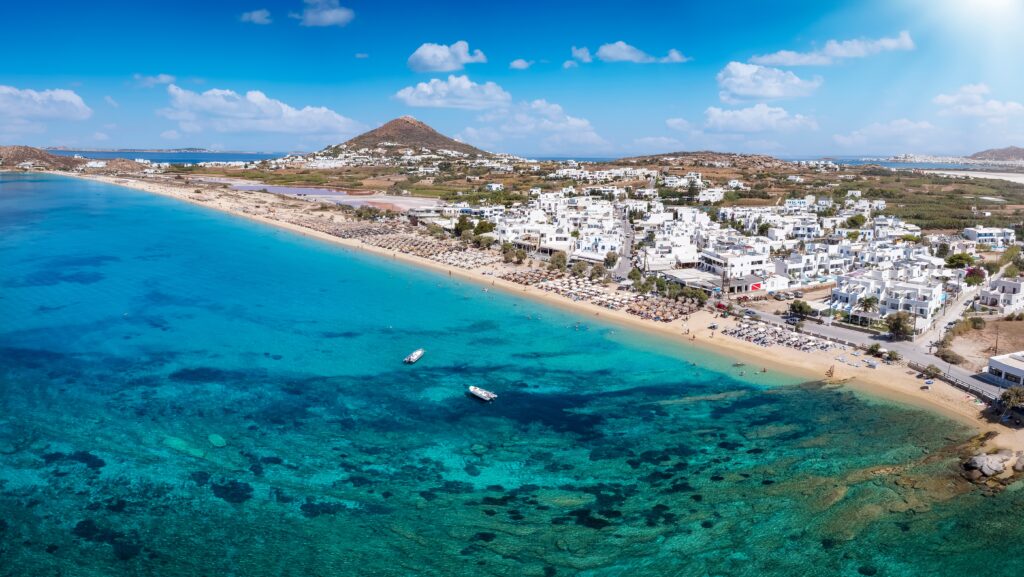
Brochures promise the best beaches in the Med, and beaches Naxos certainly has. The south-west coast is one long blonde swathe of sand. Unfortunately, much of it is coarse and gritty and many beaches are backed by flat, desolate salt marsh.
Inland, Naxos has some impressive mountain scenery, particularly around Mt Zas - the highest peak in the Cyclades. Abundant springs and rich soil create dense valleys of citrus and olive.
Naxos island's rich, agricultural heritage means the islanders don't need to make many concessions to tourism and Naxos maintains a strong Greek identity.
Those looking for a beach holiday with inland interest and easy island hopping, will think Naxos a Greek island to consider.
Naxos is the largest and highest island in the Cyclades and the most fertile with many crops and orchards in the cultivated valleys.
Miles of white sand beaches are the best in the Cyclades. They are certainly big and the sand often sugar white. But it can also be harsh, ball-bearing granules, and a splash in the sea can mean climbing over underwater rocks that line much of the shoreline.
Salt flats back many of the best Naxos beaches, creating an air of desolation that is not everyone's cup of tea. The long empty stretches add to the attraction for those who don't like company, but it may feel a little lonely for those that do.
Naxos is at the hub of the Cyclades ferry system with other islands not far away, and this is an ideal location for an island hopping holiday.

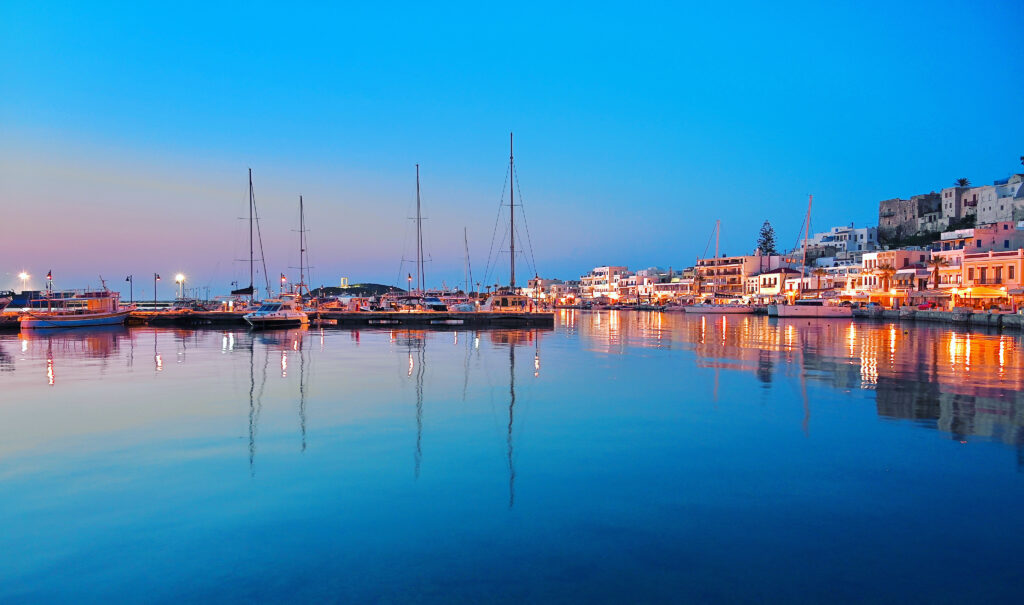
Naxos Town

Naxos Portara

Naxos shop

Naxos Kastro
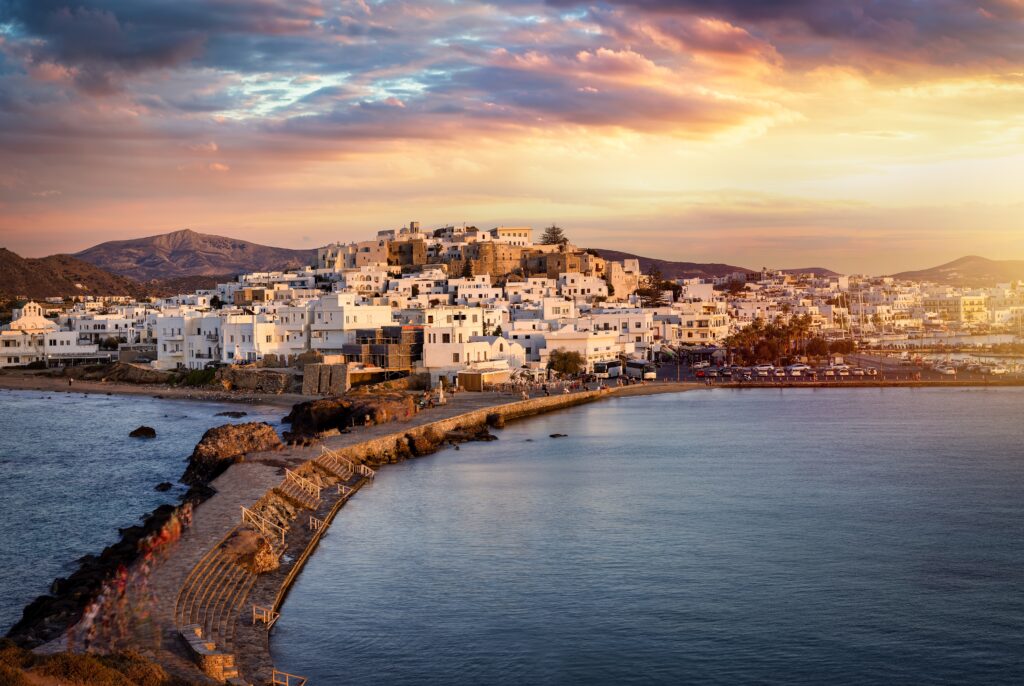
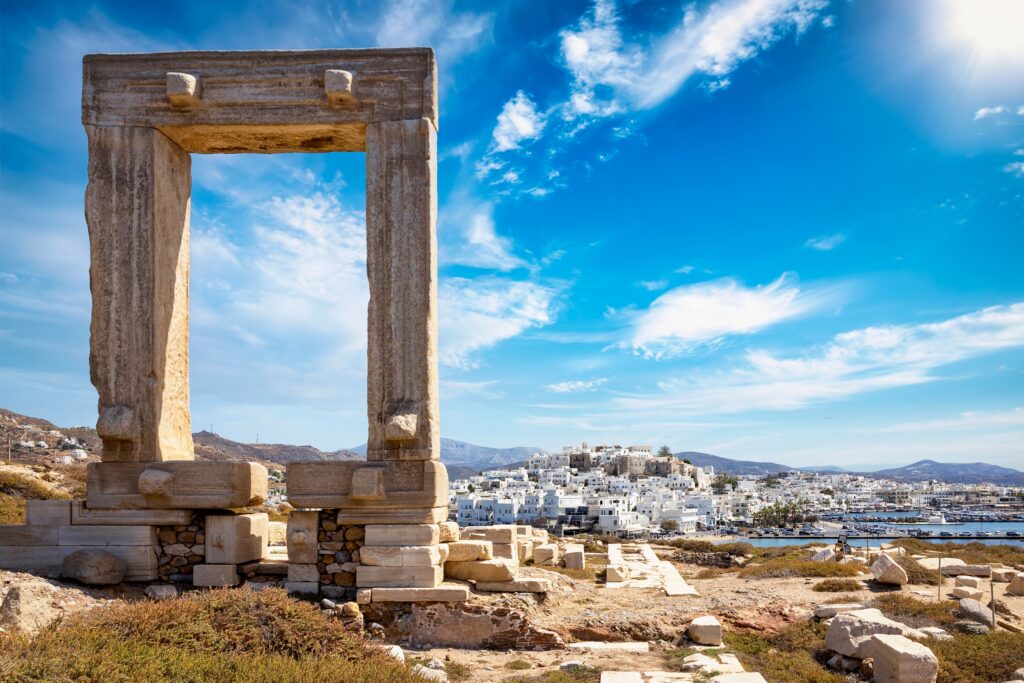
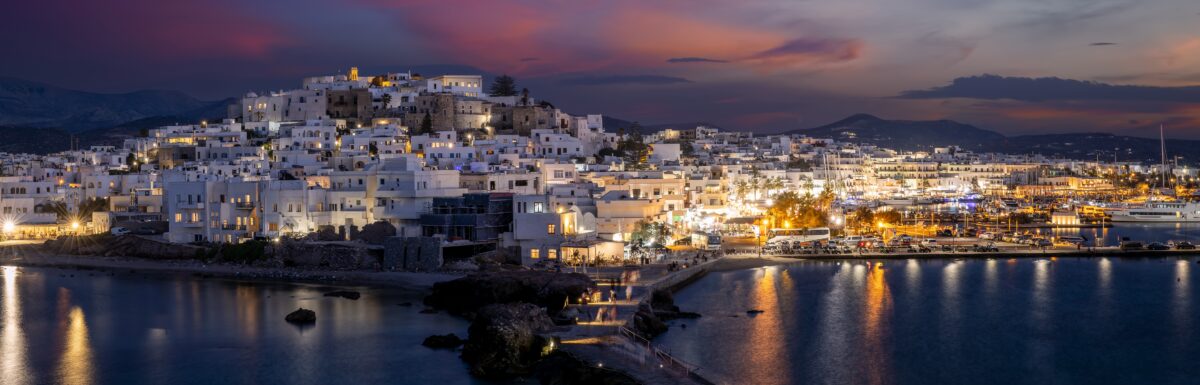
NAXOS TOWN or HORA, the capital town of Naxos claims to be the gateway to the Cyclades and has the doorway to prove it. The gigantic and somewhat creepy marble frame Portara stands 21 ft high on the tiny Palatia island linked to the town by a short causeway.
The frame is all that remains of what was to be a colossal 6th century BC temple to either Dionysus or Apollo, depending on which guide you read. It was never finished anyway and what's left is a majestic old tooth sticking out of the sea. It's worth a visit, both for the creepy feeling of standing in a giant doorway to nowhere and for good views to Naxos Town.
To the north of the causeway is the Naxos Town Grotta area - once the site of a town now sunk beneath the waves. There is a beach area here. To the south is Naxos Town proper - a happy mix of the brash (vulgar tavernas, bars, car rentals and tourist tat), the twee (an intricate web of whitewashed back streets stuffed with craft and curio shops) and the historic (claustrophobic alleyways that wind up to the Venetian kastro on top of the hill and no less than 45 churches).
Further south of Naxos Town is a suburban sprawl of hotels and studios that back onto the long town beach of Agios Giorgios. The waterfront is a promenaders' paradise with an extensive and attractive sea wall pocked with small, semicircular benches, dozens of street tavernas, shops behind and a prosaic, but interesting, harbour at the end of it.
What strikes the Naxos Town visitor is the cheerful liveliness of the place. A fun fair can be in town or a street festival under way - Naxos is rarely dull. Tiny alleys lead up the hill through cobbled whitewashed alleys to the 13th century kastro. Expect to get lost in this marble-paved warren, with its arched porticoes, crumbling mansions, gorgeous flowerpot gardens and attractive street tavernas.
The kastro in Naxos Town has a Catholic Cathedral and a good museum. Exhibits include some early Cycladic goddesses with prominent breasts and bellies and the museum has stunning views from the balcony. There are daily tours of the Kastro (except Monday) taking in the Venetian Museum, the Archaeological Museum, the Catholic Cathedral and the Byzantium Museum in the Glezos Tower.
Naxos Town may have its crappy tourist glitz but it all seems contained somehow and essentially Greek, despite having grown fourfold in the last ten years on the back of a visitor bonanza. Tourists are more tolerated than touted and I'm not surprised to learn that more visitors stay longer in Naxos Town than in any other tourist resort in Greece. There is a campsite on the road south to Agios Prokopios.
Virtually the whole of the Naxos south-west coast is one line of beaches many linking into each other with only the names of nearest villages to separate them. Some are huge swathes of sand backed by dunes and bamboo, others narrow slivers that shelve steeply into the sea. Generally the further south you go the bigger and wilder the beaches get.

Busy end of St George beach

Quiet end of St George beach
Here we are in brolly and beach bar territory, just outside the capital of Hora. Plenty of suburban tourist tat can be found at AGIOS GIORGIOS, better known at ST GEORGE BEACH, with the solid ranks of sun beds, the surfboards and jet skis. But the beach turns out to be less commercialised than first appearances suggest.
There may be hotels and studios by the score and a broken line of bars and cafes backing onto the beach, but the atmosphere at Agios Giorgios is still generally subdued. Enter a taverna and the food is mainly Greek, the atmosphere welcoming and some tavernas even play classical music. The Agios Giorgios sand is soft, deep and generally clean, gently shelving into the shallow sea. A boarded catwalk runs down the back of the long, tree-shaded crescent beach.
Agios Giorgios is a pleasant family beach but the proximity to Hora, not to say the ranks of apartments behind, demand an early arrival to grab the best spots. Ferries honking in and out of the port offer passing interest as well as sending mighty bow waves crashing on the shore now and then.
The closer you get to Naxos Town the more hectic the pace. Further south the sand turns a little more gritty, but there is the compensation of peace and quiet as the Agios Giorgios sunbeds eventually run out. Unfortunately there is also a foul, litter strewn pond to contend with and the odd derelict concrete shed.
Beyond the headland is a small bay at MANDARI that houses a windsurfing school and after that a small dyke, built at some considerable cost to the local wildlife, to prevent the salt flats and the local airport from periodic flooding.

Agios Prokopios beach

Agios Prokopios salt lakes
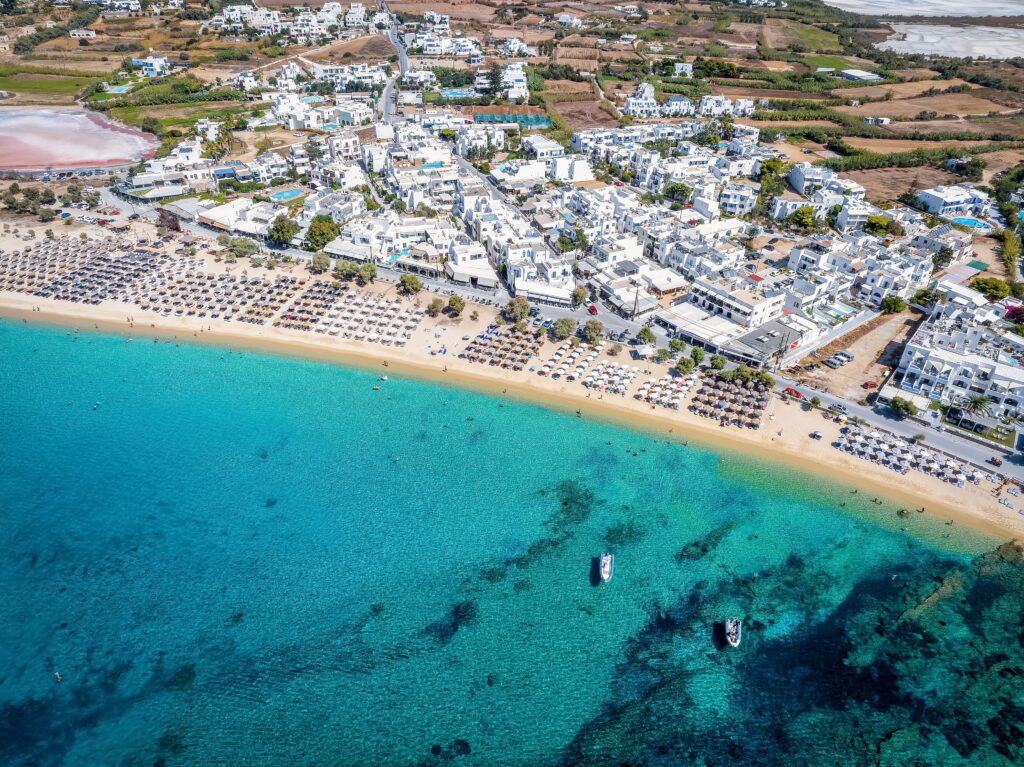
Brochures post up AGIOS PROKOPIOS as one of the best beaches on the island but the northern end is a desolate, flat salt marsh with a long and boring beach full of gritty ball bearing sand - the stuff that scours the skin off between your toes and leaves you with a pebble-dashed bum.
Agios Prokopios has an almost Saharan desolation with salt lakes behind, a single taverna and some overpriced sunbeds. Great slabs of rock lie along much of the Agios Prokopios shoreline and have to be negotiated to reach the sea proper - not too much of a handicap as the rock is at least flat and smooth underfoot, but a nuisance nonetheless.
Further south however things improve a lot. Tamarisks provide shade at the edge of Agios Prokopios beach and more tourist facilities beckon in the resort village behind. There are sunbeds on the beach, tavernas behind and plenty of small hotels and apartments.
Agios Prokopios village has been described as a ramshackle and motley collection of cheap hotels, studios, cafes and tavernas. But the place still has a certain charm despite its obvious tourist overtones and it is a good place to stay, particularly as there is an even better beach to be found at Agia Anna just a short walk along the shore.

Agia Anna beach

Agia Anna shark rock
The dainty little harbour at AGIA ANNA is the main destination of most of the caiques out of Hora and who can blame them? To the north of the small jetty, modest family tavernas lie tucked behind a fine if narrow beach of soft, golden sand with a few scattered rocks further on where the beach gives way to the coarser grains of Agia Prokopios.
Agia Anna is in a really lovely setting, its beauty is strangely unsung by most holiday brochures. To the south of the jetty is the small harbour surrounded by a rocky outcrop. Among the rocks is the formation known as Shark Rock, sculpted by winds to resemble a shark.
Snaking south from Shark Rock is a wide and dusty dirt track road which leads on to the Plaka area with its vast kilometres of white course sand. The biggest problem with Agia Anna is that it is relatively short at around 300m and numbers can quickly build as the caiques and buses roll in.
But Agia Anna beach is well placed for those who to explore the island's more remote beaches whilst staying in touch with the more lively Naxos Town which is only a short bus or taxi ride away - about 7km. The once tiny village is growing fast and there are increasing numbers of studios, small hotels, tavernas and supermarkets. And they grow the most delicious spuds on the flat, fertile plains nearby.

Maragas beach taverna
Around the headland south from Agia Anna, and past the tiny church, the coast opens up into a huge vista of flat, sparkling white sand that shoots away into a distant haze. This is the starts of the huge beach known as Plaka but which is so big the various sections have developed their own names. The most northerly beach of Plaka is known as MARAGAS
Maragas was once kilometres of empty beach with a single ramshackle taverna. Now, behind Maragas beach is a wide dirt track, substantial enough to take cars and even buses, and lined with tavernas, bars, apartments, shops and a camp site partly hidden in the trees and bamboo.
A few straggly trees line edge the track and in their shade a few wooden tables and chairs give the scene a big dollop of romance. The track eventually peters out in the dunes to where Plaka proper begins and where the naturists like to hang out.

Plaka beach
PLAKA beach is almost impossibly huge, with deep golden banks of sharp sand for several kilometres backed by low dunes and rolling farmland and the uninhabited islet of Aspronisi offshore.
After leaving the northern end of Maragas, the beach gets more exposed and desolate though small cantinas appear here and there and sunbeds come out along the most popular stretches of Plaka beach . Otherwise it is just sand, sand and sand, very exposed with little shade and some low dunes behind.
You can reach the more southerly part of Plaka beach by heading along the main road to Alyki, turning off just before Tripodes (according to the map) or Vovlios (according to the road signs) and keeping left down the valley past a high watchtower.
Curtains of bamboo and dead-end farm tracks conspire to foil all but the most intrepid. It is they who can enjoy the sparsely populated and bare delights of the sandy Plaka dunes beyond.

Orkos beach
Further south from Plaka and about 18km from Naxos Town is a chain of small, pebble coves surrounded by cedar trees - unusual for Greek island beaches. This area is known as ORKOS beach where nudist bathers enjoyed some privacy before the Orkos Village apartments were built nearby and the textiles moved in.
It is still a nice spot though with the pebble coves extending for about 1.5km and a stone mound behind Orkos beach that offers views of the coast north and south and red coloured fields behind that are usually planted out with potatoes.
To reach Orkos you take the road to Mikri Vigla and turn right at the seashore along a dirt track. Orkos is one of the best known of the Naxos surfing beaches and visitors can find water sport facilities both here and at neighbouring Mikri Vigla which much busier.

Mikri Vigla
The resort of MIKRI VIGLA, is about 18km from Naxos Town and which generally marks the end of the windsurfing region. Scores of holiday studios sprinkled higgly piggly around the headland hill give the place the air of a deserted suburb.
There are beaches both to the north and south of the large headland. PARTHENOS beach to the north, PATHENA, is sandier of the two, but windier as well; a popular haunt for windsurfers and campers. The sand is white coarse grit and it has a large hotel complex overlooking the small bay.
The SAHARA beach is to the south - and the name could not be more appropriate. Four kilometres of coarse white grit disappears into the desolate distance. It looks arrestingly beautiful but you are better off admiring it from afar. Apart from some scruffy beachside scrub, the only shelter to be found is in the single basic beach taverna.
Large rocks at the northern headland provide some interest but this is boredom beach. Slabs of rock line the shore just below the surface of the water, a nuisance for swimmers.

Kastraki beach

Glyfada beach
Poorly signposted from the main road, many think KASTRAKI the best stretch of beach on the island. It is, in fact a succession of small coves running for about 3km and about 17km from Naxos Town.
There is a shoreline track but it is often interrupted by farmland and lines of bamboo which can run right down to the beach. Kastraki means 'little castle' in Greek and there is a small Venetian fortress Pyrgos Oskelos about 2km east of the village.
The coast is punctuated by a scattering of tavernas and holiday studios and, at one spot, a hotel complex with the hugely imaginative name of Summerland. There is precious little else at Kastraki except dunes, scrub pine and prickly pear, though impressive rock formations between the various coves add interest and in places there are trees to provide some natural shade.
There are sunbeds on the most popular parts of Kastraki beach but most of the coast here is empty, despite its uncompromising beauty and probably as a result of the relative inaccessibility and the distance from Naxos Town.
There are a few seafront tavernas, a summer beach cantina and a minimarket about 100 metres back from the shoreline. Apartments are dotted along the coast and this is a delightful spot of you are looking for peace and quiet. The southern end of the beach is known as GLYFADA where there are a couple of small lakes behind the beach and some good seafront tavernas.

Alyko beach
One of the most beautiful spots on Naxos is the headland at ALYKO, sadly marred by a derelict unfinished cement hotel that at least is out of sight from the beach.
Those will to venture here, about 20km from Naxos Town, will find narrow beaches of golden sand tucked between wild rocky outcrops with near vertical cliffs behind that are covered with deep green scrub pine and cedar trees.
The scene from the clifftop is simply breathtaking, so good you could eat it. But this most exquisite scenery is blessed with the ugly forgotten shell of a monstrous hotel complex, monotonously grey and grim and spattered with grubby graffiti.
The north side of the headland has a string of sandy coves and a small port, while on the south side is a splendid cedar forest and a long beach of white gritty sand. There are a few tavernas nearby and rooms to be had with a small minimarket that opens in the summer months.

Pyrgaki beach
A wide track leads down from Alyki to the coastal resort of PYRGAKI, about 21km from Naxos Town and the last stop on the coastal bus route, though buses do not run here at weekends.
There is a shortish, sand and shingle beach (about 300m) that marks the end of the coastal swathe of beach for which Naxos is most famous. Access to Pyrgaki beach is down a short dirt track. It is very deep and exposed with no shade unless you retreat back to where the cedars, for which the area is known, meet the edge of the beach or to the nearby beach bar.
A large and intrusive hotel complex has been built as if to deliberately spoil the views but it does least it offer some useful facilities, though there is a cafe and a taverna here also. There is water skiing and wind surfing, evidence that the bay at Pyrgaki is rather exposed to the prevailing winds.

Agiassos beach
The road south out of Pyrgaki follows the coastline to the remote sandy beach of AGIASSOS. The road soon turns into a dirt track although it is not a particularly difficult drive.
A few scattered houses make up the resort which is about 22km from Naxos Town. The beach is quite large, is a mixture of sand and shingle and a gentle slope into the sea makes it popular with local families, though not many tourist families will want to make the long trek to get here.
There is a good taverna with great views above the beach and a few rooms to rent, though not many. Never many people on the beach either, making it an ideal getaway for those who like to avoid the crowds.
There are no sunbeds and little shade except at the northern end of the beach where a large clump of trees are set back some way from the shoreline.
Draw a line from Prygaki, in the southeast, to Moutsouna, in the northeast, and it will mark the boundary for all decent roads on Naxos. With a few exceptions this is donkey track territory and, with beaches less attractive, hardly worth the effort of getting around. All are worth a mention though, starting from Agiassos and heading up the east coast to Moutsouna.

Kalandos beach
The south facing beach of sand and shingle at KALANDOS sits at the head of a small sheltered inlet in the far southeast of the island.
Kalandos beach sits in a small cove, well protected from the northerly winds. It is a remote beach for those who enjoy escaping the crowds and has no facilities, though a small ramshackle cantina has been known to open in the summer months. Take plenty of provisions if you do go as the nearest store is 24km away in Filoti.
Kalandos is best reached by heading south out of Filoti and is about 42km from Naxos Town. The road is not particularly good however. There is a decent road to the turnoff for Chimaros Tower then a dirt road after that. The final stretch is pretty rough and you need a 4X4 to do it safely.
Kalandos also features on some excursion boat tours from Naxos Town so you may opt for that though the sea journey is a long one.

Panormos beach
PANORMOS is an attractive south-facing sand and shingle beach on the southeast coast, about 45km from Naxos Town. It is so remote it is mostly deserted and, despite it's beauty, is one of the quietest beaches on Naxos.
You can reach Panormos from Kalandos along a coastal footpath but it is hard going. There is also a road that branches left after the Chimaros Tower turnoff, but this is only for 4x4 vehicles. The easiest way is the longest - heading south along the asphalt coast road out of the northeast port resort of Moutsouna.
There are no sunbeds or other facilities at Panormos so you need to take some provisions, though there is parking for the car and some natural shade on the eastern end of the beach from a line of tamarisk trees.

Psili Ammos

Kelidos
The Greek name is a term for fine sand and at PSILI AMMOS that is exactly what you get. The east-facing beach is one long scimitar of rolling sand that banks up in great drifts to the scrub and cedar trees behind.
At 42km from Naxos Town it is too far away to ever get crowded and only those looking for quiet beauty will venture to find it. Psili Ammos is best approached on the south road out of the small port at Moutsouna along the good asphalt coast road.
There are a few houses scattered here and there but otherwise the area is pristine, with undisturbed fine sand and shallow, clear water. There are no facilities atPsili Ammos so take your own provisions.
A couple of kilometres to the south is an even more remote beach at KLEIDOS, also referred to as KLINDOS, a beach area of three inlets split by rocky outcrops and one of the prettiest places on Naxos.
There are no facilities here and very few people. Rock overhangs provide shade on two of the stone and shingle beaches and on the hills behind walled terraces reach almost to the sea.

Moutsouna beach

Moutsouna port
MOUTSOUNA was once the main port for shipping out the emery that was mined in and around the villages of Apiranthos and Koronos - remember emery paper? It was carried down by mule until an aerial runway was built, the remains of which can still be seen.
Emery was replaced by carborundum and the industry died, but parts of the runway remain as a monument to the island's industrial heritage as do the rail tracks that still line the harbour.
Moutsouna is the gateway to the remote east coast beaches of Naxos, a pretty port and one of the few genuine fishing harbours left on Naxos. It is reached by a good, but narrow, twisting and occasionally hair-raising road from Apiranthos and is about 45km from Naxos Town.
It is growing as more visitors use it as a touring centre but has only a few rooms to rent. Pleasant fish tavernas overlook the small east-facing sand beach and the port where the old derricks that were used to swing emery into the waiting boats still stand.
A little to the north, over the headland, is AXALA beach, known for its fine and varied pebbles. To the south are many pretty coves that extend all the way to Psili Ammos.

Lionas beach
The east road out of the hill village of Koronos leads down to the rugged but scenic seaside village of LIONAS. Another of the old emery ports it now offers peace and tranquillity for tourist visitors. At about 40km from Naxos Town it doesn't get too many of those and there are only a few rooms available to rent.
Lionas beach is stone and shingle with no sunbeds or other facilities, apart from some very pleasant seafront fish tavernas. The asphalt road goes right down to Lionas beach but drivers should take great care on the narrow, twisting bends. Lionas is an ideal beach for those looking to escape the crowds but otherwise it has little to recommend it.

Apollonas

Apollon kouros
A colossal stone statue, or kouros, abandoned on the hillside around the 6th century BC has turned the relatively remote northeast seaside village of APOLLONAS into a tourist Mecca.
This was once, like nearby Moutsouna and Lionas, an emery exporting port until the trade died. Now tourism is the main money spinner with regular tour buses from Naxos Town, about 54km away and plenty of local hotels and apartments as well as tavernas and cafes.
Apollonas beach is very public, overlooked as it is by dozens of taverna tables (there is even a taverna called Baywatch) but it has nice soft sand with shingle here and there. To the west is a walk around the rocky headland to another beach, wilder and a little more private.
The kouros is just outside the village on a well marked route. The statue is more than 10 metres from top to toe and some cement steps have been built around it to provide visitors with easy access. There are plenty of those with tour buses from Naxos Town arriving in droves throughout the summer.
Tavernas and cafes have sprouted up on the wall around the small sand beach to satisfy the hunger and thirst of the visiting tourists. Until the development of Agia Anna and Prokopios this was the main alternative resort to Agios Giorgios.
Also worth seeing are the old marble quarries at EMPOLI. Many works of art have been created from the fine marble mined from here.
The northwest coast of Naxos is noted for its wonderful countryside, particularly around the Engares regions just north of Hora but the coastline is pretty much inaccessible cliffs along most of its length. There are only a couple of beaches of note, though these are exceptionally beautiful.

Abram beach
Beaches to the northwest get the full force of the meltemi and as a result can be rather windswept. ABRAM, also called ABRAMI or even AMPRAMI is a lovely shingle beach overlooked by a huge head that has been carved into the rock - the work of the sculptor Rokkos. It is also overlooked by a small, but ugly, hotel, found further back.
There is a pleasant summer taverna overlooking Abram beach with great views of the bay and there are a few rooms to rent in the area. Rarely crowded this is an ideal spot for a quiet holiday. The beach is shingle with some sand but no sun beds. It can get windy here as Abram is exposed to the north wind. There are views across to Paros and Mykonos.
It is found in the far north-west about 20om from Naxos Town with a good asphalt road all the way, then a dirt track off it for about 300m to the beach. Nearby, and worth a look, is Agios Mirnas monastery, and there is a small shingle strip at PACHIA AMMOS to the south.

Amytis
The lovely beach at AMYTI, AMYTIS or AMITI is found below two reservoirs that supply water to Naxos Town. This is an idyllic spot with fine, soft sand and offers the best bathing on this part of the coast, though the meltemi can bring the waves crashing in and with it the usual rubbish and detritus.
Amyti is close enough to Naxos Town to be a popular target for day trippers with a good asphalt road most of the way through the beautiful Engares region and a good dirt track of about 3km. A beach cantina sometimes opens in the summer but otherwise there are no facilities. Nearby is the fortified monastery of Ypsilos.
Naxos is a big island and there is much more to it than beaches. Historically, Naxos was a major centre 4000-1000BC and later dominated by Ionians becoming enormously wealthy both from marble and sea trading. Controlled by Egyptians and Romans is was conquered by the Venetians and Marco Sanudo established a Duchy here in 1207, distributing land between Venetian nobles who built castles and towers. Turks took over in 1564 but the Venetians kept the administration of the island until it became a Greek state in 1831. It has left Naxos with a rich heritage and there are many worthwhile places to explore right across the island.

Halki street

Halki church

Gratsias Tower
On the route to the Apiranthos, about 16km east of Naxos Town, is the village of HALKI or CHALKI. The village has a reputation for its handsome houses, Byzantine churches with 12th century murals and several fine Venetian pyrgi or tower houses.
The village itself is a dusty, lifeless little place and somehow fails to live up to its reputation as one of the richest villages on the island. Guide descriptions such as 'attractive', 'quaint' and 'lovely' are hard to find in the dust and litter the greets you as you arrive.
Chalki has many crumbling old mansion houses, recalling its more prosperous days and there are several old towers nearby such as Gratsias (or Barotsis), Papadakis at nearby Akademi and of Marcopolites at neighbouring Kerami.
Also of note is the old 19th century distillery where the 'Citrus of Naxos' liquor was famous not only on Naxos but the whole of Greece. Today they sell ouzo in the centre of the village.
The local churches are also worth a visit, notably Panaghia Protothrone, dating from the 9th century and the religious museum beside it with ritual relics as well as icons. Panagia Drossiani, one of the oldest and most important, is found on the right on the steep hill as you head towards the mountain village of Moni. Built between the 6th and 10th centuries BC it has rare wall paintings from the 9th century and wonderful views over the fertile Tragea valley.
Tragea is one of the most fertile parts of Naxos, full of olive trees and citrus orchards that produce the largest amount of the island's agricultural products. Across the rolling hills are not only Halki but also the villages of Acadimi, Chimarros, Kaloxilos, Damalas, Damarionas and Tsilikario.

Filoti

Filoti cafe
But for its position and some pleasant roadside tavernas, you probably wouldn't give the drab village of FILOTI a second glance. As it is it rates highly in all the tourist guides, mainly for the wonderful views down the Tragea valley - stuffed solid with olive and fruit trees - and of Mount Za which, at just over 1000 metres, is the highest mountain on the island.
The tiny church of Agios Iannis can be seen perched on the mountain opposite and there is reputed to be a path up to the Za summit - if you can find it let me know. Zeus was born in a cave on Mount Za, they say, but it is a two hour trek up steep and poorly marked tracks and all you get for your trouble is a small cave with a smaller inner chamber, two large stalagmites and heat-stroke.
Filoti itself is little more than a single straight road on the side of the mountain - a tarmac terrace to take in the views. You leave the main road at your peril; dead end farm tracks are everywhere and signs non-existent.
Filoti's long, narrow street is lined with shops selling everything from saucepans to bagged sheep fleeces. A few roadside cafes offer refreshments and shaded tables and chairs sit under large roadside plane trees.
The village also has an interesting church, Panagia Filotitissa, built in 1801 and containing some good icons, a marble iconostasis screen and a nicely carved bell tower.

Apeiranthos

Apiranthos street
Perched precariously on the slopes of Mount Fanari with the valley below filled with olive and fruit groves APEIRANTHOS or APIRANTHOS or APERANTHOS is one of the most attractive and interesting villages on the island.
Wandering around the narrow marble streets, under archways, up whitewashed stone steps is a great delight. Small piazzas crop up unexpectedly, sometimes housing a small taverna or street cafe. The chimneys are eye-catching too and the village roofs are called ‘the garden of strange flowers’.
Local handicraft is on sale and much of it fine, local stuff. A women's co-operative sells gorgeous, if pricey, handwoven textiles and there is a clutch of museums to visit. The archaeology museum has Cycladic figurines and slate drawings while the museum of popular art has exquisite locally made artifacts.
The museum of natural history is rather less well endowed with a few old bird nests, some bleached bones, pressed flowers and fish pickled in jars and all packed into a tiny room. More interesting stuff can be found in my bathroom.
The village is noted for several varieties of cheese though the stuff I bought in the local shop had the texture, colour and consistency of marble. The local dialect is a mixture of Cretan and ancient Greek and the village has, for some unaccountable reason, produced a great number of intellectuals and politicians.

Apollonas kouros

Melanes kouros
The remarkable kouros statues can be seen at both Melanes and Apollonas. They are huge but incomplete statues of young men, thought to be destined to hold up a temple roof on the holy island of Delos but abandoned by ancient sculptors after faults were found in the marble. A Kouros is always a young naked man with clenched fists, standing with left leg forward similar to Egyptian sculptures.
Their nakedness is a unique element found only in Greek culture since the 8th century BC. The Egyptians had male sculptures but they, at least, wore a loincloth of some sort. These naked statues are important historically as they are free-standing for the first time in western art.
The best known statue on Naxos is the colossal kouros found near Apollonas, in the northeast, that dates from the 6th century BC. The kouros, lying on the hillside above the resort is more than 10 metres from top to toe . Cement steps have been built alongside it to provide easy access for visitors that arrive by the bus load.
Curiously marked as a village on most maps, Melanes is actually the name of a valley directly east of Naxos Town, dotted with several hamlets and dense with fruit and olive trees.
It is best known for its 7th century kouros or carved figure which, at 6.4 metres, is smaller than its more famous neighbour at Apollonas. The figure is well signposted from the main road out of Hora and can be approached on the right just beyond the village of Mioi.
The kouros lies in meticulously tended and lies in a lush private orchard, near a stream. Visitors are sometimes welcomed with drinks and fruit and the enchanting setting hold a charm that is missing with its more northern cousin.

Ayia Tower

Bellonia Tower
Naxos is noted for its fortified towers or Pyrgi which can be found dotted all over the island. There are several distinct types and were built either for defence against pirates or as country homes for occupying Venetians. The latter are unique in combining western and Cycladic architectural styles.
The Venetian towers were built with local, un-plastered and without any covering so that they blended into the surrounding countryside. The most important Venetian Towers are the Bellonia tower, built a little way out of the village Galanado, the towers of Gratsia and Markopoliti, in the area of Tragea, and the tower of Fragopoulos, in the village Kourounohori.
Many of the larger towers are surrounded by strong walls which enclosed a courtyard, stables and storerooms. Doors and windows are often topped by sculpted marble lintels. They often had battlements built around the roofs. In Agia, about 6 km. from the village Apollonas, is the Agia Tower at a strategic spot near the most northerly point of the island.
One of the most important towers is the Chimaros or Himmaros Tower. Guide books put it just outside Halki but it is a hefty drive south, partly along a dirt track. The tower dates from the 4th century BC, has three stories and is enclosed within a square stone wall. It probably served as a lookout post in the years when pirates regularly raided the island.

Engares valley

Demeter Temple
There are not many Greek islands that can compare to Naxos for panoramic landscapes. Good roads make this an excellent island for just driving around and taking in the many scenic delights
The ENGARES VALLEY in particular is noted for its beautiful fruit orchards and good walks. Fed by the river that rises inland at KERAMOUTI it looks lush and green even in the height of summer. The valley is the site of the heavily fortified YPSILOTERA MONASTERY also known as Angelakopoulos Castle. AGIA FANOREMA, built in the 17th century also has some fine icons and an important library.
Another good area for exploration is the huge Livadi plain that runs down from the SANGRI plateau to the sea. It is dotted with Byzantine chapels, most of them from the 13th century. There are important archaeological sites all over this area, though they are not always easy to find as can be poor and badly marked (when at all).
To the south of ANO SANGRI is the restored 6th century TEMPLE OF DEMETER, a real tribute to archaeologists who even dismantled a local Christian church that had been built from plundered temple stone in order to restore it.
Naxos is the largest of the Cyclades at around 400 sq km, mountainous but with several large and fertile valleys. An abundance of spring water make it the greenest of islands even in high summer. This is seen particularly in the valleys. The Livadi plain to the south east is the main potato growing region but you will also find barley and even dairy cattle which provide milk for the island's noted cheeses.
The rich farming has made Naxos self sufficient in produce and a small amount is even exported each year to neighbouring islands. Naxos is rich in marble and emery but decline in demand has pushed tourism to the fore as one of the island's big money spinners. Mount Za, at just over 1,000 metres, is the highest peak in the Cyclades and there are other peaks at Koronos and Fanara. The island population is around 18,000.
Cheap flights to Mykonos from European airports
Details in most European languages and currencies
There are no international flights to Naxos. Visitors often fly to nearby Mykonos or Santorini then catch a ferry. You can fly to Athens and catch a domestic Olympic Airways flight to Naxos (about 30min).
There were two flights daily but this is now reduced to an early morning one (about 7am). It maybe increased in future.
Naxos airport is on the road to Prokopios, east of Naxos Town. There are few facilities there, a small waiting area, toilets and, recently, a cafe.
An alternative route to Naxos is a domestic flight to Paros (there are three a day) then a short ferry hop. Either way this probably means an overnight stop in Athens. Try Allsun for cut price deals on Olympic Airways tickets. Aegean Airlines also flies to Mykonos and Santorini.
Naxos is at the hub of the Cyclades ferry service and there are ferries to and from just about everywhere. Ferries leave daily from Piraeus (Athens) and Rafina on the mainland. In fact Rafina is now closer to the new Athens airport. Ferries leave Piraeus in the morning, about 8am, and the evening 5-8pm. The journey takes 6-8hrs. There are faster catamarans from Piraeus. The main ferry companies operating to Naxos are GA Ferries, Blue Star and Minoan.
From Naxos you can get ferries to Andros, Astipalia, Amorgos, Ikaria, Folegandros, Ios, Kalymnos, Kos, Milos, Mykonos, Paros, Rhodes, Samos, Santorini, Sikinos, Syros, Tilos and Tinos s well as several more remote destinations. The Naxos Star does a day trip cruise to Paros and Santorini throughout the summer.
First impressions of Naxos port are not favourable. A huge swathe of dirty concrete full of parked cars, buses and lorries. There are several booths handing out information on rooms and usually a large number of people at the end of the quay offering rooms. Turn right at the end of the key for the Paralia promenade with cafes, bars and tavernas where you can sit and get your bearings. The main taxi rank is also here.
On Naxos there are any number of daily island cruises to the more remote beaches. There are also daily cruises to Paros and Santorini in the summer. Trips to Mykonos and Delos are popular although it is possible to use normal ferries, stay overnight on Mykonos and take a local day trip to Delos. Most travel agents can be found on the Paralia next to the port and they offer day cruises around Naxos and to neighbouring small islands such as Amorgos, Donousa, Iraklia, Koufounis and Shniousa.
Roads on Naxos have much improved in recent years and there are any number of car and bike hire firms to choose from. Naxos is a big island and, although there is a decent bus service to the main villages you will need your own transport to see some of the most beautiful areas. A couple of car tours are given below but, in any event, don't miss the scenery and Aperanthos, Melanes, Apollonas and Danakos; the coast between Mikri Vigla and Pyrgaki; the area around Engares and the new east coast road from Moutsouna to Psili Ammos.
Naxos bus services
Naxos has a good bus service, though it is geared to the locals rather than tourists. There are Naxos buses every 30min or so on the Hora-Prokopios-Agia Anna-Plaka route. Inland, Naxos buses go to Halki, Filoti, Apiranthos and Apollona and there are bus services to Keramouti, Koronoas, Melanes, Mikri Vigla, Moutsouna, Pyrgaki and Sangri. Details from the KTEL bus route offices on 22291. The main bus station and taxis are just outside the port near the tourist information centre. A free minibus service operates around the islands capital.
There are now many coach tours of the island - check out the travel agents in Naxos Town - though trips over narrow mountain roads and along vertiginous cliffs can be hair-raising. There are plenty of taxis in Naxos with the central station in front of the port. A radio-taxi service is also available on 22444
Naxos is a terrific island for walking, crisscrossed by paths and donkey trails. The Naxos Tourist Office has a wide variety of maps of walking trails and its worthwhile seeking out copies of Naxos and the Small Cyclades by Graf Editions, which outlines 30 hikes, and Walking Tours on Naxos, by Christian Ucke, on sale in island bookshops. There are fairly accurate maps available in local shops. Roads Edition 111 and Harms verlag are good and the Topo series is very good for planning walks. The roads are mostly asphalt and very quiet once out of Naxos Town and so fairly safe to walk.
| JAN | FEB | MAR | APR | MAY | JUN | JUL | AUG | SEP | OCT | NOV | DEC | |
| 13 | 13 | 16 | 17 | 21 | 25 | 27 | 28 | 25 | 22 | 17 | 14 | Avg day °C |
| 8 | 8 | 9 | 11 | 15 | 18 | 21 | 21 | 19 | 15 | 12 | 10 | Avg night °C |
| 4 | 5 | 7 | 8 | 10 | 13 | 14 | 13 | 11 | 7 | 6 | 5 | Sun (hrs) |
| 2 | 3 | 5 | 6 | 8 | 9 | 10 | 9 | 7 | 5 | 3 | 2 | UV Index |
| 105 | 75 | 63 | 28 | 17 | 6 | 0 | 0 | 2 | 51 | 66 | 102 | Avg rain mm |
| 12 | 10 | 9 | 5 | 3 | 1 | 0 | 0 | 1 | 4 | 6 | 12 | Rainy days |
UV: 3 Low; 3-5 Moderate; 5-8 High; 8 Very high | Rainy days=1mm+ | 1 inch=25.4mm
The climate in Naxos is similar to other islands of the Cyclades. It is a typical Mediterranean climate characterized by mild winters with low rainfall and hot, dry summers. Like all the Cyclades islands, Naxos is exposed to the meltemi winds blowing from the north during summer which are particularly strong from mid-July to mid-August. As Naxos is located in the middle of the Cycladic group, it is probably more exposed to winds, which make for good windsurfing conditions. Historically, apart from the high summer months of July and August, September is also one of the warmest months in Naxos, with an average temperature of around 23°C.
The beautiful Greek Islands are renowned for their spectacular scenery, magnificent mountainous backdrops, stunning sandy beaches and crystal clear waters. Holidays to the Greek Islands are often most cherished for this combination of sunshine, warm waters and beaches set against truly wonderful scenery. Whether it is a traditional beach holiday you would like or something with a little more history, you'll find that a break away to the Greek Islands is just the answer!
Airport Parking
Savings of up to 60% on gate prices at most top airports. Book online with Airparks for airport parking and airport hotel deals
Car Rentals
A leader in car rental services for more than 50 years Auto Europe has over 7,000 locations worldwide and a low price guarantee
Travel Insurance
Buy online at Endsleigh and save 10% on the standard travel insurance rate. Single and multi-trip, backpacker, gap year and more
Travel Gear
Extensive range of luggage, bags, accessories, holdalls, travel gadgets and more. Tasteful travel gear direct from stock
Holiday Taxis
Arrange any type of airport transfer for any party size with Holiday Taxis. Private taxis, minibus and low cost shuttle transfers