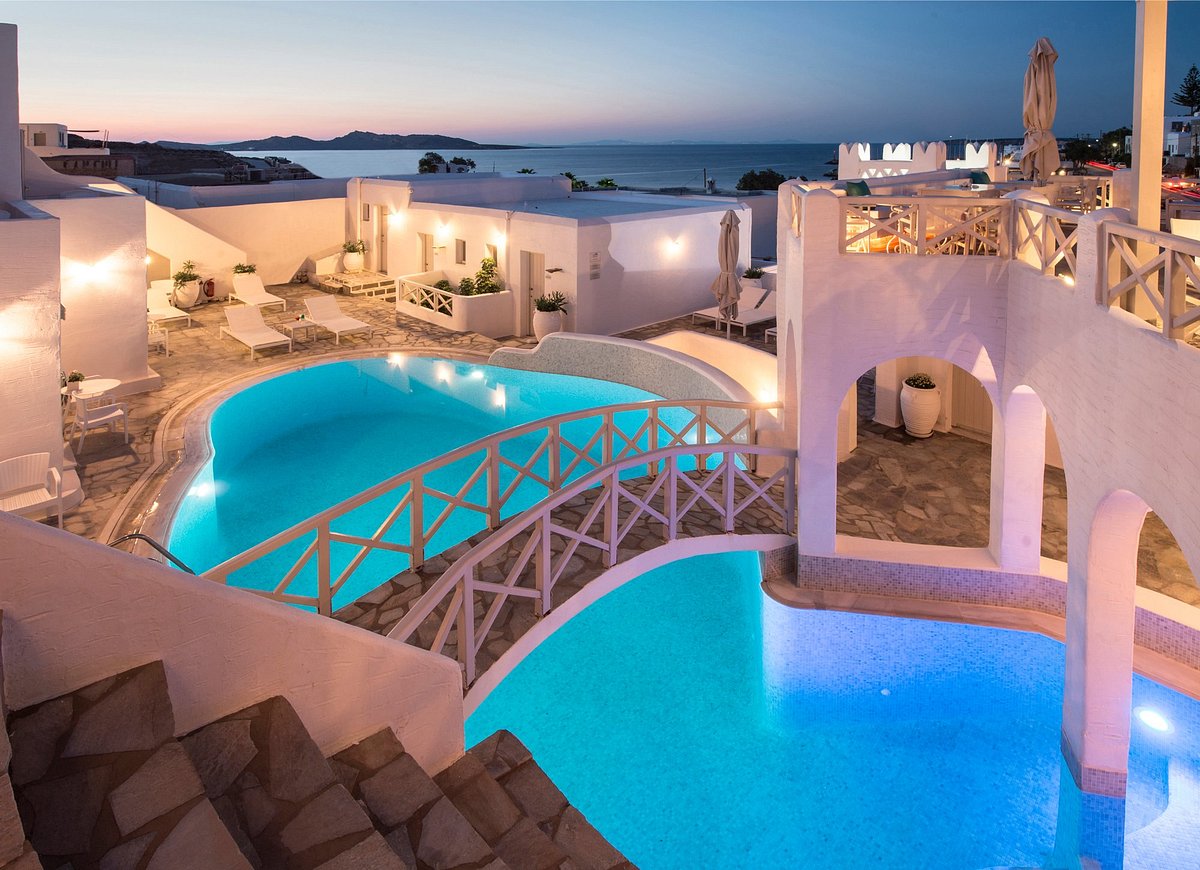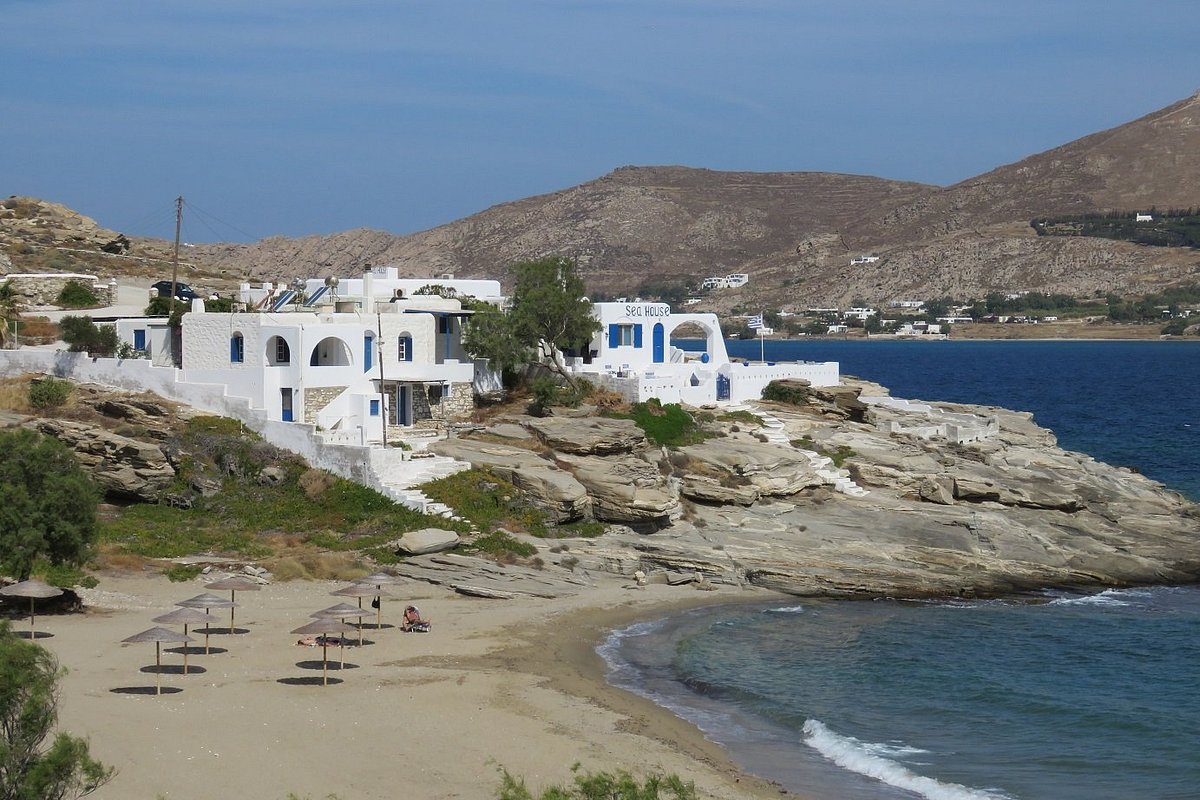
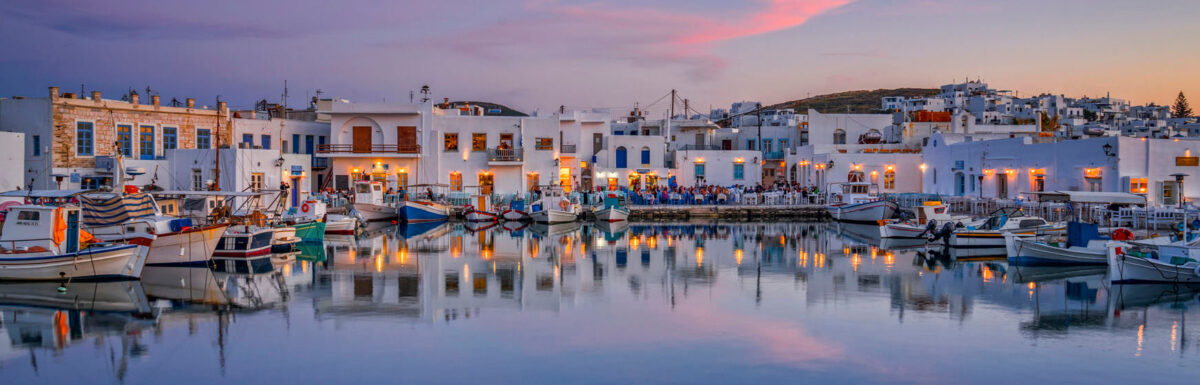
PAROS, along with its larger neighbour Naxos, forms the hub of the main central group of Greek islands known as the Cyclades. The Cyclades seem the epitome of the Greek islands, with their white cube houses, crystal clear seas and sandy beaches and Paros is arguably one of the best of them.
The lack of a large airport has ensured that the island hasn't buckled under the pressing demands of cut price tour companies. Instead Paros caters for the more independent tourist and it is a long-time favourite of young campers and backpackers.
This is a Greek island that will suit those looking for a destination with good tourist infrastructure but slightly off the beaten track. Its central location also makes Paros an ideal base for island hopping.
The the capital port of Paroikia which, despite many treasures around the old Venetian kastro and a picturesque harbour windmill, has a long, drab waterfront covered in copious amounts of scruffy concrete.
Sands here have one very un-Greek characteristic. They are clean and tidy. The island is at great pains to clear up its litter. The clear, clean sands are welcome relief from the usual flotsam of plastic wreckage that adorns many Greek island beaches.
Paros was famous in antiquity for its fine translucent marble, used to make countless masterpieces including the Venus de Milo.
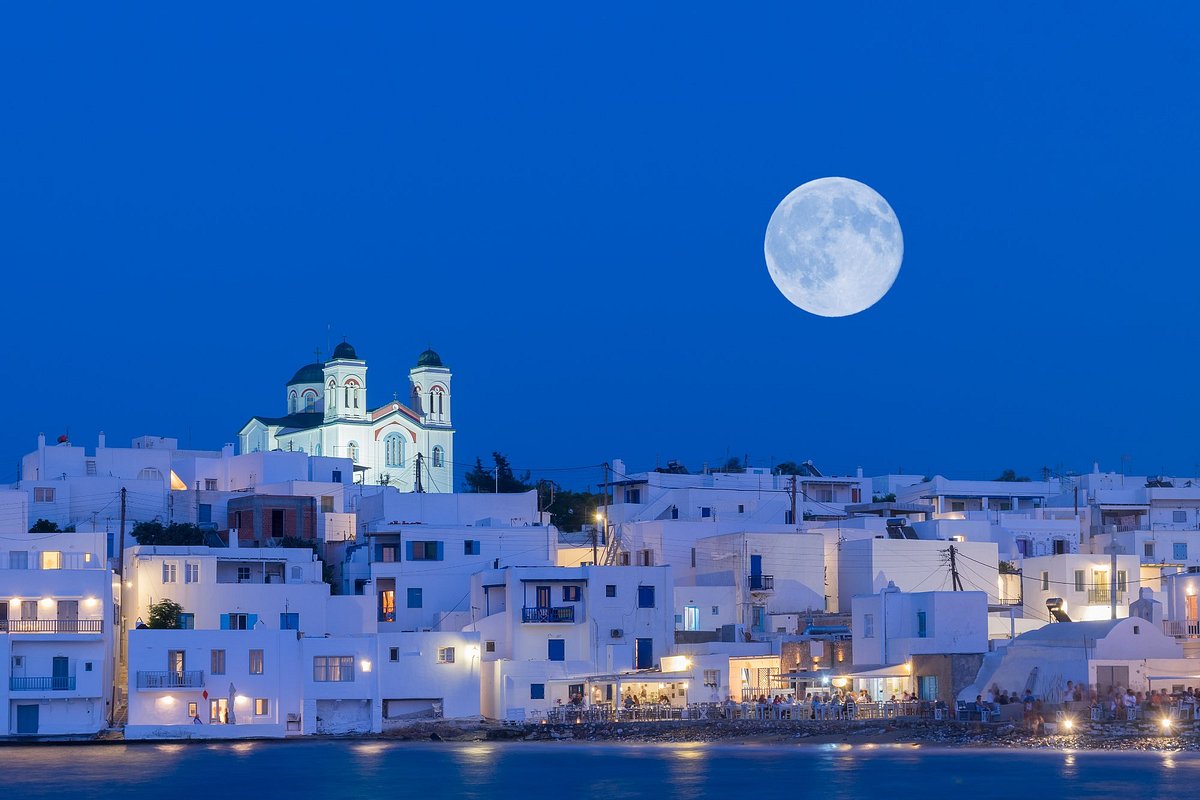
The much photographed Naoussa is one of the most picturesque resorts in the Cyclades with sugar cube houses dotted around the harbour and many pleasant beaches in the bay.

Such is the profusion of signs pointing to places of interest on Paros you might almost think that English Heritage has set up camp here with a barrow stuffed with European grant money. Someone has gone to a lot of trouble to ensure tourists aren't wandering around with a map, phrase book and lost expression on their faces. The brown and white signs are everywhere and point to just about every place of archaeological or historical note though few warrant such pointed remarks. Fields of barley sweep up the hillsides adding a warm ochre to the dense green olive and fruit groves of this rich agricultural landscape. There is a peaceful maturity about the place and a sparkling light that you won't find elsewhere in the Greek islands. And although tourism has left it mark (how could it fail on one of the most popular of holiday islands), the island is still stubbornly Greek - and may it remain so.
Blue Flag beaches

Parikia windmill

Parikia waterfront

Parikia shop
The great long waterfront at PAROIKIA, or PAIRIKIA, is the island capital of some 2,000 inhabitants but has little in the way of Greek island charm.
Cheap cafes, tavernas, rent-a-moto and trinket shops concertina in both directions from the central harbour which has a tarted up windmill at its mouth, a popular meeting place for travellers. The harbour attracts around 30 ferries a day in the high summer season often appears bursting to the seams.
To the east lies an unwelcoming swathe of asphalt and concrete littered with parked cars and lorries. The road bottlenecks at a narrow, scruffy beach at Livadia, backed by tamarisk trees and a clutch of tavernas and bars on the landward side of the busy road before fragmenting into a warren of one-way streets.
To the west, a line of restaurants stand behind a monotonous sea wall until it all peters out at a small shingle beach, a few old windmills lost among the flourishing fast food cafes that now line the shore.
The resort at Parikia has grown fourfold in recent years and it shows. But away from the waterfront, it is a different story. Following the brown signs to the Traditional Settlement takes the visitors to a wide paved square with a small triangular park and the remarkable restored cathedral of Ekatontachoni.
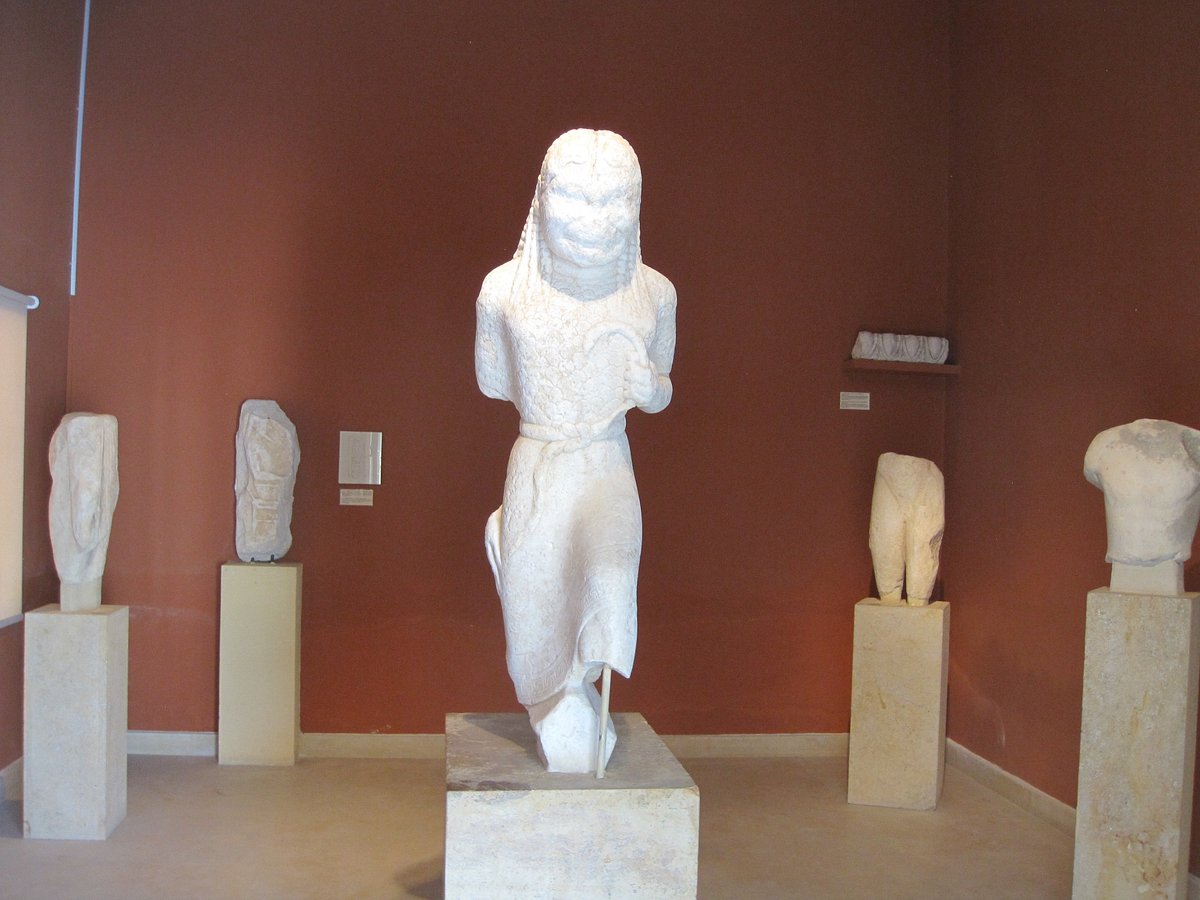
Behind that is the Archaeological Museum, then a labyrinth of alleys jam packed with an interesting mix of shops, galleries, cafes and whitewashed houses, but strangely only a single supermarket.
At the heart of Parikia are the walls of the Venetian kastro, marked on the seaward side by terraces of stone draped with foliage and flowers and inland by a 13th century Venetian castle and surrounded by dozens of picturesque churches stuffed with treasures.
Paroikia is basically a busy port, with seafront tavernas aimed at tourists just passing though, either waiting for an outgoing ferry or just arriving on an incoming one. There are some quiet beaches further round the bay to the north at Krios and Agios Fokas but they are small and undistinguished.
Although Parikia has no beach itself there are several nearby, some within easy walking distance and with accommodation nearby. Anyone looking for a beach holiday in Parikia should opt for the eastern side of the town where these beaches are strung around the west facing bay. A good road runs right around the bay to the headland at Agios Fokas.

Livadia beach
The first beach heading east from Parikia and around the bay is at LIVADIA. The beach is only about 1km from the port and easily walkable. Its proximity to Paroikia makes it very popular and it often gets very crowded.
Livadia is a long beach of good fine sand and plenty of trees at the back of the beach to provide natural shade. There are the usual sunbeds, umbrellas and watersports you would expect of a busy 'town' beach. Games of beach volley are popular and the sands often fill quickly at lunchtime as locals go for a quick dip.
The beach is naturally divided into several sections. It narrows towards Parikia and beyond a clump of trees is a small bank of sand that tends to be much quieter should you wish to escape the noisy crowds. The furthest section is also called AKTAIA and has a small cantina and beach bar. Even further is a tiny beach called KALAKONAS, found down a very steep dirt track and usually only frequented by locals.

Krios beach
KRIOS, about 2k from the centre has a snack bar, taverna and an organised campsite. For those that don't like walking there are taxis or a regular boat service to and from Paroikia port. Boats leave for Krios and Marcellos every 15min from 9am. You can also reach the it along a coastal walking track.
Krios is a long beach with fine white sand and clean water. There are good views across to Parikia itself. Although near to town it's not particularly popular and doesn't often get crowded. There are the usual sun beds and umbrellas and beach volleyball courts. The surrounding area is packed with hotels, apartments and rooms for rent.
There is also a campsite nearby and it can get noisy here, though it's easy to get away from if you prefer things quieter.

Martsello beach
Just north of Krios, and almost part of it, is one of the most popular beaches along this part of the coast. MARCHELLO or MARTSELLO is about 3km from Parikia with access from dirt tracks off the main road or by regular boats from the island port which call in here and at neighbouring Krios.
Marchello is a long, sand beach with shallow water, ideal for families with children. The sandy area attract the crowds and the sunbeds but there are stretches of rocky outcrops and small, sandy coves for those who prefer to avoid the crowds. The more isolated stretches attract naturists.

Souvlia beach
A little further around the bay from Marchello, and almost part of it, is the sandy beach of SOUVLIA. South facing and well protected from the northerly winds by the hills behind this is a very pleasant beach of good sand.
The area is small and not very deep but there is good shade and the waters are shallow. A small taverna opens up at the back of the beach in the summer. There are apartments and studios dotted al over the hillside above the beach.
Close to Souvlia is a cave thought to have been the home of Archilohos, one of the most noted poets of the Archaic period. There is quite a large cave in he almost vertical rock where he is thought to have hidden himself to seek inspiration for his poems.

Kaminia beach
There are more sand coves north form Souvlia all the way to the tiny headland chapel of AGIOS FOKAS. Most have local names but rarely feature on maps.
The main stretch of sand here is called KAMINIA, almost an extension of Souvlia and a long crescent of sand and shingle cut off by a rocky outcrop, about 5km from Parikia.
Access is down unsignposted dirt tracks and there are no sunbeds or other facilities here, though boats from Parikia do call on trips around the bay and you can get a taxi to drop you off on the road behind the beach.
There is some shade beneath a clump of trees in the centre of Kaminia beach but otherwise it is very exposed. Those who hike over to the twin chapel on the headland are rewarded by impressive views over the bay.
The north coast of Paros consists chiefly of Naoussa Bay, but then the bay is so big and packed full of so many beaches it deserves a section to itself. Most of the coast northwest of Parikia is inhospitable rock with no road access. It is only at the northeastern end of the island that the huge bay of Naoussa sweeps inland and things change dramatically, with the resort one of the jewels in the Cyclades' crown.

Naoussa

Naoussa fort

Naoussa boats

Piperi beach
Welcome to Kodak country. NAOUSSA is touted as one of the prettiest fishing ports in Greece and its picturesque reputation attracts camera clickers in their droves.
It is considered one of the most picturesque ports in the Cyclades, but it's not a view that everyone shares. The forest of TV aerials and power lines, for example, do little to enhance the acres of whitewashed cement.
The port village is cradled in a giant crab's claw of a bay and has several quays awash with gaily painted boats. The remains of a castle built in the 14th century lie half submerged in the sea, forming a great backdrop for holiday photos. In the middle of the huge Naoussa bay is a small island with a dainty chapel.
Naoussa was one of the first places chosen by the Greek government in 1997 for a general clampdown on shoddy and indiscriminate building, too late to prevent the erection of a shapeless suburb of tatty cement bunkers, but at least the port area has been spared the cement mixer.
This is a very popular holiday destination and plenty of tourist trappings come with it - hotels, studios, apartments as well as countless restaurants, tavernas, ouzeries, bars, cafes and nightclubs. Many former houses and fishing sheds around the port have been reborn as trinket shops and trendy boutiques selling everything from tatty tourist souvenirs to designer beach gear.
Taverna tables spill out onto the harbour to add to the general congestion and prices are only what you would expect in such a tourist honey trap. The port is packed in August when the villagers celebrate a battle with the pirate Barbarossa in a torchlit boat procession.
The sad fact is that on many summer days tourists are so thick on the ground you literally have to queue your way around the harbour in a shuffling crocodile.
If you tire of whitewashed houses and bobbing fishing boats there are some very good 14th and 15th century churches - Agios Athanasios and Agios Georgios are only two examples - and there is a good Byzantine museum.
There is a small beach in Naoussa called PIPERI. It a pleasant small crescent of sand with rocky outcrops at each side and fine views over the bay. It's a short walk from the port on the edge of the village. Buses between Parikia (10km away) and Naoussa are frequent.
Though Naoussa dies have a small and attractive beach itself there are many other good beaches sprinkled around the bay both east and west. Those to the west are more popular and better known but there are a couple of good beaches to the east before the road strikes overland to the northeast coast and the fine bay at Santa Maria. Roads are good in this part of the island but there are no bus services to the beaches so you need a car or to take one of the daily boats from Naoussa that visit the more popular spots.

Kolymbrethes beach ![]()

Heading west out of Naoussa the road follows the coastline closely, passing various small pockets of sand before reaching the area known as KOLIMVITHRES or KOLIMVETHRES, one of the best known beaches on the island and some 3km from the resort.
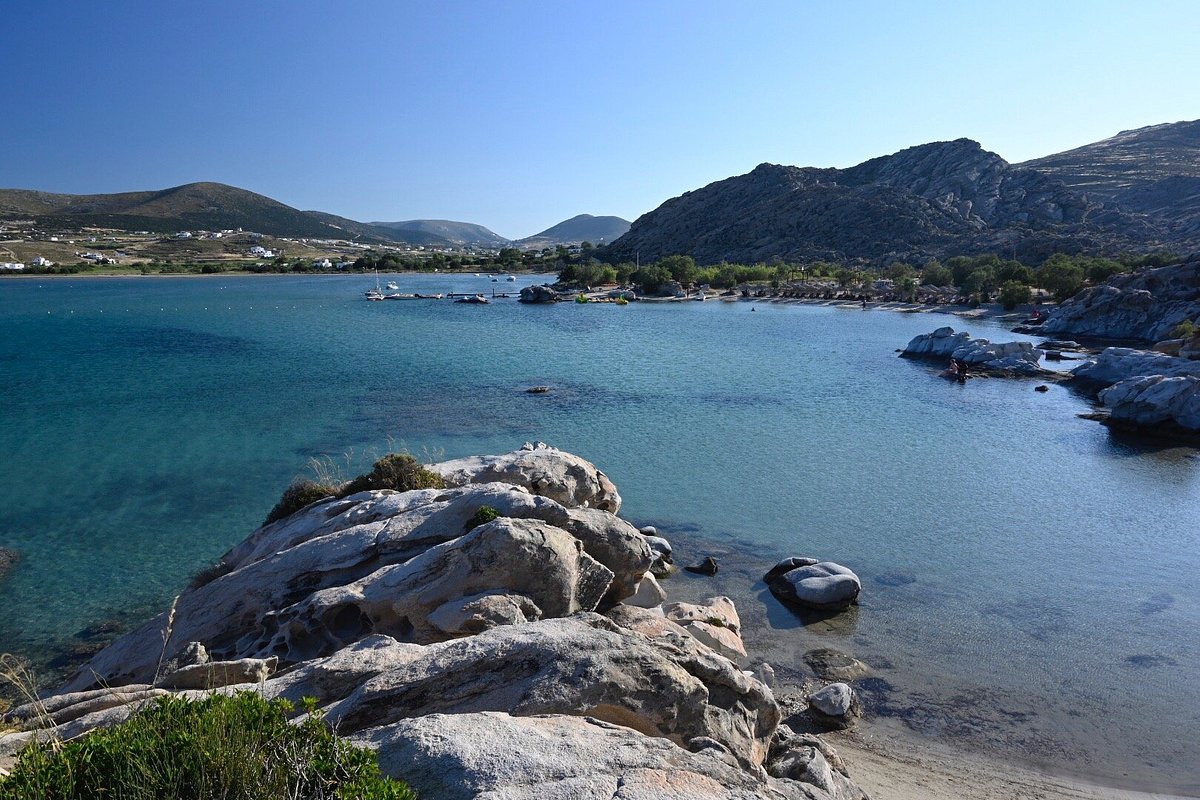
Here wind and sea has sculpted the granite into smooth, but quite bizarre shapes. Between the striking rocky outcrops is a succession of small, sandy coves of shallow with lucid blue water.
The coves are tiny and the more popular spots fill up quickly in season, with every available space used to park a sunbed and umbrella. Less overcrowded spots can be found for those prepared to hunt around among the rocks.
Trees are plentiful and provide good shade while the shallow water makes it an ideal spot for families. Offshore is the islet of Agia Kali, with the small chapel, which you may visit by boat.
The beaches are not immediately obvious from the road and are easily overshot. The coast road is lined with tavernas, apartments and bars. and rough tracks lead down to the beach Wooden signs point to several hastily erected beach bars that seem to sprout up each year, though many are subsequently lost in winter storms. Other impromptu signs point to rough areas used for cars parks.
At the nearby inland site of Koukounaries are the ruins of a 1300BC Mycenaean acropolis enclosed by so-called “Cyclopean” walls. Finally, once at the beach you may see the small islet of Agia Kali, with the small church dedicated to the Assumption of Jesus Christ, which you may also visit by private or rented boat.

beach
Beyond the beaches at Kolimbrethes the road winds it way to the headland past a water sports centre chock full of plastic water chutes and other paraphernalia. It eventually peters out at a small sandy bay at MONASTIRI, some 2km north of Kolymbrethes.< br/>
The whole place has been taken over by a huge taverna complex built on the hill beyond. Most of the beach has been covered with sun beds and shades complete with little wooden tables. The bay has plenty of watersports facilities and is so shallow it is possible to walk many metres out to sea, making it ideal for children of which there are many dozens most days.
There is a large car park on the approach road and the hillside taverna provides all the facilities including the occasional concert and organised beach party. It's a bit too organised for some but, if you don't mind the crowds and noise, about as good as this type of beach gets.>br />
For those looking for a quieter spot tracks snake up the barren hillside beyond where there are several small coves that are a favourite with naturists.

Agios Anargyros beach
To the east of Naoussa are several good beaches. The first, beyond the Naoussa town beach of Piperi, is AGIOS ANARGYRI or ANARGIRI or ANARGYROS, only about 200m along the east coast road out of the resort.
It is a fairly long stretch of good sand with plenty of trees behind to offer good natural shade. It's proximity to Naoussa makes it very popular, particularly as it is surrounded by apartments and small hotels and the soft sand shelves gently into the sea.
All the facilities, including tavernas and cafes are nearby and Naoussa is only a short walk anyway.

Langeri beach
Further east of Naoussa, the road forks with he left fork signposted to Santa Maria on the east coast. Down a dirt track off this road is the splendid stretch of sand and dunes at LANGERI or LAGERI, about 4km from Naoussa.
It's not easy to find, down a dirt track from the main road and not well signposted, but it's worth seeking out with dunes sweeping up to low trees and scrub which provide plenty of natural shade behind a long bank of fine, golden sand that makes up the main beach.
Off the main tourist trail this is popular with naturists. There is a bus to Santa Maria that will drop you off but it's still quite a walk to the beach. There are no tavernas or bars but good views over the bay.

Santa Maria beach

Santa Maria bay
The strikingly beautiful bay at SANTA MARIA is lined with soft sand that sweeps around in a huge horseshoe with a view of Naxos beyond. Backed by shallow dunes and dense green scrub it is a lovely spot characterised by open skies and a wide vista.
It is on the east coast but the only road to it is from Naoussa. There is a large car park at the entrance to the beach and signs warning of danger in the sinking sand cum salt lake nearby but, judging by the tyre tracks through it, no-one appears to take the least notice.
Golden sand lines the shore, backed by flat scrubland. Sunbeds dot the more popular spots while beach bars howl out disco music over the sand. You can escape the bedlam by following the long sands, out of hearing distance at the headland where there is a more traditional beach cantina. Further south the beach becomes more skimpy and great banks of dry, flyblown seaweed line the shore but isolated stands of sand can still be found.
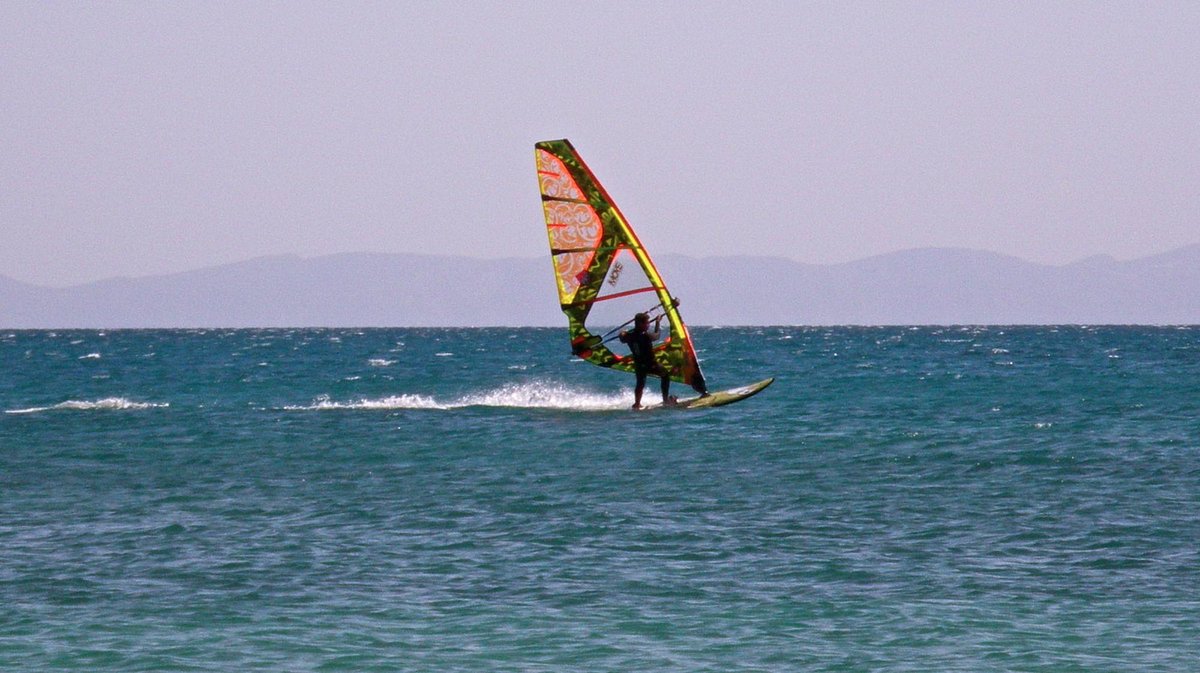
Facing south, Santa Maria is protected from the northerly winds, but breezes can freshen in the bay making this good windsurfing territory and there is usually no shortage of them. Parts of the beach are used by the local campsite and there are diving clubs based here as well as windsurfing centres.
There is an occasional bus and boats do call, though not very frequently as it is a long haul around the northern headland,
From Santa Maria in the northeast the coast heads south and east to the rocky outcrop at Cape Fanos, which marks the southernmost tip of Paros. This part of the coast is the main beach area of Paros with a long row of large sandy beaches interspersed with small coves. Chrisi Akti, in the centre, is the main windsurfing area of Paros and Piso Livadi the main port on this side of the island.

Ampelas beach
Just before the Damoulis Cape is the beach of AMPELAS or AMBELAS, within easy striking distance of Naoussa and so one of the most visited along this stretch of coastline.
Ampelas has a short, sandy beach opposite a harbour full of fishing boats and protected by a line of large boulders. The beach is small and fairly deep, but rarely gets crowded even though caiques of visitors sail in daily.
Another beach is larger, lined by palm trees, and has soft, clean sand with a few stones that and shelves gently into the sea. This is an ideal spot for those wishing to get away from the crowds in Naoussa but prefer beach facilities. There are several tavernas and cafes overlooking both the beach and harbour and there is a campsite nearby.
The more adventurous can take rough tracks north and south that lead to more remote sandy coves.

Glifades beach
A little further south and just 5km from Naoussa is the beach of GLYFADES. Access is down a dirt road and to a narrow strip of stone and shingle with patches of sand here and there, with it getting sandier the further south you go.
The beach is exposed, there is no shade and there are no facilities - just the ticket for those escaping the crowds on more popular beaches.
There are a few remote beaches to be found in the area north of Kefalos Bay but they are remote and little visited. The beach at TSOULAKIA is not much more than a thin strip of sand and pebble.

Mamara church
The road south heads further inland to the attractive hill village at MAMARA. The name Mamara means marble and many of the houses have slabs of marble though most appear to be little more than whitewashed cement.
Nevertheless this is an attractive village with several good churches, narrow streets and small gardens often edged with tall reeds of bamboo to protect them from the winds.
Mamara is surrounded by rich farmland, notably and unusually for Greece is cattle breeding and dairy production. Ancient pottery workshops have been unearthed in excavations to the northeast of the village. A dirt track leads out of the village to the wide, sandy bay of Ormos Kefalos and the beach at Molos.

Kefalos Bay and Molos beach
The wide open Kefalos Bay is reached from Mamara and has a fine swathe of pebble and sand at MOLOS beach. Molos is an isolated and exposed beach that lies between the two hills of Kefalos and Antikefalos, ideal for those looking for a quiet spot away from the crowds.
There are several stretches of sand around the bay and there are occasional stands of trees to provide shade. The sand banks steeply at the shoreline though and the water gets deep very quickly.
There are views across to the island of Naxos and a couple of tavernas that open in the summer in the clutch of houses known as Kefalos. At the northern end of the beach is a chapel to Agios Nikolaos Ftochos ('Poor' Nikolaos).
Another chapel at the southern end is devoted to Agios Nikolaos Plousios ('Rich' Nikolaos) next to a small harbour for fishing boats. There is also a track south that leads over the headland to the beach at Kalogiras.

Marpissa
Back inland and only about 1km south of Mamara is another pretty inland village at MARPISSA, about 18km from Parikia. Tourists often take in both villages when visiting the area and most will have driven from nearby holiday resorts of Piso Livadi and Logoras.
Marpissa itself is a charming traditional village built on a hill overlooking Kefalos Bay, with the Cathedral of Metamorfosi dominating the clutch of whitewashed houses that sit below.
Nearby are ancient ruins, most notably a 15th century fort, and the 16th century Monastery of Agios Antonios.

Piso Livadi beach

Kalogeros beach
Approached through a plantation of pines and eucalyptus, PISO LIVADI is a pretty seaside resort that has grown up around an attractive fishing harbour, about 19km from Parikia.
The beach runs south of the resort and it is long and the sand soft and golden, ideal for families - there is even a children's play area tucked to one side and tamarisk trees behind to provide plenty of natural shade.
Behind the arc of the bay, the slopes are dotted with small hotels and studios and, while tourist tavernas and cafes overlook the harbour and the bay, the resort of neighbouring Logoras can be clearly seen a short distance away. In fact a rash of villas and studios along the coast has now pretty much united the two resorts.
In recent years Piso Livadi has developed into a very popular holiday resort and it is a pretty good alternative to the more crowded resorts to the west. The pretty port is packed with boats and is found around the headland from the beach. Tavernas dot the quayside and boats leave here for Naxos, Mykonos, Ios, Santorini and Amorgos.
To the north, about 1km along dirt tracks are several sheltered coves at KALOGEROS or KALOGIROS. Imposing outcrops of rock are interspersed with small arcs of fine sand and this is the place to escape the crowds. There are no facilities, although a cantina may open sometimes in the high summer. The mineral-rich clay in the cliffs is said to be good for the skin.

Logoras beach ![]()
The beach resort at LOGARAS, just south of Piso Livadi is the quieter of the two seaside villages. Here you will find a long, pine fringed beach of sharp, gritty sand in a fast-growing holiday resort.
Apartments and villas have mushroomed and with them have come tavernas, beach cars, car rentals and other tourist paraphernalia. The scale is still small however and apartments are well hidden behind the trees, so the resort retains a pleasant country village air.
Like Alyki, litter bins abound which, in Greece, actually gives it a creepy, artificial air. A neat car park is provided on the headland where the odd fishing boat is usually anchored to the rocks.

Pounda
Don't confuse the beach resort of POUNDA or PUNTA with the ferry port at Pounta on the opposite western side of the island. This is basically one huge nightclub to which the sandy crescent shaped beach, 26km from Parikia, very much takes second place.
Pounda or Pounta beach heaves with young bodies most of the day. This is where the boys parade their pectorals while the girls wiggle and giggle. It's where the windsurfers come to play after a hard day on the boards.
There is a fine, sandy stretch that caters almost exclusively to to youngsters who want to dance, drink and have fun in the sun. Next to the beach is a large complex, built in quasi-Mexican style, that includes swimming pools, bars, cafes, restaurants and shops. It has everything from disco to bungee jumping.
The area surrounding Pounta beach has a wide range of hotels, rooms for rent, apartments and studios. There are buses but they drop you off at the bottom of a very steep hill.
Just south of Pounda is a small sandy cove at MESADA or MESSARA that is much favoured by nudists.

Chrisi Akti ![]()
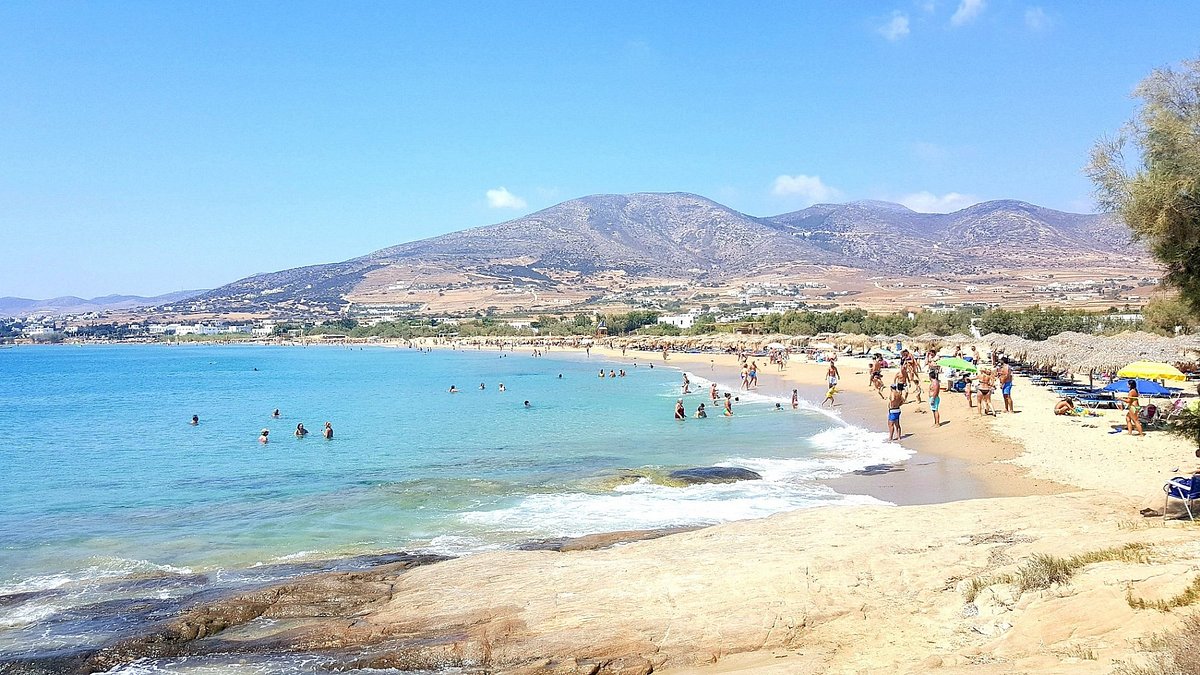
Described by many as Paros' premiere beach, and certainly its most famous, is CHRISI AKTI (Golden Beach) a very long and flat sandy beach, about 22km from Parikia, and a Mecca for windsurfers.
The main beach is a good 700 metres of soft sand backed by a several tavernas, small hotels and studios. Both long and wide, the beach is big enough to swallow up the hotels and tavernas but not their brollies and sun beds ,which carve up most of the sands and at a hefty price too.
The annual influx of free spending visitors appears to have taken its toll on the locals, some of whom appear to have adopted a grasping and greedy attitude unusual in Greeks. Freewheeling sharks, it seems, are not restricted to the surfboards.
A wide variety of windsurfing, beach and water sport facilities is also available including surf schools, scuba diving, water skiing, wind and kite surfing and catamaran sailing. The flat sand and shallow water make for ideal surfing conditions.
The smaller NEA CHRISI AKTI or New Golden Beach, nearby (also known as TSARDAKIA, has hosted the Professional Windsurfers' World Cup each August since 1993 and comes with a guarantee of plenty of wind in the sails thanks to the predictable northerly meltemi wind.

Drios beach
Northeast of Cape Pyrgos and about 2km south of Chrisi Akti is the resort of DRIOS. The beach resort has a smattering of hotels and apartments that have done little to cheer up the undistinguished narrow beach, but the village itself is pretty enough with a nice duck pond. There are several tavernas and bars in the village which benefit from the trees and other greenery.
Drios has a long, steeply banked beach of sharp sand, lined with plenty of trees. During high season, Drios can get rather crowded with sunbeds, and water sports are popular here. The beach is well sheltered from the northerly winds and there are plenty of beach bars and restaurants. There are regular buses to Parikia and Naoussa.
Drios was a major harbour in Paros around 1000 AD as the rock formations provided natural protection for ships. Nearby, there are fissures in the rocks which were used as ship piers to protect boats from storms. Offshore is the small, uninhabited islet of DRIONISSI.

Glyfa beach
The small crescent of sand at Glyfa sits below the hook of Cape Pyrgos which shelters it from the northerly winds. Access is down a good dirt road signposted off the main coastal road about 15km from Paroikia.
It is so sheltered the seas can remain calm even as other beaches on this stretch of coast get quite choppy. The beach is sand and pebble with good natural shade provided by a line of tamarisk trees at the back of the beach. Rocky outcrops at either end add interest and the shoreline water quite shallow.
Little advertised, it remains quiet even at the height of the season and a small cantina opens in the summer to cater for the few lucky ones who find it.
The west coast of Paros is littered with islets, while the long island of Antiparos sits further offshore. There are fewer beaches along this part of the coast with Alyki in he south the only major resort. Nevertheless, there are gems to be found along the long coastline where a coastal path makes for some very fine walking.

Alyki beach

Farangas beach
The Paros resort of ALYKI must be putting itself up for a tidy village award. The place is spotless, almost to a fault. Faults include litter bins parked in the middle of a long stretch of soft, clean, golden sand that shelves gently into the sea.
This once lazy fishing village, about 14km from Parikia, appears to have been under full-time construction for the past few years. Despite the boom, the village has a dainty, even twee air with its freshly painted walls (of stone, not cement), neat streets (no rubbish in sight) and tastefully decorated roadside tavernas.
The long, sandy beach has tamarisk trees behind for plenty of natural shade. A walk around the headland leads to a car park and another beach, more stone than sand here.
A dirt track road out of Alyki is signpostedFARANGAS and leads to a quiet, sandy beach and beach bar. There is plenty of natural shade beneath the nearby trees or you can hire a sunbed and umbrella. It is little known, despite a beautiful, sheltered setting and good sands, so it rarely gets crowded. The beach is also called FARAGAS and there are several small coves nearby, though this is by far the most popular
The Museum Scorpios, north out of the village and opposite the small airport on the main road to Paroikia and near the village of Voutakos, has animated handmade miniature figures depicting past life on the island.
To the south, through Akrotiri, is the nondescript hamlet of TRYPITI where there is a small arc of sand at the end of a rocky inlet and an electricity sub station to spoil both the beach and the view.

Voutakos beach
The population thins out dramatically north of Alyki. The area around the little fishing port of VOUTAKOS has been given over to quiet, relatively isolated holiday homes and apartments, mainly thanks to the spectacular views to Antiparos and to several other small islets offshore. It is said that you can see 10 islets from these hills.
At Voutakos there is a good sandy beach, well sheltered from the meltemi winds. The south side of the port is mainly rocks but the north has a long stretch of good sand. Access is not easy, down an unsignposted dirt track from the main road.
There are several small, sand coves to be found down dirt tracks from the main road, which turns inland here as it heads to Alyki, but none of the beaches has any facilities. There is also a good coastal track that runs many kilometres from Pounta to Tripiti and passes through many of these coves.
The island airport is inland from here, with regular flights to and from Athens. Local buses link the airport to Paroikia.

Pounta windsurfers
POUNTA serves as the main ferry port to Antiparos if you prefer to take a car across - highly recommended if you wish to see much of the offshore islet as there is little or no public transport. Pounta port itself is about 9km from Paroikia and is a drab little place consisting mainly of a huge concrete car park, concrete jetty and dirt.
This is the closest point to Antiparos, with few permanent residents but with many hotels and rooms to rent. Ferries dock every 15 minutes or so in season so at least you can leave the place behind fairly swiftly. Don't confuse it with the club-style resort on the east coast that has the same name.
Most visitors to this part of Paros are heading to Antiparos or for the coastal area to the south, noted for its kitesurfing. Several windsurfing and kitesurfing centres have grown up along the long, flat sands. The channel between Paros and Antiparos funnels good winds and the shallow-watered shoreline helps to make this place one of the most popular beaches on Paros for surfers. During the summer, the “meltemi” can blow between 10 to 30 knots.

Agia Irini beach
North of Pounta, on the headland and opposite the islets to the north of Antiparos is the tiny resort of AGIA IRINI. This has a very pretty and sandy beach at the end of a well sheltered bay that is noted for the many palm trees that give the sands a rather exotic air.
Access is from a shore hugging back road from Parasporos or down a rough track marked off the main road which runs a little inland. There are two sandy coves split by marble slabs, palm trees and a waterside church.
The palms descend right down to the beach and there are plenty of rock pools to add interest but bathers must take care of the many underwater rocks and stones. There is also a nice taverna next to the farm and a shady olive grove that has a wide menu.

Parasporos beach
Those heading south out of Paroikia find PARASPOROS to be the first substantial beach, but one that is strangely disregarded by many island guides. A track leads down from the main road then rises sharply to a roughly laid car park on the exposed headland.
An extensive and not unpleasant wood-built beach bar overlooks the best of the sands. Bar owners have stuck sun beds and parasols on the best parts of the beach but, as these are of natural materials, they are not objectionable - although they come at a cost.
The sand deteriorates as it sweeps around the bay past a bog-standard beach bar. At the far side of the bay it is more or less grit and dust although there is a pleasant grove of trees to give shade. Swimming is very pleasant in the shallow bay, but only after a large bank of underwater stones has been negotiated.
This has become very popular with youngsters in recent years and disco music is never far away. There is a campsite at the southern end of the beach that runs its own bus service. Public buses stop nearby on the main road and it is only a short walk to the beach.
A coastal path leads to a small bay to the north called SOUVLIA. Somewhat confusing as a long, sand beach on the other side of the bay appears to have the same name. This one is only a small scrap of sand with a few trees for shade and surrounded by recently built villas and apartments.

Ekatontapiliani

Church courtyard

Church interior
To one side of the slabbed central square in Paroikia is an imposing, if drab, wall with an unattractive gateway and steps. Beyond this monolithic marble wall however is one of the most beautiful buildings in the whole of Greece.
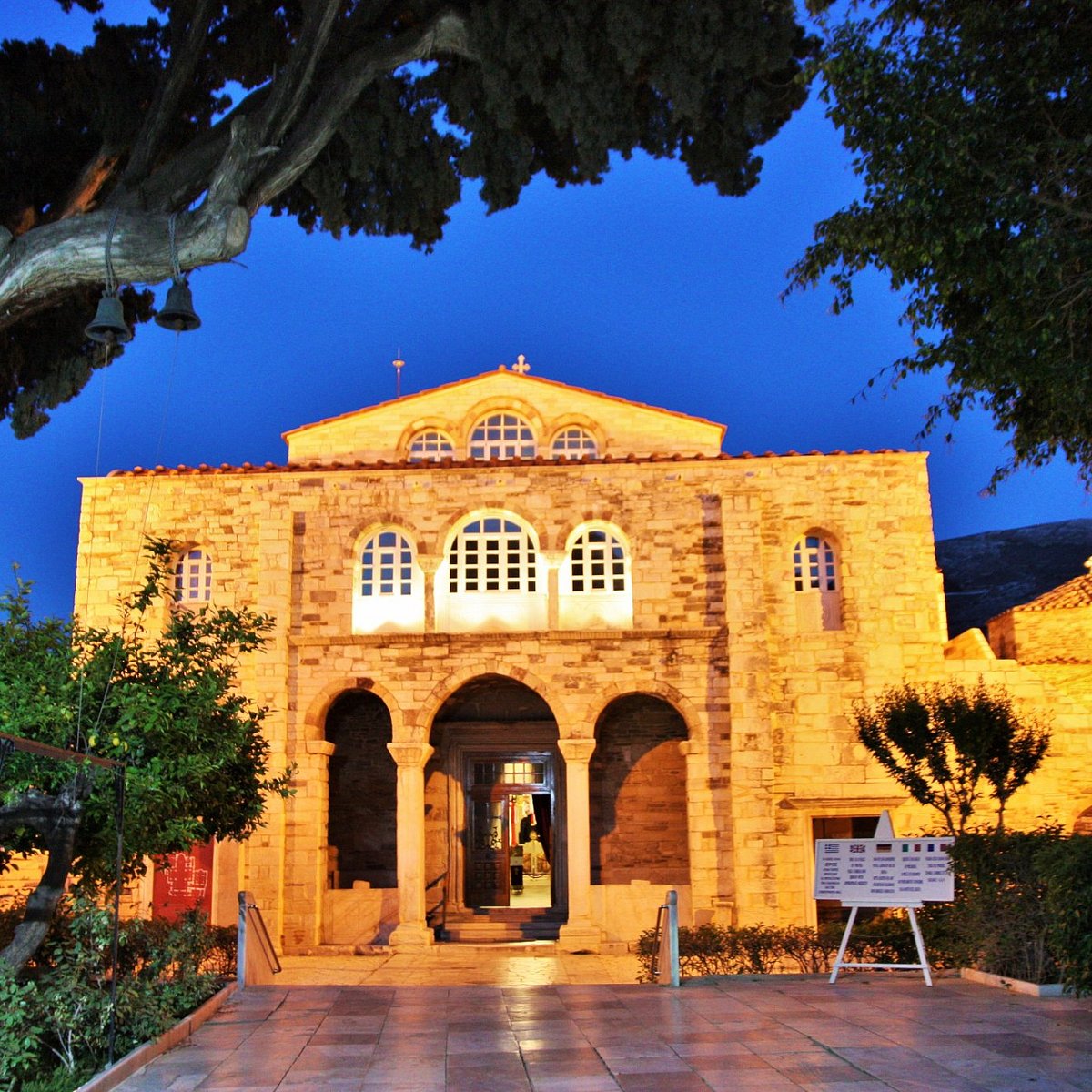
Dubbed the finest church in the Aegean, the Cathedral of Ekatontapiliani (the Church of One Hundred Doors) was founded in 327 AD, rebuilt in 527-565 AD, reconstructed after a 10th century earthquake and again in 1855 then finally restored between 1959 and 1966. What you see today is considered to be essentially the church as it was in all its 6th century glory. And what a glory it is.
The lovely courtyard is full of flowers, ancient marble slabs and the church bells hang from a majestic old cypress - the bell tower itself was destroyed in an earthquake in 1783.
The church basically consists of an atrium and baptistery outside, the porch and main church, the sanctuary and three chapels. To the right of the main door is a gallery called the yinaikonitis (women's place) where women once stood apart.
In the centre of the church is the dome supported by four large, square pillars and before you a huge, ornately carved wooden and marble screen is covered with icons and holy images. There are nowhere near 100 doors but the name has stuck anyway.
Beyond is the sanctuary; entered through two doors where once only emperors and clerics were allowed. Today you can go in, but only with the express permission of a priest or nun.
This is still a house of worship despite thousands of visitors trooping around each year and daily services are still held as they have been for 1,500 years. Matins is at 7am and vespers at around 6.30pm. If a service in progress it is proper to stand each time a priest enters, and to bow your head as he passes.

Butterfly valley
Like Rhodes, Paros has its own Butterfly Valley, clearly marked off the roads on the western side of the island to Pounta and Alyki. The luxuriant, leafy valley set in the hillside at PETALOUDES is temporary home to the Jersey Tiger moth Euplagia quadripunctaria in July and August.
Difficult to see except when in flight, the brown moths are well camouflaged. When airborne they display their deep red overwings, but the practice of disturbing them is firmly discouraged as it can reduce their sexual activity and result in fewer moths for future generations.
The valley is actually a private garden, but tourists are made warmly welcome by a small cafe with a fountain and well marked paths through the undergrowth. The dappled shade and running water can make for a pleasant break from the scorching summer heat.

Lefkes village

Lefkes street
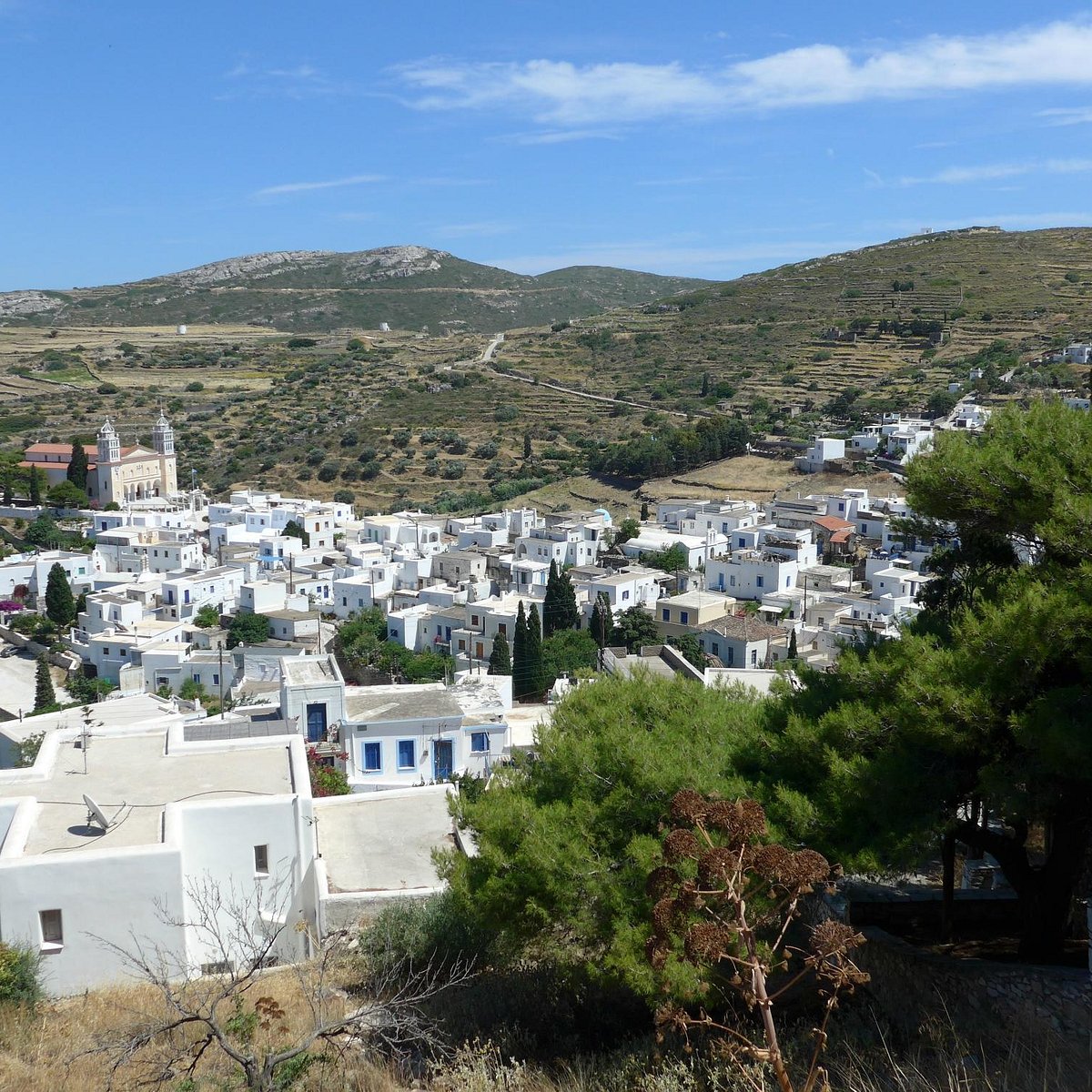
High in the hills above Marmara and Prodoromos, in the centre of the island, the village of LEFKES spills down into the head of a narrow valley, about 11km southeast of Parikia.
Marble-paved streets and whitewashed houses sit both sides of a deep valley, dominated by the white marble Agia Triada built in 1830, with its impressive bell towers and its recently repaved entrance.
The steep slopes allow chimneys to appear in abundance at street level and many have carved pelicans or other sea birds etched into them. Lefkes means poplars and the village is a leafy relief from the surrounding bare hills thanks to a patchwork of pines, olives and cypress.
When Paros was regularly raided by pirates in the 15th century this was the island capital and, as a result, there are many fine houses on the steep slopes which drop into a mesmerising warren of stepped alleyways.
The central square has huge plane trees providing shadow for the cafe tables beneath. The stone paved area leading to the square is made of marble slabs surrounded by a network of narrow streets. Occasional shops offer wares a cut above the usual tourist fodder with good local handicrafts, paintings and pottery.
What is most impressive about Lefkas is that it has managed to shrug off the annual tourist invasion and the character of a Greek village is alive and well. From Lefkes you can take to the Profitis Ilias mountain which, at 2,500 ft offers splendid views but is marred by an ugly communications tower at its summit.

Antiparos island

Antiparos stalactites

Cave graffiti

Camping beach
A short trip across the water from Pounta (a little further from Paroikia) takes you to ANTIPAROS, altogether quieter throughout its 12 km length than its more popular neighbour.
Most day trippers spent a little time looking around the island's main port of Antiparos before heading off for a look at the famous caves some, distance to the south after the road turns inland at Glyfa.
Donkeys are offered at the car park at Agios Ioannis, but they only trot around the corner up a small incline so are of little use except for the photographs. The entrance to the cave forms a broad, wedge shape underneath a massive stratum of limestone.
Electric lights and cement steps snake down for 70 metres or so among some amazing stalactites and stalagmites, many marred by graffiti (some of it 200 years old) and others broken or incomplete.
Modern day graffiti is discouraged as the caves have been developed for tourism. Unfortunately the cave has been repeatedly vandalised over the years. Officers of the Russian fleet reputedly made off with many of the 2,000-year-old stalactites in the 1770s and Nazis used guns and grenades to bring down many more, bless their cotton socks, but there is still plenty to admire even if you are not quite fit enough to reach the bottom. Photographers however will not be pleased at the truly awful yellow lighting that fills the caverns.
Elsewhere the island is a bit of a backwater with a few small, sand beaches and not much else. The main port at ANTIPAROS is the most densely populated with around 500 permanent residents and a very pleasant harbour and main square. Most of the shops are now of the knickknack variety and sell trinkets for the tourist trade. There is a sign to the CAMPING BEACH, a pleasant spit of sand on the north of the island opposite the islet of DIPLA where you can pitch a tent only a few metres from the seashore and which once was a naturist beach but today is more or less textile.
South of the port, and within walking distance, is the double stone and pebble beach of PSARALYKI. The larger beach is mostly pebble and a little sand. There are sunbeds and watersports while the smaller beach is home to a couple of music clubs and consequent noise.
A further 1km south is a small sandy strip at PANAGIA with views across to Antiparos and some trees for shade, while the sandy stretch at GLYFA is a further 2km. There are a few nice beaches. Near Antiparos on the western side of the island is one of the best at SIFNAIKOS. Also along the west coast is a narrow strip of sand at LIVADI where you could well be the only one where on any particular day.
To the south is the lovely AGIOS GIORGIOS, where a spit of sand loops out into an emerald green, though rocky sea. A good taverna sits along the shoreline with octopi often hanging out to dry in the baking sun.
See photo gallery of Paros and Antiparos VICTORIA HAMMOND
If you would like your photo gallery here then email details. It takes 10 photos to make a gallery and they can be of the whole island or of a particular resort.

The beautiful Greek Islands are renowned for their spectacular scenery, magnificent mountainous backdrops, stunning sandy beaches and crystal clear waters.
Holidays to the Greek Islands are often most cherished for this combination of sunshine, warm waters and beaches set against truly wonderful scenery.
Whether it is a traditional beach holiday you would like or something with a little more history, you'll find that a break away to the Greek Islands is just the answer!
Long, hot summers and low winter rainfall make many of the Cyclades look burned out and barren especially in the high season. Summer comes early with April and May often the best months especially for catching the wild flowers. Temperatures can soar in June but are somewhat tempered by the north west meltemi wind which can blow pretty strongly from July to September making north facing coasts particularly uncomfortable for sunbathing.
Rainfall is virtually non existent between late-May and early September and even in April and October prolonged rainfall is rare. Relatively low winter rainfall means the Cyclades do not benefit from lush green growth of islands such as the Ionian and can look bare and frazzled after the first flush of spring.
| JAN | FEB | MAR | APR | MAY | JUN | JUL | AUG | SEP | OCT | NOV | DEC | |
| 9 | 9 | 11 | 15 | 18 | 21 | 25 | 25 | 24 | 18 | 14 | 10 | Avg °C |
| 0 | 0 | 0 | 8 | 24 | 30 | 31 | 31 | 30 | 23 | 4 | 0 | 20°+ days |
| 200 | 200 | 250 | 110 | 65 | 20 | 0 | 0 | 10 | 150 | 280 | 360 | Av rain (mm) |
Paros has a domestic airport near Alyki that takes Olympic flights from Athens. There are international airports at nearby Mykonos and Santorini.
Ferries offer the best way to travel in Cyclades. The islands seethe with ferry boats throughout the summer months. Many of the larger ones are luxurious with deep bucket seats, air conditioning, ever-open bars and surprisingly cheap ticket prices too. Throughout the summer there are daily sailings to the Athens port of Piraeus by at least five boats with connections three days a week to Rafina, just Northeast of Athens. Other regular connections include daily boats to Ios, Santorini, Paros, Amorgos, Mykonos, Tinos and Andros. Sailings Syros and Silanos, Siphnos, Crete and Samos are less regular. Daily excursions go to island beaches and to nearby islands such as Mykonos and Delos. There are regular crossings to Antiparos from Paroikia but if you have a car or bike dive down to Pounta where you can take your vehicle across every 20 minutes or so.
Cars and bikes are a good bet on Paros. The roads are generally good and well marked though condition deteriorates away from the main roads and a bike is the best bet for more remote stretches of coastline. Paroikia can cause problems when ferries arrive as the road runs right past the dock. Hundreds of visitors, not to say scores of cars and lorries spew from the quayside turning the already congested centre into a maelstrom of flesh and metal. The one-way system to the north of the town is another unforgettable feature, as is the centre of Naoussa at the height of the season - avoid both if you can.
There are five main bus routes from the centre of Paroikia. One goes to Drios via Lefkes, Piso Livadi and villages between. A second plies between Paroikia and Naoussa. A third goes down the west coast to Alyki while a fourth stops at Pounta to meet the ferry. The fifth goes to Naoussa then heads east to Piso Livadi and ends at Drios. Times are posted on a kiosk near the small habourside church in Paroikia.
Paros Holiday and Travel Guides: Foxy's Greek island guide to Paros Greece holidays
Islands of Greece: Luxury villa holidays on Paros from Greek Island holiday specialists
If you want your site considered please email me