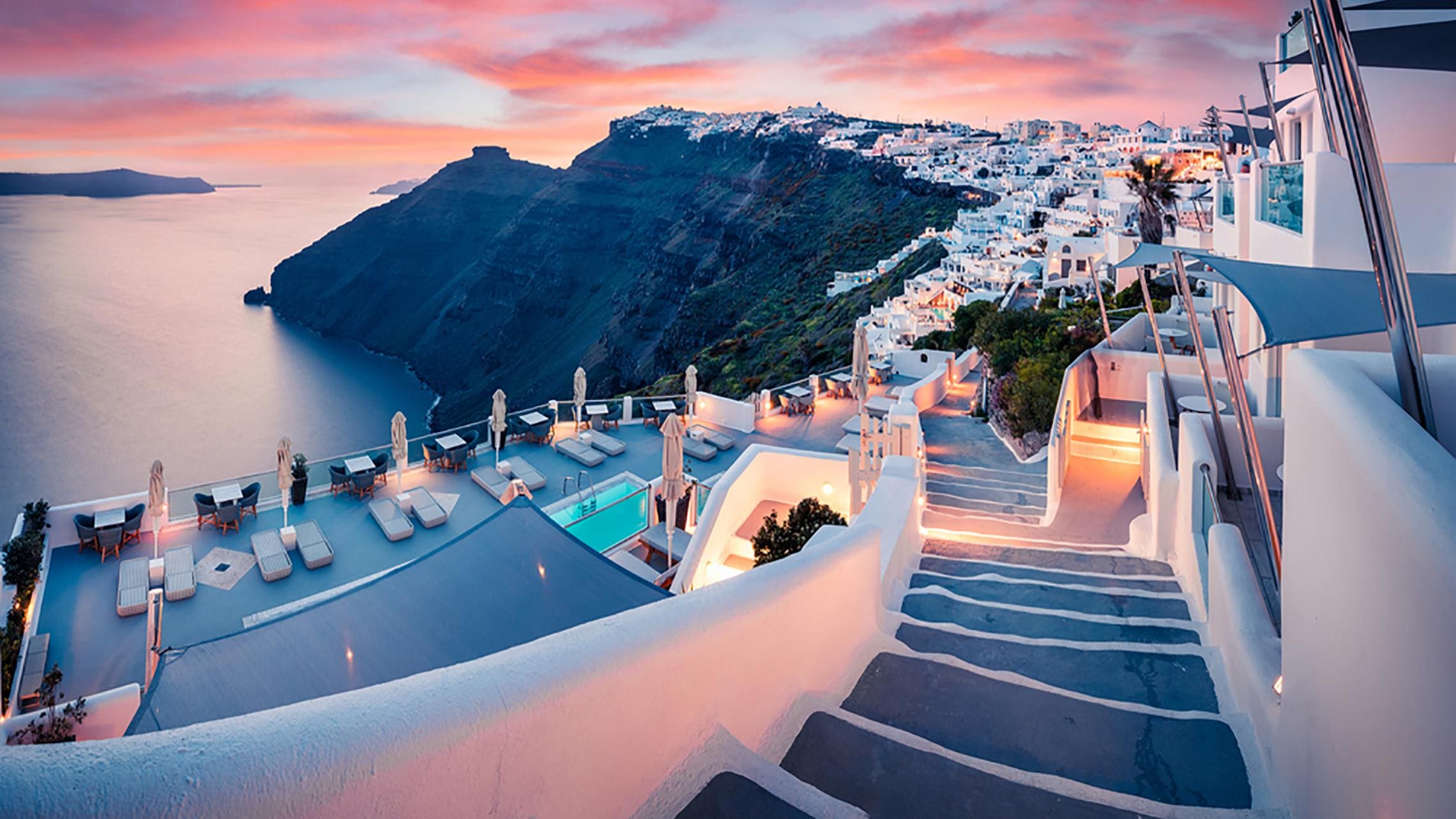
SANTORINI, also called Thera or Thira, lies at the south of the Cyclades group at the heart of the Greek islands. It is the hottest spot in the Cyclades in more ways than one. Born in a massive volcanic eruption, fumes still rise from the active offshore volcano to create the most stunning sunsets in the Mediterranean. Cruise ships arrive in droves to take in this startling island with its romantic views, highly charged air and volcanic nights.
Santorini is a hugely popular island and prices reflect the fact. Expect to burn a sizeable hole in your wallet to get the best views in the best bars.
The capital Fira perches on vertical cliffs overlooking the caldera. The romantic pull of those sunsets make this an island favourite for honeymooners. Busy beach resorts and lively nightlife make it a poor choice for a relaxing holiday, but ideal if you are looking for a lively buzz and don't mind the crowds.
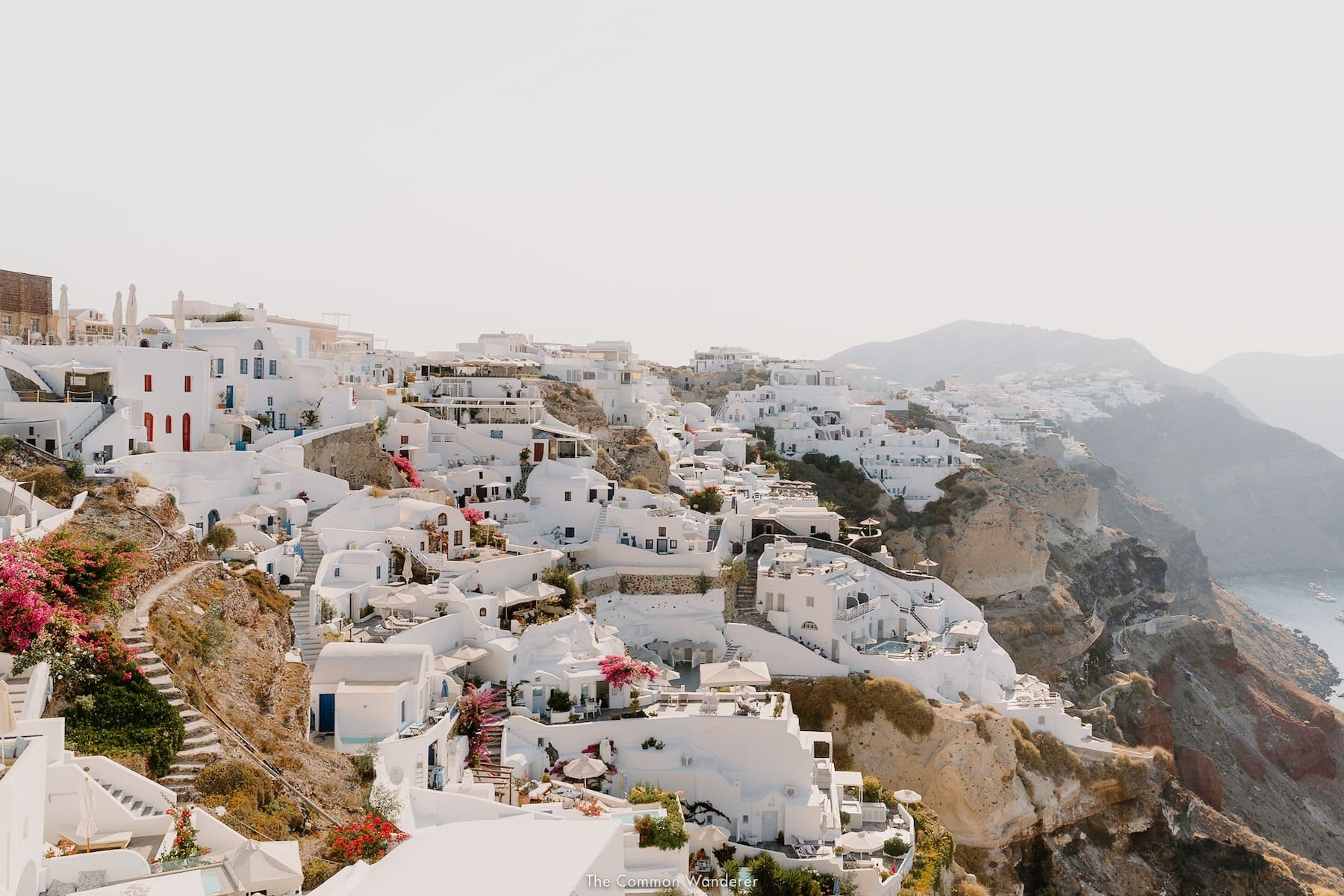
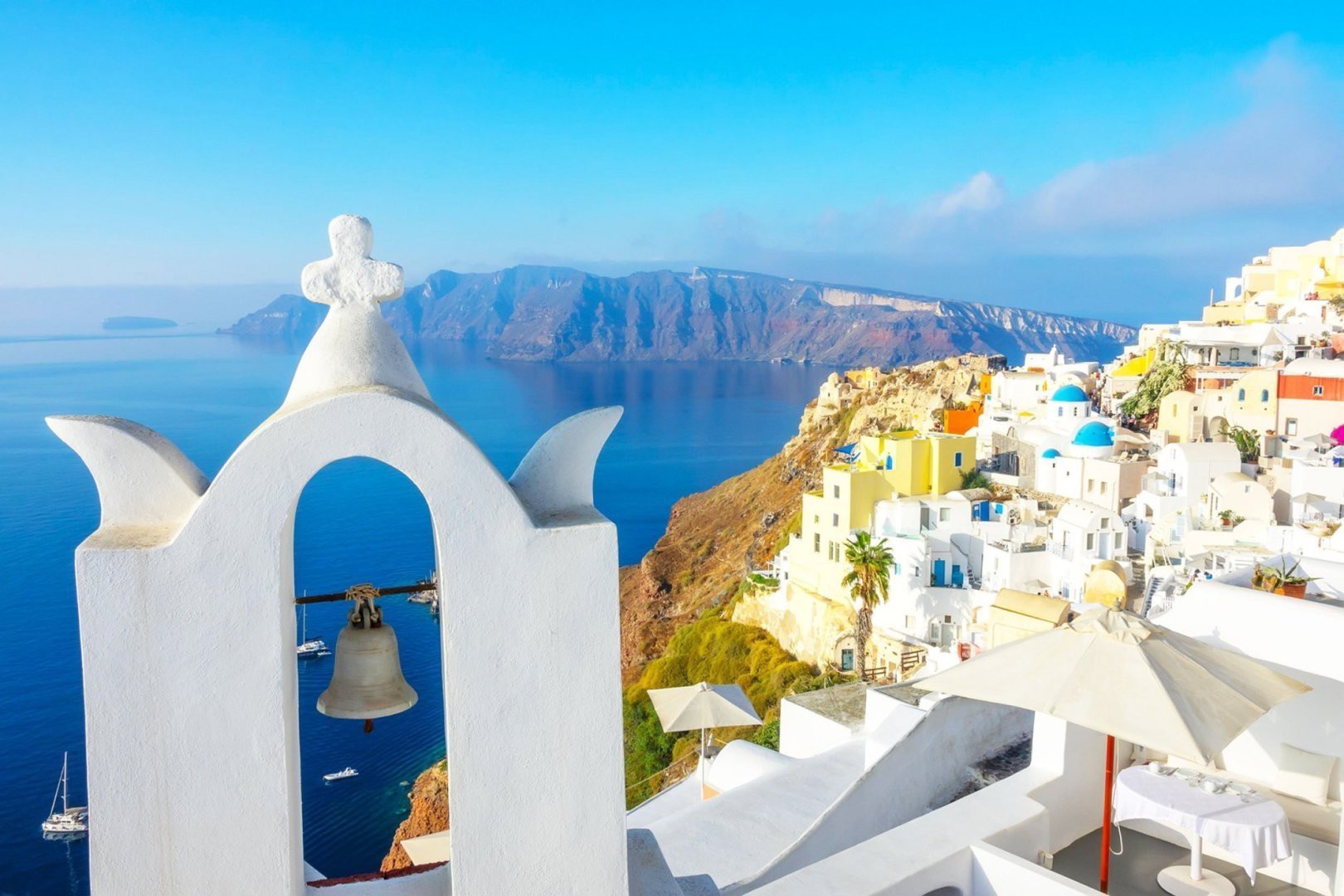
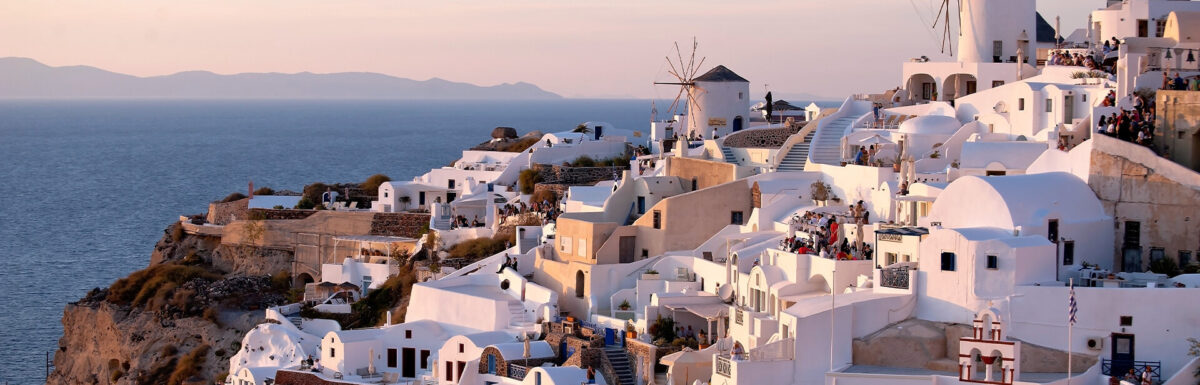
Spectacular is a word often used in describing the Greek islands but it must surely apply more than most to Santorini. Visitors sailing into the flooded crater (or caldera) are greeted by dizzying cliffs with dazzling white villages plastered like dollops of cream on the sky hugging rim.
An island of extraordinary contrasts, it can be both breathtakingly beautiful and deeply unattractive. The sheer cliffs of red and black can feel intimidating. Prepare to be slowly grilled on the burning black volcanic sands that make up Santorini beaches.
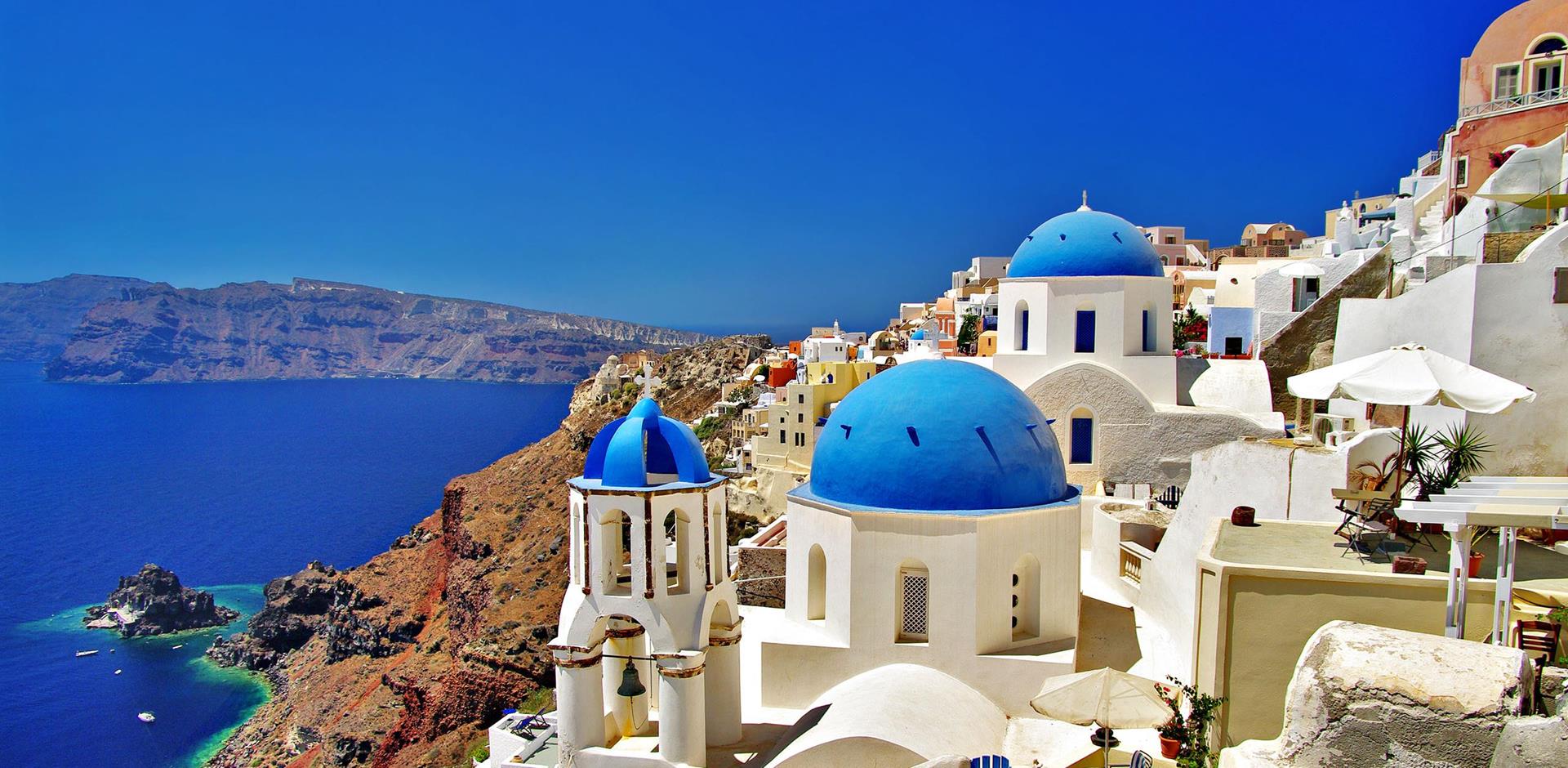
The white cube houses and blue domed churches may tumble attractively down the cliff side in the capital Thira but its streets are heavily developed with expensive cafes, trendy shops, and near nightmare swarms of tourists.
Most daily visitors are here for the famous sunsets, viewed through a forest of heads and whirring cameras. The fumes from what is still an active volcano are responsible for those gaudy skies.

Daily bus
Cash machine
Boat hire
Blue Flag beach

Fira and the caldera

Fira port
The island capital of THIRA, THERA or FIRA overlooks a magnificent caldera atop some 300m of sheer black, red and brown stratified cliffs. Cruise ships anchor by the dozen in the bay below. Most dock at the 'new' port of Athinios, built after the 1956 earthquake. A winding road snakes up the cliff in a series of tight hairpin bends that are taken a hair raising speeds by taxi and bus drivers.
The old port, 'Ormos', lies directly below the town in water so deep that ship anchor chains won't reach the sea bed. Giant mooring buoys have been built for them to tie to. The port is little more than a quayside and visitors don't stay for long, though there are now restaurants and some small shops.
Embarking tourists are pestered with offers of a mule ride up a steep, zigzag staircase while less adventurous opt for the more sedate Austrian-built cable car. It's not advisable to walk the 600 or so steps. The 250m staircase path is heart-stoppingly steep and those not brushed aside by galloping mule teams must pick through their copious droppings.
It is no more advisable to mount a mule - though the saddles do seem popular with obese Americans. The grim-faced riders bounce along, scraping thighs and legs against the rough stone walls. Mule owners don't need to rely on on customer satisfaction - there is always the next cruise ship.
Riding a mule down the steep slope is an even bigger mistake. The animals career downhill at speeds that suggest they would like nothing better than to catapult their burdens over the low walls and into the sea below.
In Fira itself white cube houses and blue-domed churches spill down the terraces in an appealing mish-mash that was extensively rebuilt by cement mixers after an earthquake in 1956. Staggering views of the caldera are offered from the tables of cafes and bars and watching the nightly sunset is a very popular, if very expensive, pastime.
And there lies Fira's biggest disappointment - nothing is now left of the quiet tavernas, the old kafenia or the tiny grocery shops. They have all been supplanted with trendy boutiques, expensive jewellery shops and outrageously pricey bars, many belting out cheesy music.
Everything is geared to teasing cash from the endless stream of wallets. Though the island abounds in volcanic pumice, shops sell 'rare' pumice to the gullible and tavernas turn out fast food by the bucket - the ridiculously named McZorbas restaurant says it all.
The most expensive shops flank the main axis while most nightclubs can be found near the main staircase, offering beautiful caldera views for the heaving crowds as they down fabulously priced drinks.
The village winds like an artery along the caldera rim with a cliff path that runs from the mayor's offices to the Nomikos Conference Centre.. A Catholic cathedral dominates and a nearby convent sells hand-made rugs and embroidery. The north of the village is less volatile, more peaceful and well worth exploring. The museum is a bit of a washout as the fabulous frescos found during excavations at Akrotiri in the south have all been carted off to Athens. But the Megaron Gyzi museum is worth a poke around if only for old maps of the Cyclades and photos of Fira before the 1956 earthquake.
The Archaeological and Prehistoric Museum opens 8.30am-3pm and the Megaro Gizi Museum 10.30am-1.30pm, 5pm-8pm and Sunday 10.30am-4.30pm. There is also the Folklore Museum which opens 10am-2pm.
Taking the road north out of Fira brings you to THIRASTEFANI or FIRASTEFANI, once a separate village but now pretty well swallowed up by its growing neighbour. The name means 'crown of Fira' and it is said to have the best views on the island though the claim is moot since all the villages that sit along the north eastern rim will claim the same and one sunset view is pretty much as good as any other.
Still, Firastefani is marginally less busy than its noisy neighbours and slightly less expensive, although its in now almost entirely composed of hotels, pools, villas and apartments with a few restaurants and cafes perched precariously along the cliff top.
Daily buses
Cash machine
Boat hire

Skaros
If you prefer your caldera sunset views without huge swarms of trippers then IMEROVIGLI is the place to head for. Though, like Firastefani, it is still little more than an extension of Fira it tends not to fill up with day visitors and is a little too far out of town at 3km for cruise boat passengers on shore leave.
It is the highest spot along the caldera rime and the awe inspiring views peak at the cliff top site of SKAROS, an imposing but ruined citadel fortress which the Venetians once made the island capital.
The village is now classed a 'Traditional Settlement' to protect it against over development even though much of the village was destroyed in the 1956 earthquake. The buildings that survived have been tastefully restored, particularly the traditional 'cave' homes that were carved into the hillside
.The Church of the Panagia Malteza has an impressive iconostasis and icons depicting scenes from the Old Testament.
A small white chapel nearby occupies the site of the Rocca - a once impregnable fortress that resisted all that an attackers could throw at it but was destroyed by the 1956 earthquake and a cliffside footpath runs from here back to Fira to offer some of the best views over the caldera.
If Fira is trendy, the phonetically challenged OIA (pronounced Eea) is upmarket trendy. The position is much the same as its noisier neighbour; splendid views over the caldera rim, yachts bobbing in the sea and a winding staircase down to a small quay.
Once a major fishing port, quite a number of houses survived the 1956 earthquake and many have been tastefully restored. Some are bright, rich colours but most are painted brilliant white, clinging to the red and grey cliffs so closely that one family's roof can be another's courtyard.
Shops tend to sell more authentic - if expensive - goods, food is more traditional Greek and the annoying thump of disco music usually absent. This is the place for designer jewellery, arty galleries and pricey boutiques.
Many people gather in the main square, overlooking the sea, to glimpse the sunsets. It gets crowded in the afternoon as buses bring in the tourists. By early evening it is packed with sunset watchers who will sometime offer an implausible and slightly daft round of applause!
Worth a visit is the Maritime Museum, with its models of ships and other sea-going paraphernalia which opens 10am-2pm and 5pm-8pm. The village also has several art galleries and a cultural centre among the inevitable souvenir and gift shops.
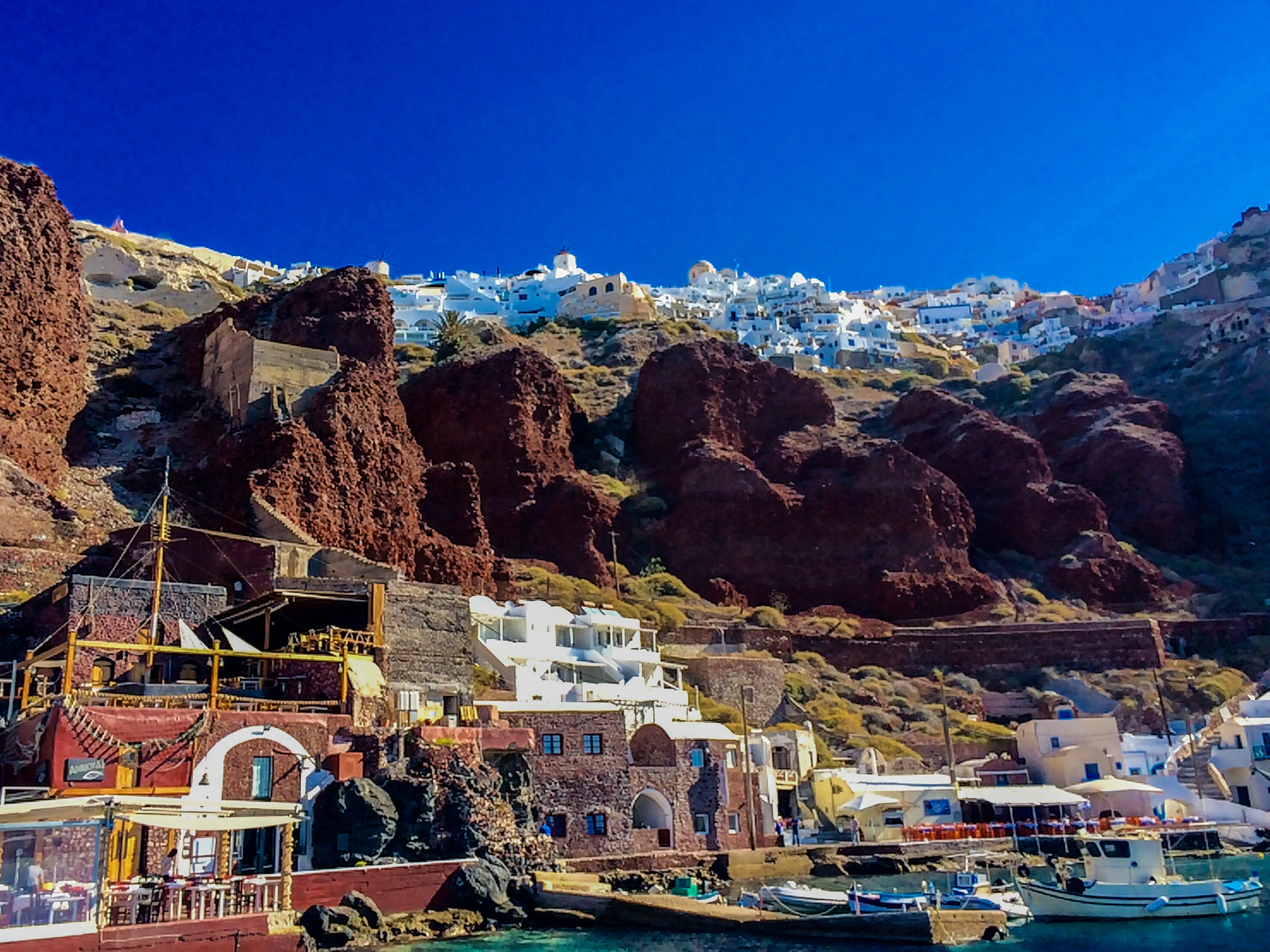
A warning for visitors in cars - stick the official car parks as illegal parking can bring a swift and heavy fine. Unlike Fira, Oia has access to the sea at AMOUDI and at ARMENI, where there are small quaysides with waterfront tavernas. They are both at the bottom of very steep stone staircases of 200 to 300 steps, though you can take a mule ride if you prefer.

Cape Koulombo
The far northern coastline is virtually inaccessible until you reach BAXEDES through an area of low rolling hills. The beach as Baxedes, also called Paradisos, is small and pebbly but, notable for Santorini, the waters are shallow. There is a beach cantina in the summer, a couple of tavernas and sun beds for hire. Another gritty black beach is found a little further south at CAPE KOULOMBO. This is a long but thin narrow strip of coarse sand backed by looming cliffs that wouldn't look out of place in a bleak sci-fi movie as the wind has carved them into weird and interesting shapes. There are no facilities and few visitors on this exposed part of the coast and it is quite a walk from the car park. About 4km offshore is an underwater crater remains of a volcanic eruption that devastated the island in 1650.
Furthere south still is a small beach at PORI set in a tranquil bay beneath hillside vineyards and with a small fishing quay and a couple of tavernas. Swimmers should take care here as the currents are particularly strong.

Vourvoulos
VOURVOULOS village is a continuation of Firastefani but a lot quieter with stunning views to both sides of the island. There are a number of small beaches along this stretch of coast. The most northerly is XIROPIGADO, a narrow strip of pebble down a dirt track off the main east coast road and not particularly notable.
Just south is Vourvoulos beach itself, down another dirt track and not particularly good either. It is the same thin strip of gravel, though black sand is more in evidence here and there. There is a small harbour with fishing boats, a coast path is lined with beech trees and there is a taverna. A long cement wall doesn't add to the charm of the place and, being open and exposed, the beach attracts a lot of debris. If the wind gets up the waves can be seriously strong.
Further south still is KANARAKI beach, named after a local factory owner, where dark greyish red bluffs of volcanic rock loom over a narrow beach of black pebbles. There are no facilities here or at nearby EXO GIALOS beach where caves have been hollowed out into the rock, although a small beach cantina sometimes opens in the summer months.
The best beach along this part of the coast is at KATERADOS where there is a long stretch of black sand and a couple of decent fish tavernas. A dirt track runs parallel to the beach all the way down to Monolithos.

Monolithos
MONOLITHOS is a rather drab seaside village about 8km from Fira that takes its name from an impressive rock outcrop where now sits the church of Agios Ionassis.
The beach is a grey sand and shingle, long and deep backed by brooding cliffs that hang above a narrow road along the back of the beach. The sand dips very sharply into the sea but the waters are shallow enough to wade so it's fine for families with children.
There is a beach cafe and shower with some tavernas and pool bars nearby but the place cannot shake off a desolate and empty air. The chimney stack of a nearby tomato canning factory fails to add much to the views.
A rough track runs south from the airport fence nearby and along the shore opening out into uninterrupted, but unremarkable, beaches all the way to Kamari.

Messaria
Inland from Monolithos and about 4km southeast of Fira is the heart of Santorini's wine making area and the village of MESSARIA, surrounded by vineyards and at a busy crossroads about 4km from Fira that is pretty much the centre of the island.
Over the past few years the village has been targetted by upmarket developers and is now dotted with luxury apartments and villas as well as a large number of speciality shops.
There are two fine churches here at Metamorphosis tou Sotiros and Aghia Irini, both built around 1700. The village retains some charm despite the recent additions and it's pleasant to stroll around the tiny streets.

Pyrgos
Higher up the mountain is PYRGOS, one of the oldest and most picturesque villages on the island. It sits on the northern slopes of the 566m-high Profitis Ilias about 8km from Fira and is the highest village on the island.
Popular with excursion tours thanks to a good road, it has the best of the island's traditional barrel-roofed houses and a Venetian fortress. It is also home to many vineyards crawling up the side of the mountain.
Near the top is a small Monastery of Profitis Ilias built in 1712 which has scenes at the entrance of heaven and hell - the latter doors noticeably wider. There is also an interesting, if small, museum. The monastery shares the mountain with a rash of ugly TV and radio masts alongside the communication towers of a military base.
Daily buses
Cash machine
Boat hire
A motley collection of more than 300 hotels and even more bars and tavernas make up Santorini's main beach resort at KAMARI. Black stones dominate the beach which is about 2km long and generously strewn with sun beds and backed along its length with concrete villas and apartments.
If you want a modern, charmless beach resort with all the facilities this is the place. If it's peace and quiet you are after, think again - the airport noise alone will be enough to put you off, though the resort is more family oriented with nothing in the way of clubbing nightlife.
Completely rebuilt after the 1956 earthquake this is basically a beach with wall-to wall tavernas, bars, cafes and tourist shops. The black grit can be insufferably hot at the height of summer and wise visitors will grab a spot near the sea.
The beach drops sharply into the water and there can be strong currents offshore, so it's not ideal for children. There are also millions of fag ends and problems with the stray dogs that frequent the resort.
Of note is the church of Panagia Myrtidiotissa which holds a festival on September 24 when tourists are invited to wine and dine with the locals and on August 15 Panagia Episkopi celebrates the feast of the Virgin Mary. There is also an annual jazz festival and an outdoor cinema in the summer on the road to Fira. Films are in English with Greek subtitles and start at 9pm and 11.15pm, June to September.
Daily bus
Cash machine
Boat hire

Perissa ![]()
Looking down from the mountain you can easily make out the black sands of PERISSA. The pretty seaside setting has attracted holiday developers in force. Apartments have sprung up in ramshackle fashion well back from the beach so that many holidaymakers face a long and tiring trek to the sands which stretch to the south for around 5km.
The black shingle/sand tends to get very hot very quickly and by midday the shade-free resort can feel more barbecue than beach. It is also well sheltered from the northern meltemi wind.
Perissa beach shelves steeply into the sea where there are slippery slabs underfoot so it's not a great place for children but it has the usual tourist facilities and a wide selection of watersports.
Eucalyptus groves provide some shade in the resort centre (if you can say it has one). Perissa has a rough and tumble air that attracts young couples and it sports a huge campsite to house them. There are a couple of good laundrettes,an excellent bakery and several minimarkets.
Perissa is also a popular day trip target for those based in beachless Fira on the other side of the island. The water park is little more than a pool and a couple of slides.
Daily bus
Cash machine
Boat hire
The beach resort at PERIVOLOS is mainly used for tourist overspill from Perissa, about 20 minutes walk along the pretty coastline on the southern side of the headland.The beach is long and deep and the sand is a little lighter than its more popular neighbour.
The village little more than a handful of tavernas, a mini market and a bakery. Like other beaches on this coast the sand drops sharply into the sea, so children must take care, although it seems softer underfoot beyond the shoreline than on most other Santorini beaches.
There are plenty of bars and tavernas along the back of the sands and popular beach bars that belt out club music an attract a lively club scene crowd in the high season. There is little to show where Perissa beach becomes Perivolos except for the sand turning a lighter shade of grey. Further south it becomes AGIOS GEORGIOS, again with no noticeable markings but a headland shows you are on the southern tip of the island. It is considerably quieter here with just a few beach bars.
It is quiter still at nearby VLICHADA where there is a small marina and a beach backed by eroded cliffs and strangely sculpted rock and sand formations that look like a landscape from another planet.

Red Beach
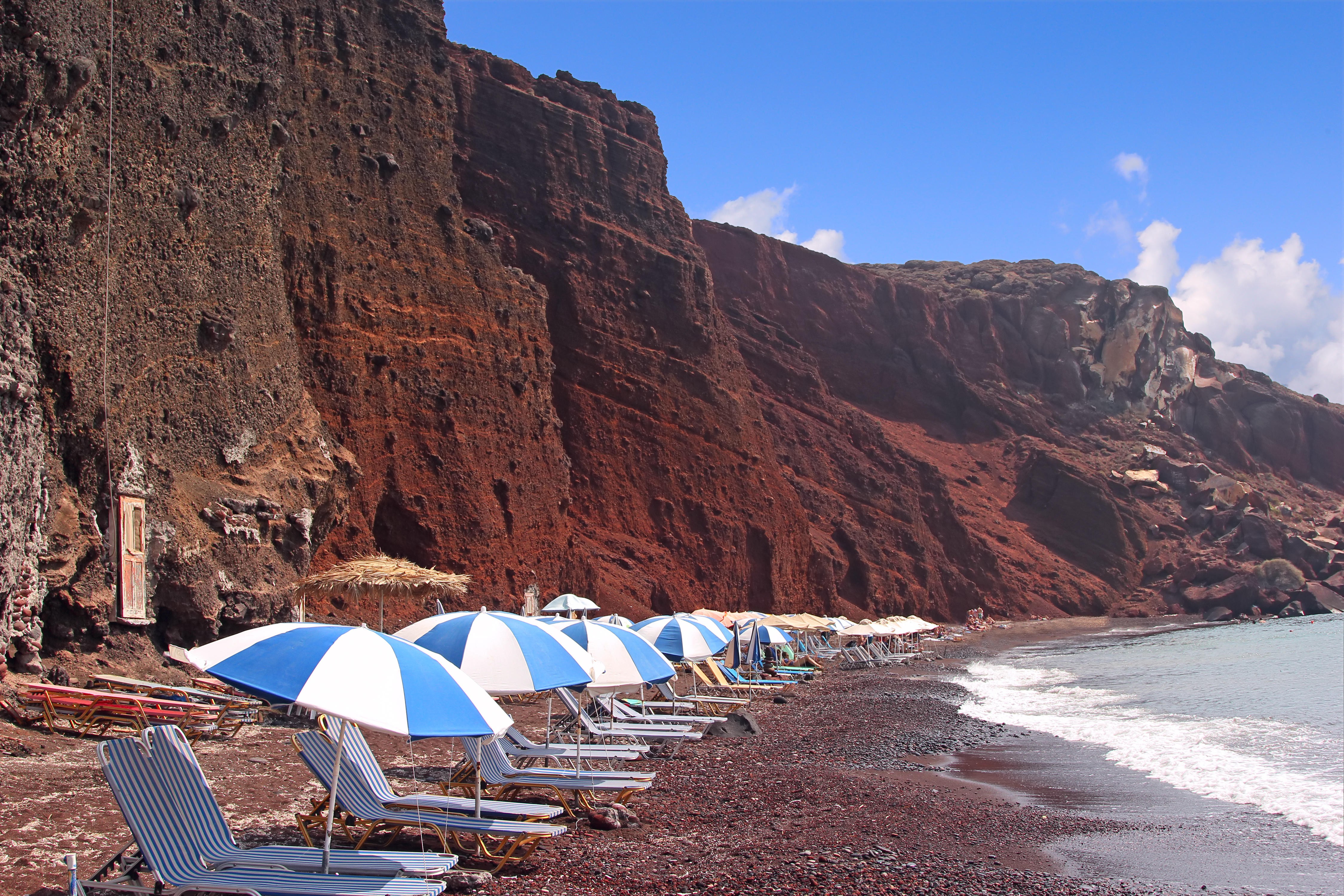
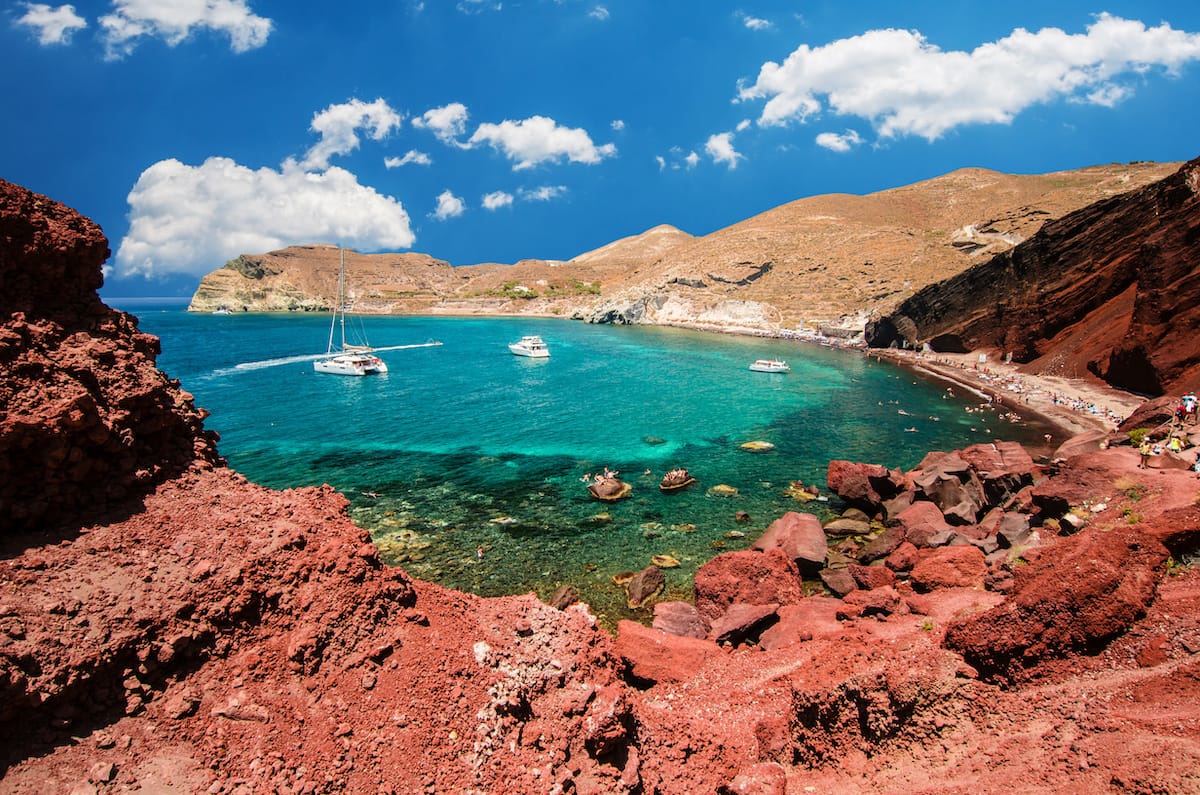
Just below Akrotiri are a string of small beaches, the best know of which is KOKKINO PARALIA or RED BEACH where sun beds sit on pebbles under the most startling blood-red cliffs of lava that plunge almost vertically to the black sand shore.
The beach, a favourite with nudists, is narrow and shelves rather steeply into the sea and the sheer cliffs behind give a claustrophobic feel. There are meals and snacks served at a nearby hotel and boat trips from here to some less accessible beaches along this stretch of shore.
These include ASPRI PARALIA or WHITE BEACH to the west and found down a narrow dirt track, although it is more usual to arrive by boat; KAMBIA BEACH signposted from the lighthouse down a dirt track which has large pebbles, sun beds and a summer cantina; and MESA PIGADIA, again off a dirt road near the lighthouse that is notable for its unusual rock formations and caves where there is a summer cantina. These beaches are served by boats that leave daily from the beach below the entrance to the Akrotiri archaeological site.

Ancient Fira

Just inland from Kamari on on the hill overlooking both this beach resort and Perissa to the south is ANCIENT THIRA, the excavated site of the foremost post-Minoan settlement on the island.
A steep 4km hairpin road leads from Kamari to the site where excavations are spread over a long terraced area. The views alone are worth the trip, quite exhilarating with a dizzying drop to the sea below.
Here are remains of an early Christian basilica, foundations of temples and houses, an impressive amphitheatre, relief rock carvings and even some 3,000-year-old graffiti.
The Artemidoros sanctuary was hewn out of the rock face around 400BC and is carved with inscriptions and symbols of the gods, such as an eagle for Zeus and a lion for Apollo.
In the centre of the city is the Agora or market place.
The northern part is older with a Doric temple. The southern part was added in the Roman period with a portico, a temple building and the Royal Stoa built about 100BC. A Doric colonnade once supported the roof. Two inscribed slabs in the west wall, record that the portico was repaired in AD 149 by Kleitosthenes.
The road up to ancient Thira is a steep series of tight bends, very narrow but with a few passing places. Parts of the can be seen from the parking area, but to see everything you follow a steep and twisting trail over the hillside with sheer drops in places so you need a head for heights.

Akrotiri house

Akrotiri pots

On the south western arm of the island stands AKROTIRI, a pleasant if unremarkable village with fine views over the caldera. There are the remains of a Venetian fortress which stands above the village, much damaged in the 1956 earthquake and there are beaches nearby on either coast to the north and to the south.
It also has one of the finest and best preserved archaeological finds in the Cyclades, if not the whole of Greece. Totally enclosed by a massive roof structure, the site has been unfortunately closed since 2005 following a roof collapse that killed a visiting tourist. Hopefully it will be open again in 2008.
Here a Minoan city was buried in volcanic ash around 1500 BC. It remained untouched until evidence of its existence was uncovered in the 1860s as pumice was being excavated to help build the Suez Canal. Subsequent excavations unearthed paved lanes lined with three-storey houses and rooms full of artifacts including large, unbroken vessels and storage jars.
As at Pompeii, the finds were of an extraordinary state of preservation as a result of being buried under tons of ash. Particularly impressive were superlative collections of murals and wall frescos. Unfortunately for island visitors they were removed from the site and now adorn the walls of the Archaeological Museum in Athens.
Visitors to the site on Santorini must be satisfied with a glimpse of a badly illustrated guide book, some poor quality photo-reproductions and a series of dispiriting signs saying exasperating things like 'In this room the famous painting of the Akrotiri boxers was found.'
Archaeologist also found elaborately carved wooden furniture, though no skeleton remains, suggesting the inhabitants had abandoned the place in a big hurry.
Latest news is that the site is unlikely to reopen until late 2008. Anyone interested in the island's Minoan history can visit the Museum of Prehistoric Thira in Fira

Nea Kameni

Palea Kameni from Nea Kameni

Swimming at Palia Kameni

Korfos on Thirassia
Regular boat excursions head for the charred volcanic islets that sit in the Santorini caldera. The main islets of PALIA KAMENI and NIA KAMENI, also Palea and Nea Kameni sit squarely in the centre of the caldera. The burning core of the old volcano is still active with the latest crater on Nia being formed in 1950.
Expectations of daily boat trippers who toil up the steep ash slopes for a taste of live volcano are rarely met. The well-worn 30min tourist trail is well strewn with rubbish, the air is foul with sulphur fumes and the views of hot, black ash are about as interesting as - well, views of hot, black ash.
For a further attraction you can jump off the boat at Palea Kameni (literally) and enjoy the volcanic waters that are warmed by hot springs and sulphur smelling mud.
THIRASSIA is the other islet, and a far more attractive proposition for those less interested in volcanoes. Actually another part of the caldera rim It was the main port for Santorini until an earthquake in 236 BC separated it from the main island.
The views from here are every bit as good as those on the main island but without the downside of rampant tourism that runs through Fira and Oia. The fertile inland plateau is great for growing the tiny tomatoes and beans for which the island is noted and the local dishes based on them are delicious.
Most tour boats make for the shingle beach at KORFOS where a path climbs up to MANOLAS, the largest village. There is also an uninhabited rock islet at ASPRONISI that everyone except vulcanologists quite properly ignore.
The cataclysmic eruption of 1640 BC split the island in two and water flooded into the caldera to a depth of around 375m. The tidal wave from this extraordinary event is generally held responsible for the destruction of the Minoan civilisation on the coast of northern Crete. Volcanic ash more than 30m thick in places and quarrying resultant pumice was central to the island's economy before the advent of tourism. This was not the only eruption in Santorini's history there have been many more before and since. A series of 18th century eruptions threw up the island of Nia Kameni at the centre of the caldera and in 1956 severe earthquakes demolished the main town of Thira and reduced many homes in Oia to rubble.
Links to Santorini volcano sites
Santorini Volcano
Prehistoric Archaeology of the Aegean
Volcano World

Santorini covers an area of 96 km2 and has a total coastline of around 70km. It is around 18km long and width varies from 2km to 6km. About 5,000 people live there, rising to 11,000 over the summer. The highest peak is Profitis Ilias at 550m. The caldera covers approximately 32 square miles to a depth of 600 meters. Santorini has very few springs and they don't supply much water. The islanders drill wells or collect rainwater in cisterns. Visitors drink bottled water, widely available.
Santorini's volcanic rock is dry and dusty, but rich in minerals and good for vine growing. What makes Santorini vines special is their age - many are more than 100 years old, having survived deadly diseases that ravaged crops on many other islands. Vines are grown low and are protected from the wind by woven cane fences.
Boutari built a new winery in 1988 and helped revive the wine industry which is now very healthy. Santorini is famed for its white wine although it may be too sweet for some tastes.
The island also produces fava beans and very small tasty tomatoes which are made into tomato paste. It is also noted for its 'chloro' goat's milk cheeses and for the pumice stone which is abundant.
| JAN | FEB | MAR | APR | MAY | JUN | JUL | AUG | SEP | OCT | NOV | DEC | Temp |
| 12 | 13 | 14 | 18 | 24 | 26 | 27 | 27 | 25 | 21 | 17 | 130 | Avg °C |
| 5 | 6 | 7 | 8 | 9 | 11 | 12 | 12 | 10 | 8 | 5 | 4 | Sun(hrs) |
| JAN | FEB | MAR | APR | MAY | JUN | JUL | AUG | SEP | OCT | NOV | DEC | Rain(mm) |
| 19 | 13 | 10 | 7 | 5 | 2 | 0 | 0 | 10 | 16 | 22 | 24 | Avg |
| 15 | 13 | 11 | 8 | 3 | 1 | 0 | 0 | 1 | 7 | 9 | 15 | Days rain |

The beautiful Greek Islands are renowned for their spectacular scenery, magnificent mountainous backdrops, stunning sandy beaches and crystal clear waters.
Holidays to the Greek Islands are often most cherished for this combination of sunshine, warm waters and beaches set against truly wonderful scenery. Whether it is a traditional beach holiday you would like or something with a little more history, you'll find that a break away to the Greek Islands is just the answer!
Flying into Santorini is quite unnerving. Planes fly in over the resort at Kamari and only the main road separates the runway from the sea. The planes bank sharply and the runway so short you feel you are landing in the sea. There are Greek flights from Athens to the small airport at Monolithos.
Ferry connections over the summer season are very frequent. There are daily sailings to and from the Athens ports of Piraeus and Rafina. The best way to approach Santorini is by boat but unfortunately departure times from the mainland mean you will probably arrive after dark. The main ferry route is Piraeus - Paros - Naxos - Ios - Santorini. Rafina is mostly for high-speed and hydrofoil boats. Most ferries dock at the 'new port' built following the 1956 earthquake. There is a steep, winding road up the cliff with hairpin bends that are taken at terrifying speeds by taxi drivers.
Cruise ships mainly dock near the old port where they tie up to giant floating buoys as the water is so deep the anchors can't reach the bottom. A cable car or mule ride are the only way up to Fira.
Santorini also has many connections to other Cycladic islands with daily sailing to Mykonos, Anafi, Amorgos, Naxos, Paros and Ios as well as to Rhodes and Crete). And there are many local excursions, particularly to the volcanic islets. Most visitors recommend this trip but, if you go, lunch at the Windmill taverna. It is furthest to get to but well worth the effort.
Roads are generally good and though the island is small it is very hilly, so you will need a car if you want to explore. The mountain roads - especially the one Ancient Thira are not for the faint hearted - sheer drops and unfenced bends can be scary. Also beware the local youths on motorbikes - they have no regard for others which is dangerous for drivers and pedestrians alike. There have been reports of youths on bikes snatching bags from tourists as they drive by.
The bus service is very good, with buses running to 4am but you will be lucky to get a seat after mid morning, they are packed. Buses are frequent and punctual. In summer they leave Thira central station every 30mins for Oia, Monolithos, Kamari and Perissa and every hour to Akrotiri.
Taxis are in shorter supply ( 38 on the island on the last count). The central taxi station is in Thira next to the bus central station. There is also a radio taxi service (tel: 2860 22555)
![]()
Going to Santorini this year? If you would like to see your photos here then email with details.
It takes 10 photos to make a gallery.
Santorini Hotel Reviews : See hotels and apartments with reviews and reports in Santorini
Santorini Hotels : A wide range of accommodation options on Santorini from Hotel Travel
Visit Santorini : Tourist and visitor guide to the island of Santorini in Greece .....
Go to Santorini : Santorini island info and photos and descriptions of the resorts
Santorini Web : Hotels, accommodation, maps and tourist information on Santorini
If you want your site considered email me