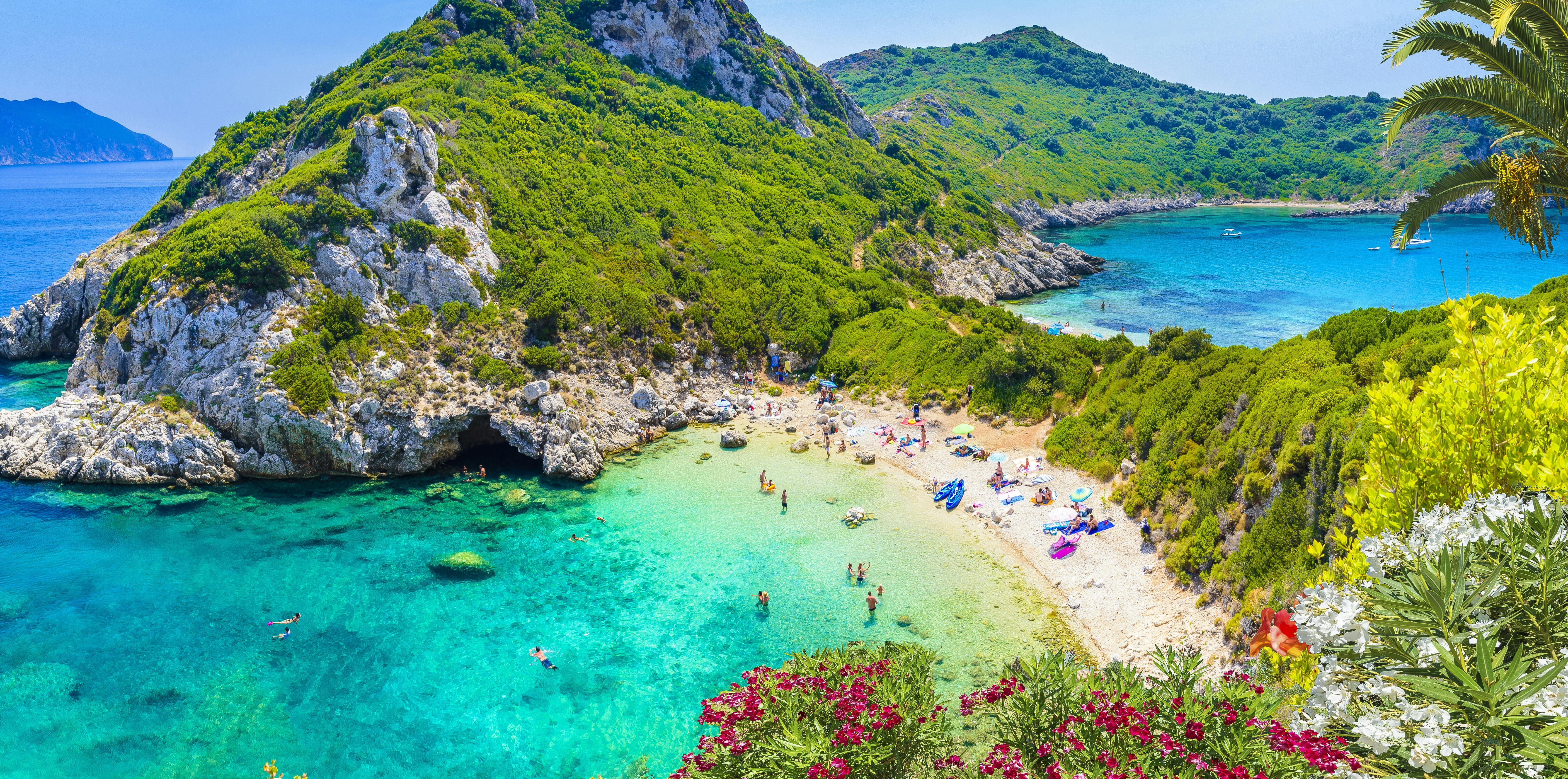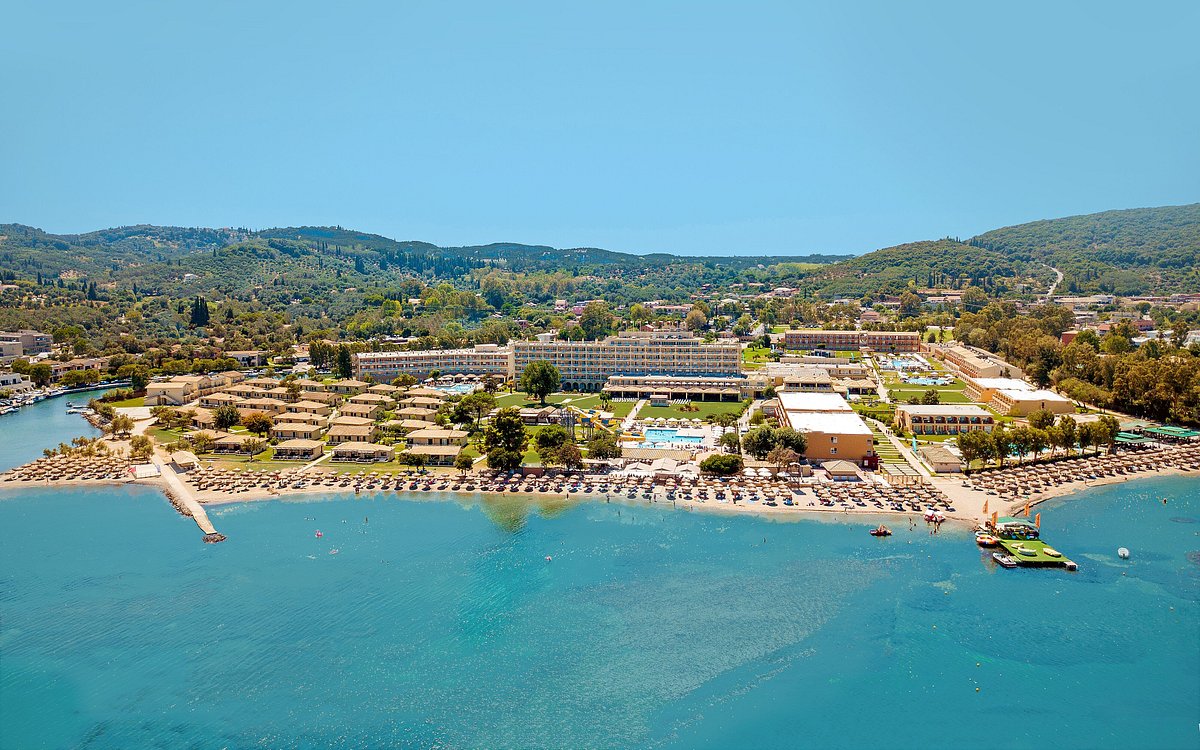
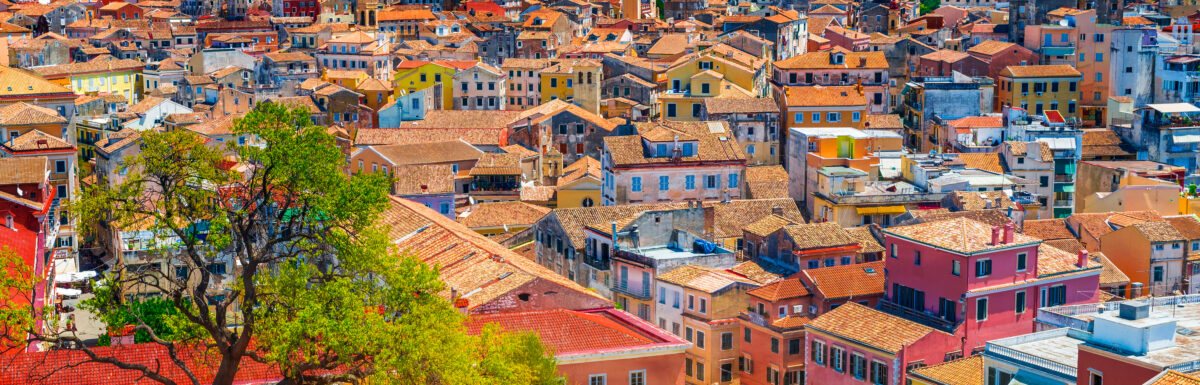
CORFU, or KERKYRA, is the most northerly of the Ionian chain of islands that run down the west coast of Greece. It was one of the first Greek islands to be 'discovered' by package tour firms and many parts quickly surrendered to the demands of cut-price operators.
Beautiful bays and quiet resorts were overrun with cheap hotels, happy hour bars and noisy discos. Fortunately, not all was swamped and some of the loveliest beaches and most romantic villages in the Greek islands can still be found all over this beautiful island.
The island is still a popular destination for independent travellers and thousands seek out Corfu hostels each year for the best in budget Corfu accommodation.
The most popular tourist spots for Corfu holidays are north and south of Corfu Town and along the north coast. Those looking for a more relaxed and traditional holiday will find many other parts of the island relatively untouched and some Corfu villages, notably in the lush, green interior, seem to have escaped the holiday hotel boom altogether.
The most sought after beaches are near Corfu town, where the biggest hotels in Corfu also predominate. The north and northwest of Corfu have longer, and better, stretches of sand, though some resorts have suffered from overdevelopment. The more remote west, and southwest, in particular, lay claim to wild, unspoiled countryside.
A favourite since Victorian times Corfu is still the most popular Greek holiday island for Brits - even more than Crete or Rhodes. Around 10,000 Brits now live there.
The north is dominated by mountains while the centre and south are home to lush farmland and islanders that are famously friendly - even by Greek standards. Corfu is also the nearest Greek island to the UK at about three hours flight time.
Corfu holidays remains attractive to those who prefer cheap and cheerful all-inclusive hotel resorts. Those looking for a quieter, more relaxed holiday may have to travel further, but they get rewarded by exceptional beaches and beautiful scenery.

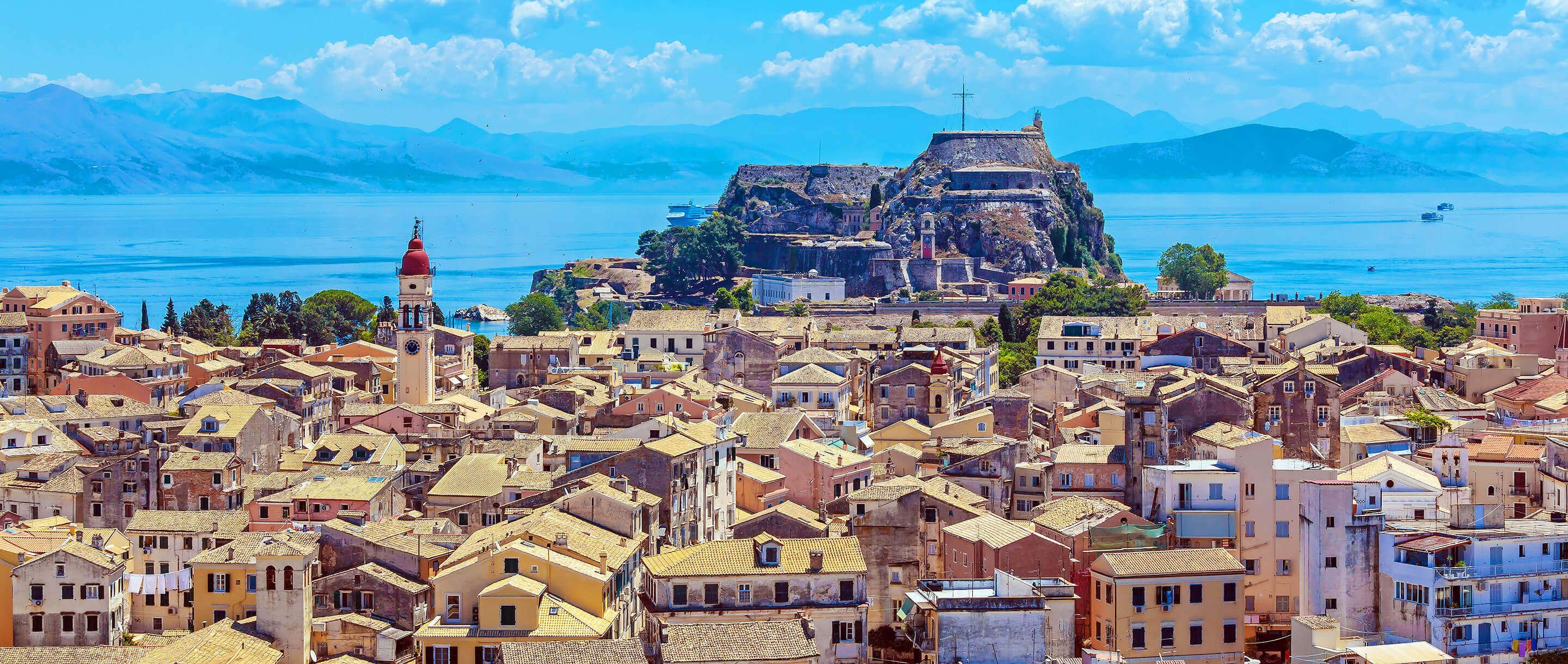
Kerkyra forts

Kerkyra street

Corfu shop
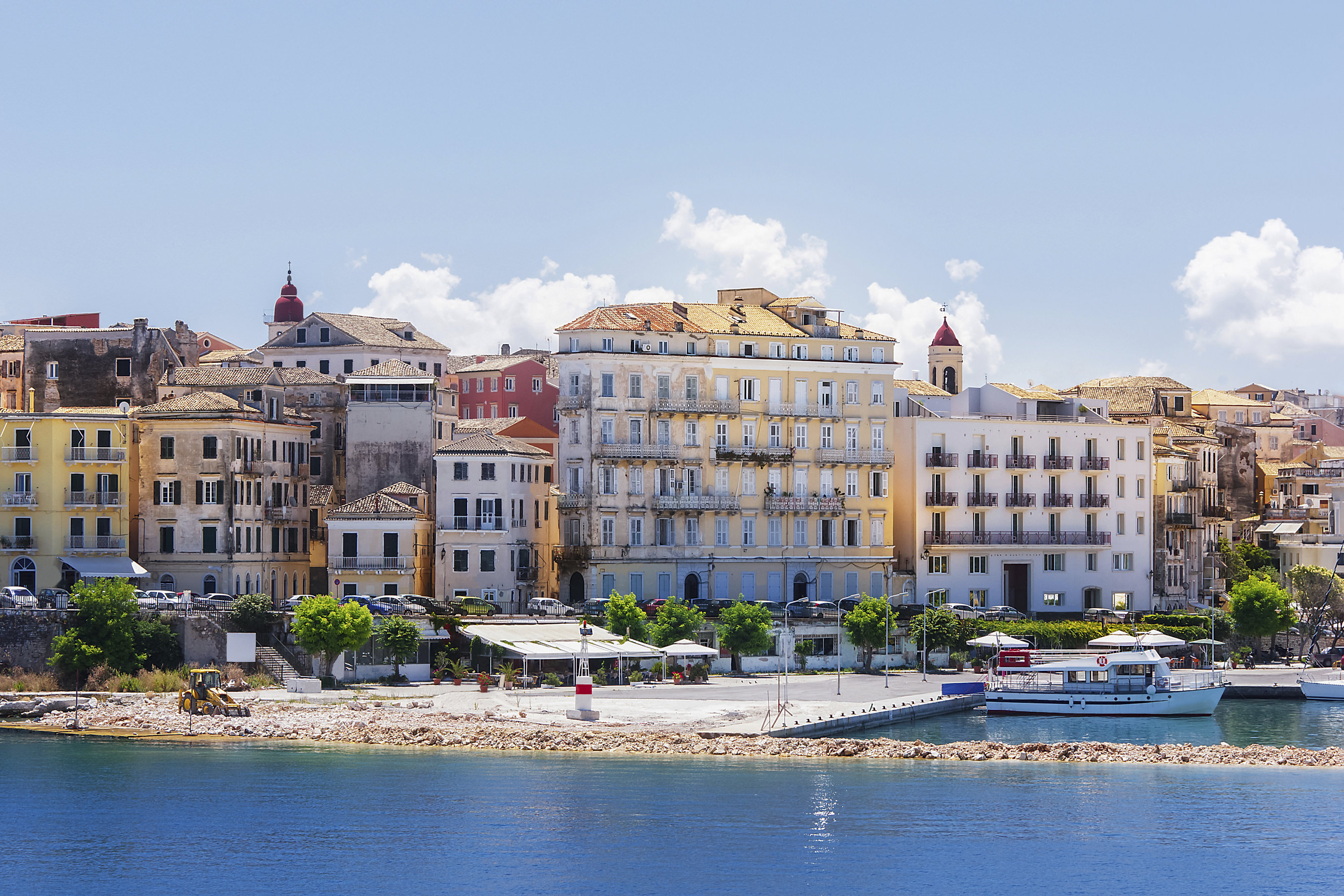
If you can afford it, and if you can bear the crowds, KERKYRA or CORFU TOWN is as pleasant a major holiday hotel centre as you will find anywhere in Greece.
Venetians, French and British have all had a hand in developing the town and the results are both impressive and attractive, especially since 1994 when public buildings were given a major clean-up in preparation for a EU summit.
Corfu is a large town of 40,000 inhabitants (and who knows how many at the height of summer) but it is an expensive one, particularly in the main tourist areas.
Corfu Town is dominated by double forts. The 13th century Neo Frourio (New Fort) with its dungeons, cellars and impressive turret battlements is much more interesting to visit than the older but less exciting 6th century Paleo Frourio (Old Fort).
The focus of the town is the Spianada, a public square and park - one of the biggest in Europe - where evening crowds stroll as children play.
It is rather spoiled since parts were turned into a car park and there is a bizarre cricket field where matches are still played. You can even find a McDonalds, if you would rather not be in Greece at all.
North of Corfu Town square is the French-designed and arcaded Liston, built to resemble the rue de Rivoli in Paris and packed with elegant cafes and restaurants.
It's a pleasant place for a stroll but it will cost you a packet to eat in this tourist honey pot. The food is generally bland and unmemorable and the service brusque.
Nearby is Georgian Palace of St Michael and St George which houses the wonderful Museum of Asiatic Art, one of the largest and best collections in the world. In fact Corfu is noted for its many weird collections. The Ionian Bank houses a Museum of Banknotes and you can even find a Serbian War Museum (the Balkan Wars of 1915-17, not the recent one).
The Byzantium Museum is housed in a restored 15th century church and the Solomos Museum is dedicated to the island's poet. Also of note is St. Spiridon's Church, home to Corfu island's patron - a 'mummified' saint - located just behind the Liston. The church is impressive and well worth a visit.
To the north of the Corfu Town is the coastal beach suburb of ALYKES which has a sandy beach and shallow water. A regular bus service runs into town and there are a few tavernas and shops nearby.

Kontokali

Venetian shipyard
The highway north out of Corfu town isn't the best introduction to the island. A dreary motorway through a commercial wasteland ends at island's main marina and ferry stop at Gouvia.
Just before then and merged into is the resort of KONTOKALI. Despite its noisy neighbour it manages some charm, enjoying subdued nightlife and good tavernas and bars. But every year the two grow closer as more apartments go up and it only a matter of time before Kontokali is completely swamped.
The resort has two beaches, both of sand and pebble, if you can see either for the sun beds. One beach is in front of the massive Kontokali Beach Hotel and looks like a private beach, but it's not.
Showers are available and you can even rent beach towels. It's shallow in the water, particularly between the two groins, and the watersports areas are cordoned off to prevent accidents.
The other beach to the north is smaller and tends to get greater use from the locals. In the village are scores of shops and restaurants, the remains of a castle and, north along the coast, an ancient Venetian shipyard.
Big supermarkets are found on the main road notably the Diellias hypermarket at the Gouvia turnoff if you want to stock up on cheaper provisions.

Gouvia marina

Gouvia beach
Massively overdeveloped, GOUVIA overlooks a large marina usually crammed full of boats. It has a good selection of bars and restaurants with a very lively atmosphere at night but not a great deal to do in the day.
Gouvia is on the main green bus route for all the resorts on the northern part of the island. A timetable is posted near the Pippilas Restaurant and buses generally run on time, are clean, air conditioned, and the staff are very helpful.
An Ionian theme park has been built at the nearby Danila Village - the well-meaning if slightly crackpot, 'Corfu Experience' features a reproduction Greek village. All of this is slickly delivered in a Disney style without the slightest hint of irony.
Worth a visit is the Corfu Shell Museum, rather precariously placed on the busy dual carriage way. The Louis Kerkyra Hotel has a water park complex open to the paying public.
The beach is a rather bedraggled strip of pebbles and stone with sun beds and watersports. The drop into the sea is sharp, the beach gathers rubbish in high season and there are several outlet pipes into the sea, so it may not be the cleanest beach in Greece.
Curving around the bay from Gouvia is CAPE KOMENO which looks interesting but isn't. Swamped and dominated by an enormous Grecotel hotel and bungalow complex it has little to offer but scrubland and rocks unless you are a sucker for luxury hotel life.
To the right are views over the town of Corfu and the yachting marina in Gouvia, whilst on the left is the gulf of Dassia.
The hotel is surrounded on three sides by the sea and many small creeks and bays, mostly shingle and rock, some of them having changing cabins and showers.

Dassia beach
The resort of DASSIA, also known as DASIA,or DAHSIA is little more than a cluster of bars, restaurants and shops on either side of a very busy main road.
Hotels line the beachside of the road and apartments are on the other side. Traffic rarely thins and it can be a nightmare to cross.
A network of footpaths lead down to the beach - a long narrow strip of sharp shingle and a little sand, about 200m long and 30m deep. Shallow waters are backed by dramatic pine and olive covered cliffs.
A long cement path runs down the back of the beach and sun beds are relatively cheap though there are no showers or toilets. Doughnut sellers parade up and down for the peckish.
At the southern end of the beach is a small, pleasant bay with a ruined Venetian boatyard, but it's a bit of a scramble to get there.
The resort proper has a wide choice of restaurants and bars, though most offer uninspired tourist fare and chips with everything. Shops carry little else than tourist tat but the locals are known for their friendliness.
Surprisingly, Dassia has relatively little in the way of nightlife, so many visitors hop to nearby Ipsos for a night out clubbing - about 15 minutes on foot and fabulous views along the way.

Ypsos

Ipsos beach

Ipsos bars
Tacky IPSOS or YPSOS is the lager lumphead's paradise. The hideous resort boasts a couple of kilometres of wall-to-wall burger outlets and music bars.
It's a resort where you are touted smutty slogan T-shirts and blow-up plastic turtles. A firm favourite of British package tour operators Ipsos also attracts a growing number of east Europeans.
The beach is nothing but a narrow, long and uninviting straight strip of shingle and sand backed by a very busy main road. The road is a nightmare to cross but families must run the gauntlet to reach the tavernas and cafes on the other side.
The best bit of beach is near the harbour to the south; it's quieter though not much. Another small harbour to the north divided the beach and landing jetties every 50 yards or so.
The watersports you would expect are all available - bananas, parasailing etc - with several jetties built along the shore to accommodate them. Showers and toilets are available and there is lighting along the main road.
But there's a rip-off air about the resort with many tourists complaining about having to buy their own loo paper. Visitors say the place was a ghost town in 2005 as many gave it a wide berth and who is to ask why?
The downmarket atmosphere pervades, but this is not Ibiza or Faliraki - clubs are relatively tame and they generally close around 4am. Quiet in the daytime, the main street livens up around midnight.
Touts are a nuisance, pulling passers by into the clubs, often literally. The children selling glo-sticks and Ispos branded headgear annoy even more. Stray cats and mangy dogs add to the general seediness.
Tavernas sell basic, low-priced meals - a meat course on a pile of chips - and bars boast giant TVs, all-day English breakfasts, karaoke, pool tables, video arcades and gaming machines.
Select this place ain't and, if you want more than a tan and a hangover you'll probably be sadly disappointed. But if it's cheap, cheerful and noisy you're after then it could be just the ticket.
The neighbouring resort at PYRGI is little more than an extension of Ipsos itself; a little less hectic, a bit cheaper maybe and the occasional Greek meal to be found in the tavernas.
What a difference in the hills above where the lovely village of AGIOS MARKOS is a step back in time

Barbati
Following the north west coast out of Kerkyra you must wait until BARBATI for the beaches to improve. This long, narrow kilometre of sand, shingle and pebble (mostly pebble) is away from the main road and set in a fine bay cloaked in pines.
Sun beds are for hire and showers and toilets are at the back of the beach as well as small tavernas and beach bars.
The east facing bay is very sheltered and the water is shallow for children though it does drop off steeply a little way out.
Rocky shores at both ends of the beach provide interest. The remains of an ancient church are worth a look, though it is usually locked.
The beach would be much quieter if it didn't suffer daily visits by boatloads from Kerkyra and Ipsos. The southern end also offers the usual water sports.
The back of the beach is covered by three vast complexes of apartments arranged in serried ranks and the network of roads to feed them provide plenty of parking.
The resort village is 10min from the beach up very steep lanes to the main road where there are stunning views over the bay and plenty of shops and restaurants. In the village are the usual tavernas and bars, mostly geared for families.
Nightlife is low key but Corfu town is only 30min away on the bus for those that prefer it more lively.

Nissaki

Krouzari
The shingle and stone beach at NISSAKI or NISAKI is very pretty, sitting in a horseshoe bay with a taverna at one end.
It was three beautiful pebble beaches necklaced together, and an offshore islet that became 'joined' to the mainland as rock was quarried away from it (Nissaki means little island).
It shouldn't be confused with the beaches at nearby KROUZARI, which is much bigger and dominated by the massive and inaptly named Nissaki Beach Hotel. A Club Med complex is also nearby.
The real Nisaki beach, away from the hotels, is quiet and has good snorkeling. As it is so small it can sometimes get busy, especially when the day trip boats arrive.
There are no toilets on the beach but you can use the taverna if you buy a drink. Plenty of deserted rocky coves are around to explore if you follow the coastal path.
Krouzari is pretty much dominated by the large hotel and is a long strip of steep sloping shingle. Showers, changing rooms and toilets can be used and a boardwalk runs over the stones for the length of the beach.
Trees behind provide natural shade, and the usual sun beds and water sports you expect on a developed beach.

Kaminaki
A delightful and romantic bay of single and sand pebbles greets visitors to KAMINAKI. The stone beach is surrounded by olive groves and is well sheltered from wind in an idyllic setting.
Unfortunately it's only a short coastal walk to the Nissaki Beach Hotel, so the beach tends to get busy later in the day.
Sun beds are for hire and the beach has a single shower. For toilets visitors use the taverna on the beach and another taverna on the cliffs above. A single mini market provides for basic shopping.
It's a steep drive down to the beach which has is limited parking. This is still the place to chill out and relax.

Agni
AGNI bay is found at the bottom of a very steep and twisting lane from the main coast road. It's a small bay of pebbles with the odd patch of sand. Three tavernas open in the summer, all with views across to Albania.
Jetties have been built to accommodate the boats that pull in. The beach shelves deeply into the sea but some sharp underwater rocks make it unsuitable for children,
Apart from the tavernas, which offer free sun beds for customers, the resort has no facilities. It's a beautiful and peaceful setting though and a step back in time for those seeking a more relaxed Greek island holiday.

Kalami
The exquisitely beautiful bay at KALAMI has a fairly long beach of white shingle littered by sun beds and with showers and toilets.
The stones are sharp, so footwear is advisable, but the sheltered bay is safe for snorkeling. The resort has strong romantic and literary connection through the Durrells - Lawrence and Gerald who had a lovely home, the White House, here.
Unfortunately Kalami also now home to one of the biggest self-catering compounds on Corfu. The complex sprawls up the hillside, though the owners have planted enough wisteria to hide most of it.
The coast of Albania sits 2km offshore and the seas get choppy in the channel should you hire a boat, not to mention the wake from dozens of passing cruise boats.
Kalami has three mini markets and a couple of tourist shops in the village and some good tavernas. On the headland near Kouloura are a couple of sheltered coves that have flat rocks, but you need a boat to get to them.

Kouloura
Around the headland from Kalami is the pretty fishing village of KOULOURA. Not much of a beach, just a narrow strip of sand and shingle under the cliffs opposite the harbour.
But it enjoys a beautiful setting that oozes peace and tranquillity. Rocky coves offer snorkeling and sunbathing.
Much visited by boats the sea can get dirty with fuel in the summer and sea urchins are a problem on the rocks. No boat hire, no watersports, no bars, no clubs, one taverna and the nearest shop is a 20min walk to Kalami - heaven on earth.

Kerasia
The long 300m sweep of shingle at KERASIA is in a beautiful spot and ideal for those wishing to escape the crowds.
Surrounded by olive and pine the beach is flat and water shallow, though it dips sharply after a few metres.
Kerasia has a single beach taverna and a small shop on the beach but not much else, although sun beds are available to hire and plenty of parking can be found.
Prince Charles, apparently, is an irregular visitor of the Rothschilds, who have a large estate nearby but don't expect to rub shoulders with royalty on the beach.

Agios Stefanos
AGIOS STEFANOS is a lovely, isolated and secluded cove with a small, but attractive, pebble beach, not to be confused with the resort of the same name on the northwest coast.
The resort has four tavernas on the beach and a couple more in the village where there is also a mini market and a few half-decent gift shops.
Agios Stefanos is a favourite upmarket resort that has earned the nickname 'Kensington-on-Sea'. Villas dot the surrounding hills and the resort's exclusive tag is reflected in the local prices, which are high even for Corfu.
A target for day tripping boats, the resort can get busy as the day wears on and tavernas can get pretty full.
Sun beds line the beach but facilities are few so it's a case of spending a few euro in the tavernas if you want to use the toilets. The waters are not shallow and the shingle drops very steeply into the sea, so it's not recommended for children.
The sea also suffers from gobs of washed up seaweed and sea urchins on the rocks. The narrow, winding road down to the beach is steep and difficult, not least because you will repeatedly want to stop to take photos.
Neighbouring coves include the pretty Kerasia beach and horse riding can be had at the nearby Emeritus Nature Reserve.
The north has the best and the worst of the landscape. For 10km or so out of Corfu town the visitor is greeted by a dismal swathe of package holiday squalor. A dreary sprawl of hotels and restaurants is relieved only by occasional vegetation.
Further north the highway finally peters out and the scene changes dramatically.
The impressive rocky coastline is backed by the greenest of hills and dominated by mountains. A few resorts north and east have escaped the desecration of their more southerly neighbours and enjoy the more typically Greek atmosphere that comes with small pebble coves and dazzling turquoise waters. It is only in the larger resorts that it slides back into tourist driven tackiness.

Avlaki
The long splendid bay at AVLAKI tends to get missed by most visitors probably thanks to its better known neighbour Kassiopi and not particularly well signposted roads.
It's very popular spot for weekending Greeks and it's not hard to see why. The narrow 800m-long beach is mostly shingle but there are boardwalks and sun beds and the sea is shallow, though only for a few metres then drops off sharply.
It's very quiet, but more lively resorts are only a short walk away and you can always opt for a boat trip to Kerkyra.
Avlaki has no watersports as such but there are canoes for hire and a sailing school in the village which has a couple of tavernas, a single bar and no shops - the nearest is at Kassiopi.
Unfortunately the building of some pretentious villas has blighted the countryside, the architects deciding they required the re-siting of huge amounts of soil and stone.
A couple of small coves lie beyond the headlands along footpaths at either end of the beach but they are just narrow and rocky strips of shingle.

Kassiopi harbour

Kassiopi street
I had KASSIOPI down as a haunt for head bangers and got shot out of the water by regular visitors who swear it is just an attractive seaside village.
The small town square is however dominated by big-screen TVs, disco bars do thump until dawn and karaoke bars will offer free shots for the get-drunk-quick teenagers - though it is all done on a smallish scale and is nowhere near as dreadful as lumpen resorts like Kavos.
Kassiopi still finds room for more traditional tavernas and quiet bars and regular visitors to the resort do emphasize the relaxed friendliness of the locals, although that is something you should experience just about anywhere in the Greek islands.
Kassiopi has a very pretty waterfront that is a favourite of photographers, but much of the village is thick with shops selling the usual tourist tat. Two large mini markets and a couple of smaller ones meet the shopping needs.
Four nearby beaches can be reached by footpaths around the headland but none are particularly good. The main beach is pebble and has showers and toilets.
The others have no facilities and sea urchins can infest the rocks so it's probably best to steer clear without plastic footwear.
A pleasant taverna sits on the headland offering a decent menu. Better beaches can be found to the south at Avlaki and Koyevinas - about 20min drive.
Boats trips leave from the harbour daily for Kerkyra and other beaches along the coast. The ruins of a castle overlook the harbour but little is left to see as it was demolished by the Venetians in the 14th century, though there have been some recent attempts at restoration.

Agios Spiridon
A peaceful tiny bay until an 850-bed hotel complex sprang up behind it. Now AGIOS SPIRIDON looks to be overdeveloped as the big tour operators get a tighter grip.
A sandy beach is set in a smallish bay enclosed by rocks on either side. Another longer and better beach lies about 500m to the west.
On both beaches are sun beds, showers, toilets and changing facilities. On the smaller beach are also found great gobs of seaweed that get cleared now and then by a JCB.
The water is shallow on both beaches and fine for children, with rock pools to add interest. Plenty of fag ends too since that hotel turned up.
The village has a couple of mini markets and a tourist shop and three tavernas - all recommended. A beach cantina opens in the summer.
This part of the coast is a nature reserve and walkers will find plenty to admire. Wild flowers are abundant in the spring and a lagoon behind the resort that is home to the showy sea daffodil.
Don't pick the daffodils. They are getting very rare and this is one of the few habitats left to them in Greece.

Almyros beach
Just beyond the beach at Agios Spiridon are the protected wetlands of Antinioti where birds and other creatures nest in the wide lagoon. A little further east is the huge sandy beach of ALMYROS
The western end of the 7km long sands is fairly quiet with dunes and shallow water. As you head east more hotels and restaurants make their mark.
The centre of Almyros beach is pretty well packed with tourist hotels, bars and tavernas. There are shops and mini markets nearby and plenty of beach sports including windsurfing.
Towards the centre of the beach there are more pebbles, and it drops quite sharply into the sea so the waves can be quite large and heavy when the north wind gets up.
The beach is also quiet varied here with plenty of room in places but only thin strips elsewhere and there is only room for a single line of loungers on parts of the seashore.
There are good views across to the Albanian hills from here and this is a good spot if you like the combination of lively and quiet. It is easy to escape the crowds by walking east or west.

Acharavi
The resort at ACHARAVI has all the immediate appeal of an M6 truck stop but appearances are deceptive.
The actual village is tucked away from the main road and comprises a quiet crescent of traditional tavernas and cafes behind a 3km straight and long pebble and sand called Almiros beach.
Doughnut and ice cream sellers frequent the sands but are not too intrusive. Sun loungers are cheap and plentiful. The main part of the beach is pebbles but walk about 500m in any direction to find the best of the sand and a nudist area in the Kassiopi direction.
The beach overall runs to 3km and gently shelves into the sea but stones lie underfoot so it's wise to have footwear. The water is shallow but waves can get a little choppy in the afternoon breeze.
The main beach is a clear favourite of families and couples and a great relief from the dishevelled mess that flanks the main highway though, as the main town in the region the resort does offer doctors, banks, post offices, mini markets etc.
Good restaurants can be found and local shops sell olive wood carvings. In the hills behind the village walkers can get on the Corfu Trail and other excellent walking paths leading up Mt Pantokrator.
There are the remains of Roman baths nearby and a Doric temple at Roda along the coast. A good water park (Hydropolis) is 10 minutes walk from the village and most hotels offer free use of the pool if you use the bar.

Roda beach at night

Roda beach
It's a three hour crawl from Corfu airport along twisting and badly maintained roads, so expect to feel exhausted when you arrive.
RODA or RHODA is a small, pretty, but essentially charmless village with a large number of bars, restaurants and small shops.
Forget any Greek flavour too - Roda is English seaside town with karaoke and bingo nights in the scores of British theme pubs, many run by ex-pats.
The drab uniformity can make a long stay in Roda fairly tedious. A noise restriction after midnight does something to mitigate the music throb and the infernal karaoke. Beware Roda apartments sited on the main Sidari road as this is busy and noisy for 24 hours-a-day.
Access to Roda beach is down some steps from the main road where there is limited parking. The beach is sandy for the most part with some pebbles and gets better at the western end.
The sea is shallow and sandy underfoot so it's safe for children and non-swimmers and Roda beach has plenty of watersports.
The resort of Roda has been making efforts to improve itself of late adding benches along the seafront, some palm tree planting and daily beach cleaning, though much needs to be done about the endless fag ends in the sand.
The excellent cheap and air conditioned bus service is worth using, with a bus stop by Roda beach. The place is plagued by stray dogs and feral cats but they are not a nuisance if you ignore them.

Canal d'Amour

Sidari at night

Feel at home Sidari
The big guns of the British package firms have been trained on SIDARI for some years. What beauty Sidari once had, and this was clearly substantial, has long been blown out of the water.
The once pretty Sidari village square is now lost in a hectic maze of happy hour bars, grubby pubs and trinket shops - we are firmly in the cheap and tacky end of the market.
Sidari has three beaches. The first near the old fishing harbour in the east and tends to collect seaweed between the conspicuous outlet pipes.
The central one is a long sweeping bay of grey sand with sun beds and a vast array of watersports, even an occasional bouncy castle. Avoid the stream of green soup that cuts through the middle of it.
To the west of Sidari is the Canal d'Amour area, where sandstone cliffs have been eroded into spectacular formations and small sandy coves. They are very attractive but can get very overcrowded in high summer.
Visitors report that the canal area can also suffer from smelly drains, but the Sidari beach area does have a blue flag for cleanliness.
Watch out for the dangerous paths along the cliffs. They have been known to collapse, so it's not a place to let the children wander.
The resort's main road is narrow and busy. The restaurants and bars that fringe it offer a diet of bingo, TV football and pie and chips. Sidari is about as Greek as Blackpool.
It's cheap and cheerful if you like a home-from-home holiday thing and there are so many Brits here it can be hard to believe you are abroad.
The Sidari nightlife is cheap and cheerful, and enlivened by endless karaoke. The pestering bar touts can be a nuisance but will leave you alone if you show no interest.
Stray dogs and cats are the usual problem, despite an annual winter cull. The Sidari area is also notorious for mosquitoes so don't forget the insect spray.
If Sidari visitors feel the need to get away from the British abroad they need look no further than PEROULATHES, a handsome hill village of traditional tavernas and cafes providing access to very quiet beaches and some lovely walks.
The main beach is hardly that - just a narrow strip of sand below vertical cliffs that floods with waves at every passing boat and you can only get to it by making a perilous descent down scores of winding cement steps.
The taverna above the beach offers stunning sunset views and lends the place its alternative name of Sunset Beach
From rocky cliffs to long sandy beaches, the west coast has more to offer those looking to get away from the crowds. Though tourism has spread, the grip is not quite so tight as it is in the east and south. It still has its low points but they are far more widespread.
As mountains give way to farmland and Corfu town gets nearer the desolation becomes more notable but away from the crowds visitors are rewarded by some of the most beautiful landscape and the best beaches to be found on Corfu. Satellite coverage of the north west in poor but I'll include them as soon as I can.

San Stefanos
The low-key resort of AGIOS STEFANOS also known as SAN STEFANOS to distinguish it from the village of the same name on the north east coast.
Gentle hills roll down to a 500m long, flat and deep sandy beach that is remains fairly quiet even in the high summer season.
The shallow water and gently sloping sands make this a particular favourite for families and there are sun beds on the beach which, at 70m deep, is big by Corfu standards. The flat expanse and low cliffs help to give the resort a very English feel.
The resort has some watersports and a child play area. Tucked away from the main traffic routes and only approached along narrow lanes the resort tends to be quieter than most.
It has some good tavernas and small family hotels and apartments as well as the usual selection of shops and bars. Some outstanding scenery is around for walkers to enjoy in this part of Corfu.

Arilas
Walks along the headland from Agios Stefanos to nearby ARILAS or ARILLAS are popular with the fine views and splendid sunsets.
The beach at Arilas is a little busier than its neighbour, though not as long at 250m nor as deep at just 15m.
But it is flat and very sandy in shallow waters, so it's great for families and backed by low rolling hills except at the southern end where cliffs loom behind and you can get away from what crowds there may be.
The islet of Gravia just offshore and reachable if you are a decent enough swimmer. Sun beds, watersports, boats for hire and a water taxi to other resorts along the coast are all on offer.
In the resort itself is a wide selection of mini markets - I counted at least seven - and a few shops selling tourist souvenirs.

Agios Georgios
AGIOS GEORGIOS or GIORGIOS is a newish sprawling resort set at the mouth of a wide wooded valley. Don't confuse it with Agios Georgios to the south.
Many regard the long and gently sloping beach as one of the best in Corfu and it is a popular destination for young families.
It's very long (1,400m) and deep too (140m). The northern and middle parts are the most popular (nudist right at the northern end), with water sports the high season. The southern bit is narrower and less crowded but seaweed tends to pile up.
Most of it is clean golden sand and clear shallow water, though seas around on this part of the coast do tend to become a bit choppy. A river runs through the main resort where you find the usual supermarkets, tavernas, bars and car hire.
Mountain bikes can be hired, an internet cafe is open at the Katoi Bar and you can even enjoy a small bowling alley.
But don't expect much 'old Greek' ambience. This is more a British bucket and spade holiday resort - only with sun.
The village of AFIONAS on the headland has great views over the bay and the 13th century Venetian fortress of Angelkastro is a 30 minute car ride away.
The resort's central position also makes this an excellent base for exploring the island.

Paleokastritsa overview

The main Paleokastritsa beach

Plenty of boat trips for visitors
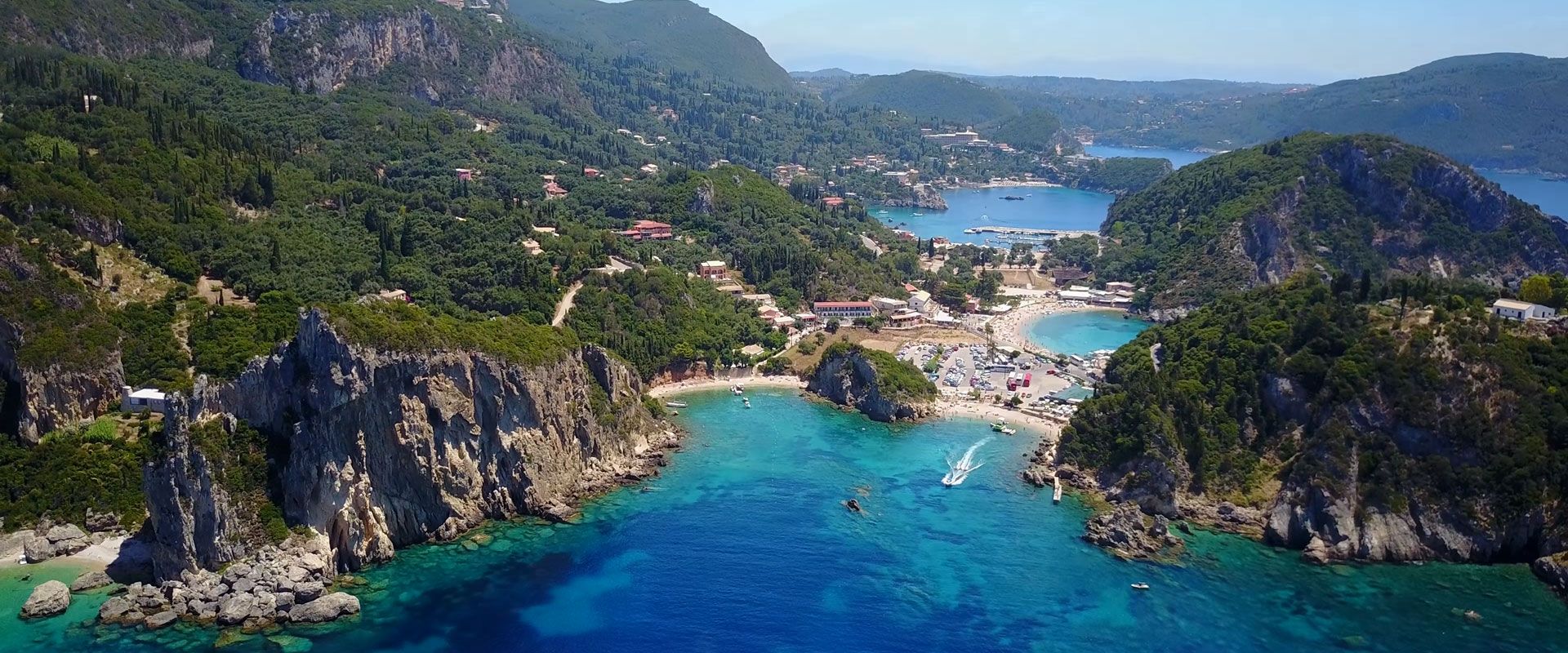
PALEOKASTRITSA is a firm favourite of British holidaymakers. Surrounded by lush and beautiful countryside, it is one of the most scenic resorts on the island.
But it is very hilly as well and the lack of footpaths can make walking at night quite dangerous and scary. Night noise can also be a problem as motorbikes scream up the hills.
The resort is spread over three large bays and although plenty of visitors frequent the bays they are big enough to contain just about everyone without it feeling too busy, though visiting day-trippers do add substantially to the numbers.
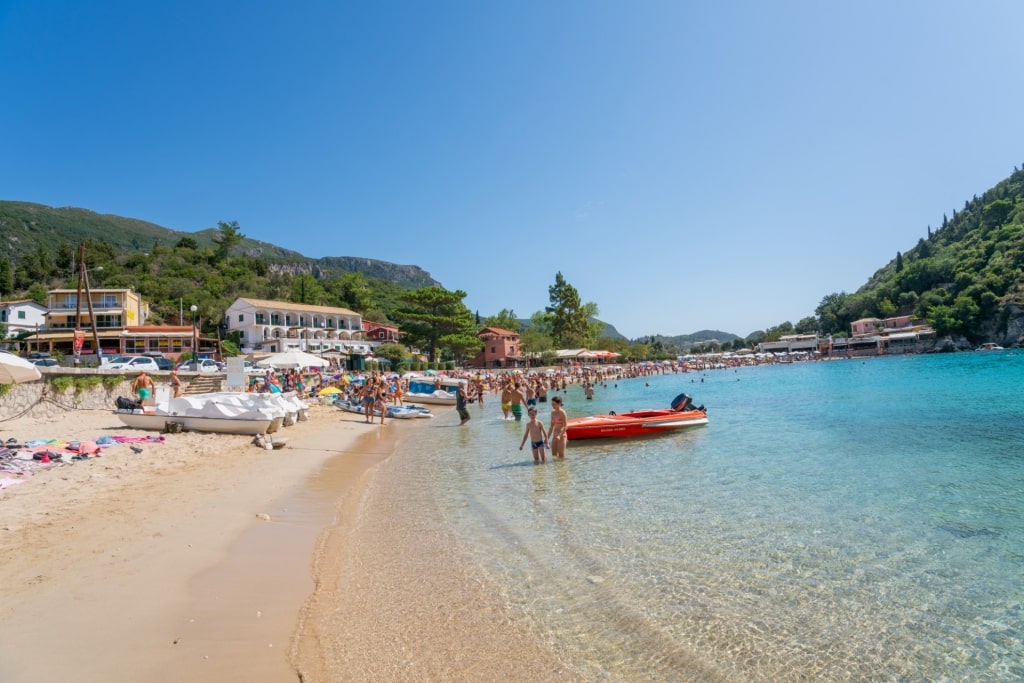
The holiday focus is on the main beach, a relatively narrow horseshoe crescent of shingle backed by a large hotel complex and a large car park.
The water is deep and unsuitable for unaccompanied children but sun beds and plentiful and showers and toilets are available. Boats leave regularly for reasonably priced trips to nearby caves, grottos and small beaches.
More than a dozen places are visited regularly and there are taxi boats to drop you off at the beach of your choice. The usual tourist watersports are also on offer including scuba diving.
The other two bays and smaller but sandier, one to the north and another sandy strip around the headland serviced by boat taxis. The overspill from the main beach and the daily influx of trippers ensure they are rarely peaceful.
A handful of tavernas can be found in the resort but all are notoriously expensive and uniformly mediocre, so it's not great for a family holiday.
There are a few tame music bars on the edge of the resort. Around the headland is an exclusive marina boasting some seriously show-off boats to admire.
Overlooking the bay is a 13th century monastery that is such a favourite of coach parties traffic lights have been installed on the access road.
The visiting traffic can spoil the monastic atmosphere. The monastery itself has some impressive icons, a carved wooden ceiling and a bizarre sea monster.
The most impressive attraction though is the paved gardens and stunning sea views, though you might not be so impressed at being implored by money-minded monks to buy a candle as you enter.
There are spectacular views to be had in a ride up to Lakones and the villages beyond as well as some notable roadside tavernas to visit on the way.

Liapades
LIAPADES or LIAPATHES is a picturesque resort set in a sheltered bay, though sadly dominated by a large hotel complex.
Mercifully it is not a high rise one but it does rather spoil the views. The beach is mostly soft sand with a few stones and waters very shallow, ideal for children.
Large rocks either side of the bay add interest and there is parking close to the beach. Visitors report that wasps are a problem, no doubt nesting in the nearby pines.
The village is about 1 km inland from the beach, but still worth a visit. It's a typical Greek village of narrow streets and some good tavernas.

Ermones beach
Busy ERMONES has been rather overrun by surrounding hotel complexes. It's only a small 300m cove surrounded by very steep hills but these are littered with four hotels and dozens of ugly apartment blocks.
German tour operators dominate and the Ermones Beach Hotel even boasts a small funicular railway to ferry guests down the almost vertical cliffs.
The beach is sand and shingle, clean but marred by a smelly stream running through the middle of it. It shelves gently, so safe for children, and rocks invite exploration at either end.
Sun beds, toilets and showers are on the beach and parking above, though there are some very steep steps to negotiate. Wind surfing and boat hire are on offer. The beach has three tavernas and three more above so the crowds get very well fed.
After dark, the place thumps to the hotel discos but there is no other entertainment. For shopping there is just one mini market and that's it.
OK if your choice is an all-inclusive package deal but otherwise not many good reasons to visit Ermones.

Mrytiotissa beach
Lawrence Durrel once described the tiny sands at MYRTIOTISSA as “perhaps the loveliest beach in the world” which is going it a bit, especially today.
Relatively difficult to reach requiring a scramble down the cliff face from the nearby village at Vatos, the narrow but pretty stretch of sand is pocked by mighty boulders and overlooked by scrub covered cliffs.
Once a well kept secret the beach is now regularly invaded by day-trip boats and it can get seriously crowded in the high summer.
But the beach still has great charm, despite the crowds, and it is best enjoyed at the end of the day when the boat trippers have left.
It is still quiet enough to be a favourite haunt of nudists, though these get fewer every year as the beach grows in popularity. The beach cantina is noted for its excellent sandwich snacks.

Glyfada beach
GLYFADA has a huge 1km beach of pure golden sand that shelves gently into the sea, very attractive and a favourite of families.
There are the usual sun beds and watersports. This being one of the longest, sandiest and cleanest beaches on the island and hugely popular, especially with Italians, it can get very crowded in high season.
It is also somewhat overwhelmed by the Louis Grand Hotel which takes up a mammoth portion of the beach. The small car park nearby soon reaches capacity and finding a place to park can be a pain later in the day.
Facilities like showers and toilets and a beach taverna are available. All the usual watersports that you expect on a big popular beach are also on offer.
On the headland there is a large rock formation, about 40ft at its highest point, that is a popular spot for show-off diving displays by the young Italian bucks.

Pelekas
The attractive hilltop village of PELEKAS sits on the west coast south of Glyfada and almost opposite Kerkyra, around 15km from the capital.
The beach lies below the village - about 10mins walk - and is a wide crescent of sand with sun beds, showers and toilets.
Beachfront tavernas are plentiful and boat rental and a variety of watersports on offer. Once a favourite haunt of backpackers it has now given way to more conventional tourism, though it is still less crowded than neighbouring Glyfada.
The small fishing harbour to the south gives added interest and the small beach of YALISKARI has some amazing rock formations just around the headland.
The town above still has an authentic Greek character and the locals are noted for hospitality. It is also noted for its sunsets and here sits the Kaiser's Throne, a lookout tower on an outcrop of rock that was a favourite spot for Kaiser Willhelm II.
These resorts are found below the line drawn from Kerkyra to Pelekas on both west and east coasts. The eastern side of the long peninsula was first to attract package tourism which has so overwhelmed much of the island. Tacky, tawdry, tatty - some resorts were once as downmarket as you could go. You would once cross yourself before entering these desperately awful places.
Fortunately the bottom appears to have dropped out of this market and locals are now looking for more upmarket clients to bring in the euros. But it will take some years yet for some resorts to shake off their easily earned shabby image. By way of contrast the western coast is both wild and uninhabited yet still wildly popular, mostly among the Greeks themselves

Agios Gordhios
The relatively small resort at AGIOS GORDIOS is noted for its 600m long sandy beach and relaxed atmosphere.
The soft sand and shallow water is ideal for families and children, though a few rocks in the central area can attract mounds of seaweed and scraps of litter. There are no watersports.
Empty coves can be found beyond the sands to north and south, with interesting beach rocks at the southern end and the Ortholithi, the trademark standing rock in the sea.
Expect nudity in the more isolated coves. The main beach can get quite busy and watersports are on offer.
The resort itself is a single road leading inland from the beach to the main road with a selection of tavernas, shops and mini markets strung along it as it meanders steeply up the hill.
Parking can be a problem as the narrow road is a dead end at the beach having little room for turning. More tavernas can be found along the sea front.
Though some are disappointingly English, there are several more traditional Greek eateries. Prices tend to be high in such an out-of-the-way resort.
Most nightlife is at the north end of the resort, though this amounts to little more than a few music bars. The mini markets provide basic supplies and the resort has a doctor and now an ATM.
The bus to Corfu Town runs five time a day in the summer season and is reliable enough for a day out in the town.

Paramona
About 6km south of Agios Giordios the beautiful beach of PARAMONA sits below the village at AGIOS MATHAIOS.
It is only a small (200m) and narrow (10m) strip of sand but it's in an idyllic setting. It has developed as a small resort in recent years with holiday hotels, apartments and some beach tavernas. There is parking on the road and showers on the beach.
More remote beaches lie further south at PRASOUDI and SKIDI but they require a 30min walk through olive groves to get to them, though the long walk can be broken by a visit to the fort at Gardiki.
Prasoudi has become particularly popular blessed by fine golden sand and a couple of tavernas on the beach, noteworthy for their seafood.
Standing rocks offshore add interest and plenty of parking can be found at the taverna, although it's a steep scramble down to the sands. No buses go here.

Gardiki Fort

Lake Korissa
South of Paramona you leave the hills behind and reach wide open spaces at the ruined Byzantine fortress of GARDIKI or GARDHIKI which overlooks the salt water lagoon at LIMNI KORISSA or KORIOSSION.
The lagoon is now a nature reserve and home to turtles, lizards and migrating birds. Wide, soft sands appear to run for miles with the lake and sea separated by a narrow strip of dunes and a rough road.
The lake was created by the Venetians who flooded the marshy plain behind by dredging a route to the sea at the northern tip, presumably in order to harvest the salt, which was a much sought after commodity in Venetian times.
Today, this is a wild and unspoiled area having no beach facilities and its exposed nature can leave you battered by wind and whistling sand.
It has few visitors although a mobile cantina doe spring up in the summer to serve basics near the Gardiki end of the beach.

Agios Georgios

Issos
The natural wild disappears at AGIOS GEORGIOS (not to be confused with its more popular namesake to the north or the similar sounding Agios Gordios) to be replaced by wilder commercial offerings of late night drinking, clubbing and karaoke.
Paragliding and jet skis are the order of the day at this long and straggling resort that has become very popular among Brits. Who else could delight in such a resort?
It's not quite as nightmarish as Kavos, only 20 mins away, appealing more to the middle aged than muddle brained teens.
The northern end of the long, long, long sands is known as ISSOS beach overseen by a massive hotel complex just to the south of the salt lake.
To the south are the long sands of GOLDEN BEACH which merges with a string of sandy stretches variously known as MALTAS, MARATHIAS and SANTA BARBARA.
Agios Georgios itself has the usual popular tourist facilities, loads of tavernas and bars, karaoke, wide screen TVs, beach sports, doughnut sellers, souvenir stands and plenty of day trips and excursions on offer from the local travel agents.
A walk to the inland village ARGIRADES will reward with astonishing views, lovely cafes and a taste of traditional village life. It's about 3km from the resort and offers extra amenities such as petrol station and pharmacy.

Kavos street

Kavos at night

Kavos beach
The first thing to hit you on arrival in KAVOS will probably be the rank smell of the rotting black seaweed that is regularly washed up on the nasty Kavos beach.
It's augmented by the stench of broken drains, foul toilets and a Kavos main street permanently lined by stale vomit.
Desperately dire and unrivalled for ugliness, Kavos is a fit place for the mentally challenged 18-30 year olds that it attracts by the thousand.
Gangs of youths looking for a "larf" give Kavos the hostile air of an English soccer town on match day.
Expect shops selling lewd T-shirts, video bars named after TV sitcoms and lager swilling bozos trying to match IQs against sandal sizes. Men usually outnumber women about 10-1 so boys are far more likely to get tanked up than chatted up.
The Kavos resort is a single busy street - no pavement - with scores of music bars (80 at the last count), dance clubs and karaoke cafes that go mental from 11.30pm to sunrise.
Club and bar touts are the usual problem - they pester passers by constantly, don't take no for an answer and some will forcibly drag you in if they think they can get away with it.
Take plenty of money - drinks in Kavos are not cheap and usually watered down. It is rumoured that the cheaper drinks and 'free shots' are mixed with meths to cut costs.
Food in Kavos is more reasonably priced, but it's almost exclusively pizzas, burgers, kebab and chips.
Thieving is common and walking at night is dangerous on the narrow road as half-wit boys outgun each other on their quad bikes.
It all makes for a very exciting atmosphere on the main narrow Kavos drag as the youngsters still standing spill out of the bars to dance in the street.
The beach at Kavos is notoriously is poor, covered in rotting seaweed, fag ends, beer cans and condoms. It's often used as a nighttime toilet by drunken clubbers. The water is oily - hardly surprising as two sewage pipes run into it.
Boat trips are a good way to escape Kavos - those to Parga, Paxos and Blue Lagoon are recommended. Don't even think about going to Kavos out-of-season to avoid the crowds - the place shuts like a clam when the 18-30s leave.

Levkimi harbour
The lovely village at LEFKIMI is well off the beaten track and a step back in time. Donkeys are still used as transport and you may even spot the odd Greek in traditional costume.
The village has two striking churches, Agios Theodoros is in the main square and the distinctive orange dome of Agios Arsenos can be seen for miles. Some ancient Venetian salt pans nearby are currently being restored.
The village has a long harbour serviced by a river and boat trips visit regularly. Small beaches and fishing harbours can be found at nearby PETRITI and BOUKARI.

Moraitika

Messonghi
The resort at MORAITIKA has now virtually merged with neighbouring MESSONGHI thanks to a strip of music bars, car rental outfits and souvenir shops.
Moraitika is north of the harbour, about 30km south of Corfu Town. The shingle and sand beach is always busy - no doubt helped by the massive 2,000-bed Messonghi Beach Hotel.
The beach has the usual facilities associated with a popular hotel centre including plenty of sunbeds and the usual water sports.
For a change, visitors can head for ANO MORAITIKA up one of the steep lanes where you can find an unspoiled village of tiny whitewashed houses covered in flowers, and blessed by excellent tavernas and great views.
The resort at MESSONGHI or MESONGI was once a quiet backwater village but it is now blended in with its neighbour, though this is still the more peaceful end of the resort.
All the facilities are concentrated on the beach area, hotels, tavernas, bars and gift shop. It's off the main road so it tends to be quieter.
The beach is long and sandy having more shingle and pebble than its neighbour. There are changing rooms and showers and no end of beachside tavernas.
One large mini market is found in the centre of the village and several small shops. Visits to the traditional hillside village of KHLOMOS are popular.
Agios Ioannis is a small village that sits on the east coast about half way between Messonghi and Benitses. This is one of the most attractive areas of the island and is fast being developed as a tourist resort with plenty of amenities.
The beach is small, about 200m ling by 15m deep,mostly shingle with a quay at the southern end. Shallow waters make it suitable for families and children.
A small parade of tavernas and bars, some shops, a minimarket and a wide range of hotels are built along the back of the beach and along the main road, which is far enough from the shoreline not to be a nuisance.
Watersports are available and a bus service goes to Moratika and Benitses if you fancy a change of scenery. Agios Ioannis is about 18km from the Kerkyra and Corfu airport. Driving down the east coast it is just after the tunnel 5km past Benitses.

Benitses

Benitses harbour
BENITSES or BENITSAS, once the favourite haunt of the downmarket dimwit, is slowly reverting to a more grown-up way of life.
The resort is about 1km along, strung along the east coast about 7km south of Corfu Town. The southern part of town still clings precariously to the past with a string of brash music bars and tasteless tavernas.
But the old town has miraculously recovered some of its pre-60s charm and whitewashed houses are fairly drowning in cascading flowers.
Some say too much damage has been done for it ever to recover but the locals are doing their best and for the most part seem to be succeeding.
The busy main road clings to the waterfront and the beaches are not the best on Corfu - you might just as well sunbathe on the cement. They are pebble and shingle with a very steep drop into the sea. There are the usual sun beds and water sports.
The resort seems over endowed with tourist souvenir shops and you can hardly walk anywhere without passing a taverna or bar.
Many of the tavernas at the harbour end have improved so much they are now even frequented by local Greeks who can be relied upon to know a good restaurant when they find one.
Benitses makes a good choice for those looking for more lively nightlife and would like to spend the day exploring the more remote beaches in the south of the island.

Gaios on Paxos
A boat trip to Paxos and Parga is highly recommended. It takes 2-3 hours to get to Parga and then a further 90mins to get to Paxos. If you are staying on the north coast add a coach trip to Corfu Town of 45mins. Parga is a beautiful little town of coloured houses with big sandy beach and clear water. For Paxos see my report.
Boat trips leave Sidari and Roda daily for local islets such as Erikousa in the summer. They also leave from the port of Agios Stephanos Monday to Thursday. Trips leave from Corfu Town though these take rather longer. Trips can be arranged through San Stefano Travel. Captain Aris does a beach barbecue - see Corfu Castaway.

Corfu Trail
Corfu's long-distance footpath is said to meet all the expectations of the first hikers from the UK. Around 220 km long it round the length of Corfu island from the southerly white cliffs of Arkoudillas to Cape Agia Ekaterini in the north. Paths have been cleared and way-marked by yellow signs. There are 11 daily walks and terrain varies, from rough tracks to cobbled mule paths, minor roads and beaches.
The best months to follow the trail are from February to June and from September to November. Details of the trail can be found at www.corfutrail.org. The trail is marketed in the UK by hiking specialist tour operator Walks Worldwide.
Island roads are generally good, especially in the more heavily populated east and north. They deteriorate in the mountainous north west and down the western coast. They are not always well signposted so you need a map, though even these may not prove reliable .There are year-round ferries to Italy and summer sailings to all the other Ionian islands. Regular charter flights from Britain and other European countries land here but there is no regular bus from the airport to Corfu town.
| JAN | FEB | MAR | APR | MAY | JUN | JUL | AUG | SEP | OCT | NOV | DEC | |
| 11 | 12 | 15 | 17 | 22 | 27 | 30 | 29 | 24 | 21 | 17 | 12 | Avg °C |
| 0 | 0 | 2 | 6 | 24 | 30 | 31 | 31 | 30 | 26 | 5 | 0 | 70°+ days |
| 5 | 6 | 7 | 7 | 9 | 10 | 11 | 12 | 9 | 6 | 4 | 3 | Sun hrs |
| 132 | 136 | 98 | 62 | 36 | 14 | 7 | 18 | 75 | 148 | 181 | 180 | Avg rain (mm) |
| 11 | 11 | 9 | 7 | 4 | 2 | 1 | 2 | 4 | 8 | 11 | 13 | Rainy days |
Corfu is the most northern island of Greece and has a unique weather pattern. The basic climate is mild having the most winter rainfall in the whole of Greece, making for the lush, green landscape.
Having risen to popularity as a holiday destination in the 1980's, Corfu has gone from strength to strength with a spectacular growth in the amount of accommodation and attractions on offer. The island is dotted with myriad stunning beaches set against some of the most quintessentially beautiful Mediterranean backdrops, making a HOLIDAY TO CORFU truly memorable. The mountainous interior of the island is home to ancient groves where traditional farming practices are still there for all to see. The island is steeped in culture and history with the highlights being the Kerkyra forts and the historic village of Paleokastritsa.
Fly from all major European airports.
Details in most European languages and currencies.
Corfu has an international airport about 3km south of Corfu town. It's notorious for long delays. It is clean and modern but a single terminal building serves both international and domestic flights.
Some efforts have been made to improve things such as outside seating beneath a sun canopy at busy times but passengers report flight time bottlenecks - especially on Monday and Friday, long shuffling queues, tour reps herding visitors around like cattle and just two carousels.
As well as the many package charter flights are three flights daily to Athens and to Thessaloniki on Monday, Thursday and Saturday. Olympic Airlines and Aegean Airlines are the main carriers. AirSea Lines now runs a scheduled seaplane service to Paxos and Ioannina. Easyjet is offering flights from gatwick and Manchester in 2009.
For information on flights call the airport on (26630) 30180. Essential facilities include a bank and ATM, money exchange and a post office. There are telephones and toilets for the disabled. Once through to the departure lounge, you get a reasonable amount of seating and a cafe and bar for drinks and snacks.
No public buses serve the airport itself, but bus #5 and #6 run along the main road in front of the airport to Corfu Town, about 500m from the entrance. It is about 15 minutes to Corfu Town. Regular buses pass throughout the day and many of the larger hotels have their own free minibus service.
For those travelling by car or taxi, Corfu town is 3km to the north on the route 25 Kerkira-Kanoni road. Taxis are also readily available outside the terminal but agree a price first. An information desk is in the Arrivals hall. There is some limited car parking just outside the airport terminal.
Using Greek Island Postcards you can now pre-book a taxi to meet you on your arrival on Corfu. Drive straight to your hotel or apartment, no queues, no hassle. Get your holiday off to a quick start and make the most of every day. And book a taxi pick-up from your hotel when it's time to leave.
A ferry connection from Igoumenitsa runs every day, 6am to 10pm. There are two types of ferries : the open ferry is cheaper but takes 105min while the larger ferry takes 1hr. From the port of Igoumenitsa you can also sail to the southern part of Corfu at Lefkimi. Daily ferry departures are also available from Patras.
Every Friday a ferry links Corfu to the Sagiada, on the mainland 40-45min and, four times a week, a ferry goes to Paxi, via Igoumenitsa.
Corfu is also on the ferry route between Italy - Brindisi, Bari, Ancona, Trieste and Venice. For the Corfu port authority telephone (26630) 32655.
Daily bus services run to Corfu from Athens and Thessaloniki. For details telephone (26630) 39862. Corfu itself has two bus services - Blue Bus which serves Corfu Town and the surrounding area and KTEL (Green Bus) for routes to many resorts and villages on the island and several cities and towns on the mainland. Buses are modern and comfortable (some with aircon) but do tend to get full at popular hours.
Timetables are posted on the bus stops but buses do wander around the villages sometimes as drivers like to drop local people off, even if the village is not on the posted route - so times can vary. Believe it or not you get used to it - it's the Greek way.
Every resort has plenty of car and bike hire firms. They can be cheaper then online booking but take care to check the vehicle's condition and insurance terms before you set out. Taxis are plentiful but not as cheap as they used to be. Rates are fixed but the change to the euro has seen fares rise steeply.
There are several places to hire mountain bikes in the area. They are reasonably cheap and crash hats are provided. Greek would never think of taking them but other holidaymakers are not always as honest as your hosts. Check the saddles too - they can be pretty hard and you may want to tape from foam rubber around them.
As to walking roads are generally very narrow and have no pavement so take care. Cars travel fast and coaches and taxis hurtle around at frightening speeds. Drivers don't give way for anyone, ignore road signs and speed limits. There is a 20km (12mph) speed limit in some villages that is almost totally ignored. For the Corfu Trail see (CORFU HIGHLIGHTS) above.
West Corfu photo gallery by HELEN DAVENPORT
Going to Corfu this year? If you would like your photo gallery here then email details.
It takes 10 photos to make a gallery.