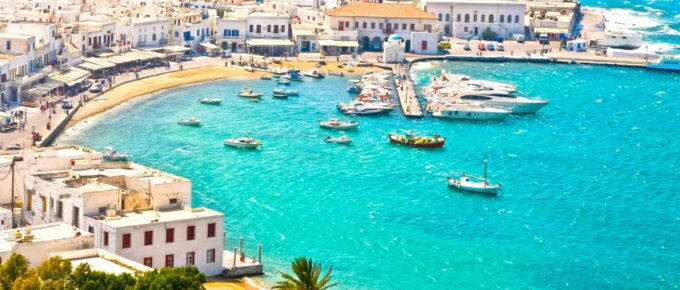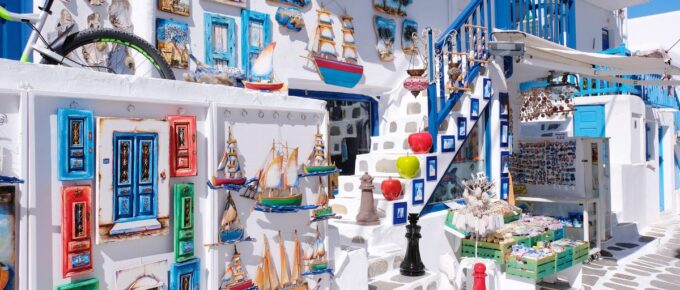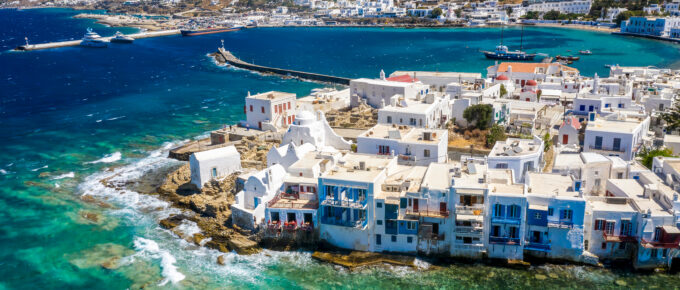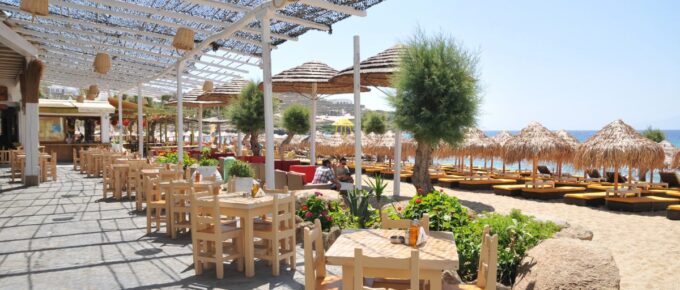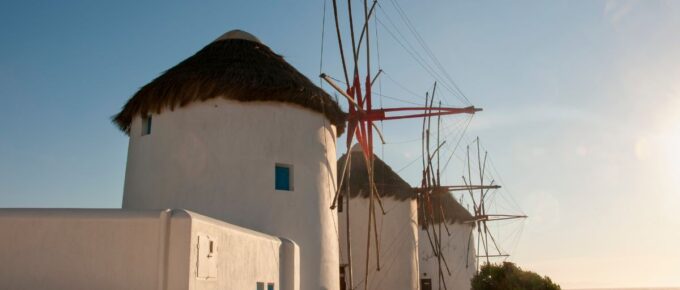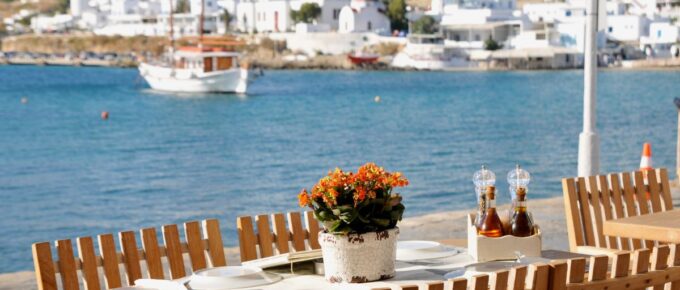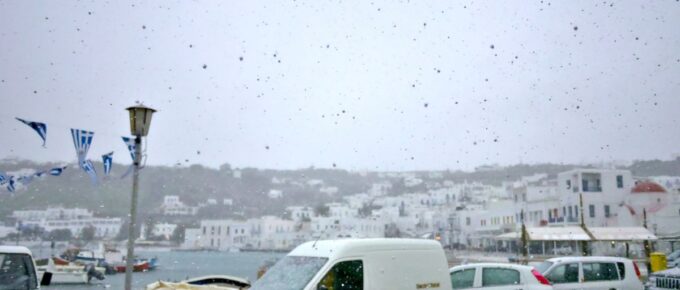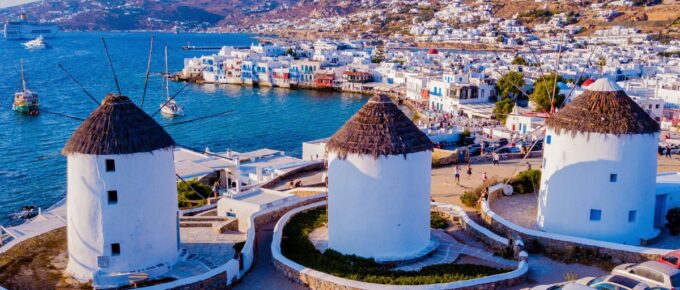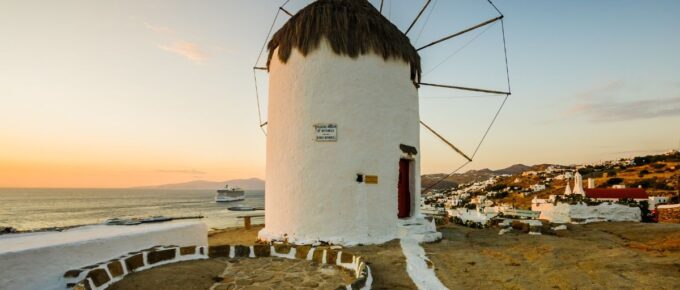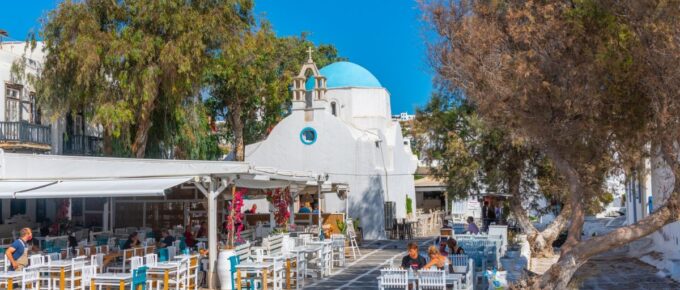
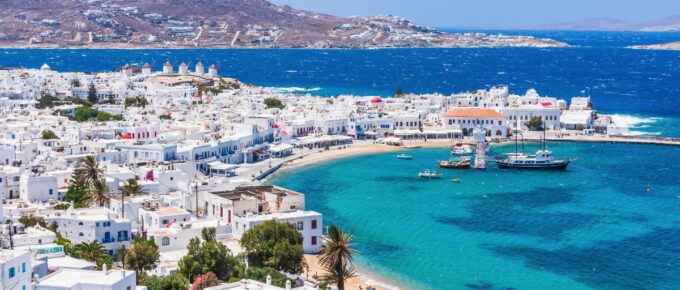

Mykonos is located in the Cyclades Greek island group about 150km south-east of Athens. It is a small island about 105sq km and with a coastline of about 90km. Mykonos has a rocky, infertile, granite terrain and there are no notable rivers. Seasonal rains are collected in two reservoirs to provide water, supplemented by a desalination plant.
The island has about 9,300 residents, half in the main town of Mykonos (Chora) in the west and another large proportion in the inland village of Ano Mera to the east of Mykonos.
The nearby island of Delos was once considered the centre of the Greek world and is noted for it's archeological treasures including many fine sculptures and carvings


The islet of DELOS is one of the most important historical and archaeological sites in the whole of Greece. Delos was considered the birthplace of Greek gods Apollo and Artemis and it became the sacred centre of a major cult between 900BC and AD100.
The island of Delos lies about 10km south-west of Mykonos and it is a vast archaeological site. The island pulls in thousands of visitors each year, mainly from Mykonos but also from other islands in the Cyclades as well, as day trips to Delos are hugely popular .
Archaeological excavations have been carried out on Delos since 1873 and in 1990 UNESCO put the whole of Delos island on the World Heritage Site list.
Treasures on the island include the famous Terrace of Lions, marble animals that once guarded the Sacred Way; the Sacred Lake where Apollo is supposed to have been born; the Minoan Fountain, carved into the rock and reconstructed in 166BC, several market squares, or agora, (Delos was one of the biggest slave trade centres in the Mediterranean); temples to various gods and some quite magnificent private houses dating from the 2nd century.
The entire island is strewn with marble fragments and wall sections and Delos is considered one of the most extensive archaeological sites in the world.
Many cultures have left their mark on the island, with shrines to Egyptian and Syrian deities among those to the Greek gods.
Many sections of the residential area are remarkably intact for their age and the streets are clearly outlined. Mosaics remain from some of the more opulent houses and Doric columns still stand that once supported the upper floors of homes.
Boats leave Mykonos every day (except Monday) for trips to Delos. Visitors only get a four-hour stay on the island, hardly enough to enjoy more than a fraction of the treasures here. The museum houses many of the most important sculptures.
Mykonos is noted both for sunshine and wind. Summer rainfall is almost unheard of and what rain does fall is confined to the winter months. Mykonos can have as many as 300 sunshine days each year. Arid conditions result in bare, treeless hills with limited natural vegetation. In summer temperatures can occasionally hit the high 30's, though this is often tempered by frequent high winds. Winters are generally mild with an average temperature of 15 °C. Winds are mainly southerly in winter with the northern meltemi blowing daily in the summer particularly during July and August. Gales are not uncommon
| JAN | FEB | MAR | APR | MAY | JUN | JUL | AUG | SEP | OCT | NOV | DEC | Averages |
| 12 | 12 | 14 | 16 | 20 | 25 | 27 | 27 | 24 | 20 | 16 | 12 | Day °C |
| 4 | 5 | 7 | 9 | 11 | 13 | 14 | 13 | 11 | 7 | 6 | 5 | Sun (hrs) |
| 2 | 3 | 5 | 6 | 8 | 9 | 10 | 9 | 7 | 5 | 3 | 2 | UV Index |
| 99 | 70 | 59 | 26 | 15 | 4 | 2 | 2 | 12 | 45 | 63 | 100 | Rain (mm) |
| 12 | 10 | 9 | 7 | 3 | 1 | 0 | 0 | 3 | 6 | 8 | 12 | Rainy days |
‡ The Greek island of Mykonos was voted the 'Best European Island of the Year' 2010 by readers of the luxury travel magazine Conde Nast Traveller.
‡ The comedy film 'Shirley Valentine' was shot on Mykonos in 1989 on Agios Ioannis beach, about 4 km from Mykonos Town. Many popular films have scenes shot on Mykonos including 'The Bourne Identity' .